
cmon richter... CA cycles through drought and non drought every few years.
Anybody who skis out here also knows we cycle through droughts.
http://www.huffingtonpost.com/2013/02/27/california-drought_n_2772154.html
The dry conditions have been caused by a persistent blocking ridge of high pressure off the coast that has diverted storms around the state. Powell called it "highly unusual" to see a blocking ridge stick around for two solid months.
"We just haven't had the storm tracks," he said.
Bill Patzert, a climatologist at the NASA Jet Propulsion Laboratory in Pasadena, said there is a larger cause: a phenomenon called the Pacific Decadal Oscillation, which is a periodic warming or cooling cycle in the North Pacific Ocean that can last for as long as two decades.
The oscillation differs from the El Nino-La Nina temperature cycle, which takes place in the equatorial Pacific over a shorter period, typically 18 months to two years.
The Pacific Decadal Oscillation has been in a negative or cool phase since 2000, Patzert said. When it began, he predicted 20 years of drought for California. That has largely been the case so far, he said, noting that rainfall in Los Angeles has been below average for seven of the last nine years.
In addition, another phenomenon called the Arctic Oscillation is also currently negative. This means cold Arctic winds have shifted south, causing the recent blizzards that have struck the Midwest. Sometimes these Arctic winds sweep through California, as they did in 2011, bringing massive snows to the Sierra.
"Sometimes we get lucky and they hit the West, but not this year," Patzert said. "They've mostly been east of us."
The prospects for more rain this winter are not good. The National Weather Service's Climate Prediction Center released a long-range forecast on Feb. 21, saying that the odds favor dry conditions across California and the Southwest through May.
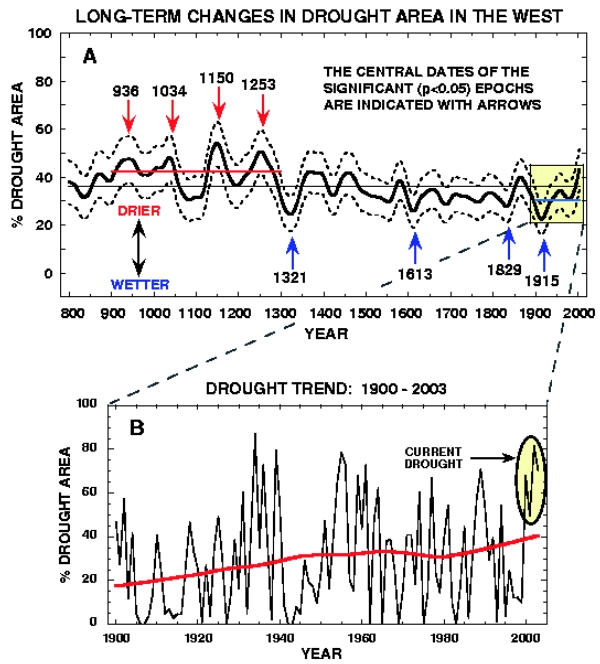
http://www.nytimes.com/1994/07/19/science/severe-ancient-droughts-a-warning-to-california.html
BEGINNING about 1,100 years ago, what is now California baked in two droughts, the first lasting 220 years and the second 140 years. Each was much more intense than the mere six-year dry spells that afflict modern California from time to time, new studies of past climates show. The findings suggest, in fact, that relatively wet periods like the 20th century have been the exception rather than the rule in California for at least the last 3,500 years, and that mega-droughts are likely to recur.
The evidence for the big droughts comes from an analysis of the trunks of trees that grew in the dry beds of lakes, swamps and rivers in and adjacent to the Sierra Nevada, but died when the droughts ended and the water levels rose. Immersion in water has preserved the trunks over the centuries.
Dr. Scott Stine, a paleoclimatologist at California State University at Hayward, used radiocarbon dating techniques to determine the age of the trees' outermost annual growth rings, thereby establishing the ends of drought periods. He then calculated the lengths of the preceding dry spells by counting the rings in each stump.
This method identified droughts lasting from A.D. 892 to A.D. 1112 and from A.D. 1209 to A.D. 1350. Judging by how far the water levels dropped during these periods -- as much as 50 feet in some cases -- Dr. Stine concluded that the droughts were not only much longer, they were far more severe than either the drought of 1928 to 1934, California's worst in modern times, or the more recent severe dry spell of 1987 to 1992.
Anybody who skis out here also knows we cycle through droughts.
http://www.huffingtonpost.com/2013/02/27/california-drought_n_2772154.html
The dry conditions have been caused by a persistent blocking ridge of high pressure off the coast that has diverted storms around the state. Powell called it "highly unusual" to see a blocking ridge stick around for two solid months.
"We just haven't had the storm tracks," he said.
Bill Patzert, a climatologist at the NASA Jet Propulsion Laboratory in Pasadena, said there is a larger cause: a phenomenon called the Pacific Decadal Oscillation, which is a periodic warming or cooling cycle in the North Pacific Ocean that can last for as long as two decades.
The oscillation differs from the El Nino-La Nina temperature cycle, which takes place in the equatorial Pacific over a shorter period, typically 18 months to two years.
The Pacific Decadal Oscillation has been in a negative or cool phase since 2000, Patzert said. When it began, he predicted 20 years of drought for California. That has largely been the case so far, he said, noting that rainfall in Los Angeles has been below average for seven of the last nine years.
In addition, another phenomenon called the Arctic Oscillation is also currently negative. This means cold Arctic winds have shifted south, causing the recent blizzards that have struck the Midwest. Sometimes these Arctic winds sweep through California, as they did in 2011, bringing massive snows to the Sierra.
"Sometimes we get lucky and they hit the West, but not this year," Patzert said. "They've mostly been east of us."
The prospects for more rain this winter are not good. The National Weather Service's Climate Prediction Center released a long-range forecast on Feb. 21, saying that the odds favor dry conditions across California and the Southwest through May.
http://www.nytimes.com/1994/07/19/science/severe-ancient-droughts-a-warning-to-california.html
BEGINNING about 1,100 years ago, what is now California baked in two droughts, the first lasting 220 years and the second 140 years. Each was much more intense than the mere six-year dry spells that afflict modern California from time to time, new studies of past climates show. The findings suggest, in fact, that relatively wet periods like the 20th century have been the exception rather than the rule in California for at least the last 3,500 years, and that mega-droughts are likely to recur.
The evidence for the big droughts comes from an analysis of the trunks of trees that grew in the dry beds of lakes, swamps and rivers in and adjacent to the Sierra Nevada, but died when the droughts ended and the water levels rose. Immersion in water has preserved the trunks over the centuries.
Dr. Scott Stine, a paleoclimatologist at California State University at Hayward, used radiocarbon dating techniques to determine the age of the trees' outermost annual growth rings, thereby establishing the ends of drought periods. He then calculated the lengths of the preceding dry spells by counting the rings in each stump.
This method identified droughts lasting from A.D. 892 to A.D. 1112 and from A.D. 1209 to A.D. 1350. Judging by how far the water levels dropped during these periods -- as much as 50 feet in some cases -- Dr. Stine concluded that the droughts were not only much longer, they were far more severe than either the drought of 1928 to 1934, California's worst in modern times, or the more recent severe dry spell of 1987 to 1992.


