
You are using an out of date browser. It may not display this or other websites correctly.
You should upgrade or use an alternative browser.
You should upgrade or use an alternative browser.
Laffer: Get Ready for Inflation and Higher Interest Rates
- Thread starter Tom B
- Start date
Just for referenceQuote from makloda:
Laffer should have been fair and extended the graph all the way back to the 30s. There was a similar spike - but Oh God - that period saw no hyperinflation but deflation. That would have contradicted the article so he opted for a time series starting in the 60s
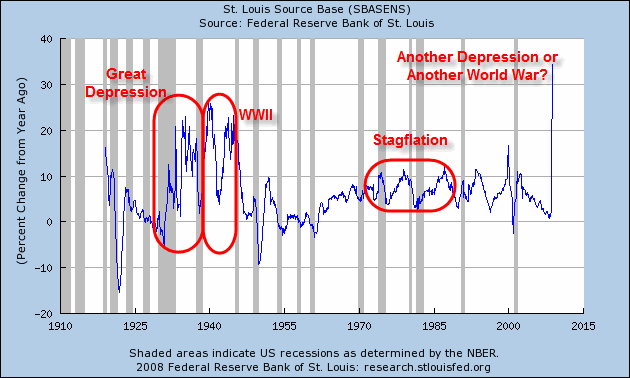
(courtesey of http://globaleconomicanalysis.blogspot.com/ )
Quote from makloda:
Laffer should have been fair and extended the graph all the way back to the 30s. There was a similar spike - but Oh God - that period saw no hyperinflation but deflation. That would have contradicted the article so he opted for a time series starting in the 60s
Do you think his omission was intentional?
Laffer's a pretty sharp guy, so my assumption is that you're going to say yes, which would lead me to asking why he'd play a political angle here.
Quote from makloda:
IMO Laffer is spot on with much higher taxes to come; marginal top bracket tax rates during and after the Great Depression:
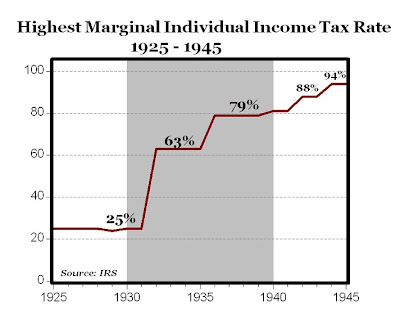
I think I'm on safe ground saying the ONLY thing that truly and with certainty dragged us out of the economic morass in the wake of the Great Depression was WWII.
How the hell are we going to recover with high unemployment, high inflation (if some here are right), high taxation, coupled with stagnant or falling wages (and again, high unemployment and underemployment)?
The reason why Laffer didn't mention Japan is because its banking situation is different:
"The lack of credit expansion, even after expansion of the monetary base, is not due to investors expecting that future interest rates will rise, but is instead caused by the enormous amount of bad debt in the banking system that makes banks unwilling to lend (Herbener 1999)."
In the US, the government magically wiped out the bad debts in the banking sector, so there's no real reason why the banks won't lend going forward (and, as we see, ARE lending).
Consumers will continue to borrow if rates are set ridiculously low and they can purchase assets that will inflate higher than the cost of borrowing!
They will also borrow at fixed rates that are low and not worry about interest rates spiking, or use derivatives to control for this (a recipe for disaster).
Basically, we are looking at 1 of 2 outcomes:
1) LONG TERM: Banks keep lending at low rates, consumers keep borrowing. Inflation escalates out of control. Interest rates are FORCED to spike. Borrowers massively default, credit default swaps collapse, banking sector fails.
2) SHORT TERM: Either rates spike early (in anticipation of scenario 1) or banks/consumers realize what's going to unfold and cease lending/borrowing practices prematurely. Deflation, job losses, equity declines ensue. Unemployment climbs enormously.
"The lack of credit expansion, even after expansion of the monetary base, is not due to investors expecting that future interest rates will rise, but is instead caused by the enormous amount of bad debt in the banking system that makes banks unwilling to lend (Herbener 1999)."
In the US, the government magically wiped out the bad debts in the banking sector, so there's no real reason why the banks won't lend going forward (and, as we see, ARE lending).
Consumers will continue to borrow if rates are set ridiculously low and they can purchase assets that will inflate higher than the cost of borrowing!
They will also borrow at fixed rates that are low and not worry about interest rates spiking, or use derivatives to control for this (a recipe for disaster).
Basically, we are looking at 1 of 2 outcomes:
1) LONG TERM: Banks keep lending at low rates, consumers keep borrowing. Inflation escalates out of control. Interest rates are FORCED to spike. Borrowers massively default, credit default swaps collapse, banking sector fails.
2) SHORT TERM: Either rates spike early (in anticipation of scenario 1) or banks/consumers realize what's going to unfold and cease lending/borrowing practices prematurely. Deflation, job losses, equity declines ensue. Unemployment climbs enormously.

Quote from ByLoSellHi:
"... How the hell are we going to recover with high unemployment, high inflation (if some here are right), high taxation, coupled with stagnant or falling wages (and again, high unemployment and underemployment)?
This is the $64,000 question.
I believe the answer is, "we're not". But it's very likely the government will print money, pump this and that, inflate, run ever more HUGE deficits and create government jobs in the effort.
Bottom line is likely to be high inflation, currency destruction, bankruptcy of nealy all American citizens, and what?
Only real question is "how long does it take?"
I think we are all forgetting the market's ability to adapt to government intervention.
The fact that long-term bond rates are already spiking is evidence that foretells the possibility of the market saying NO to an increase in money supply.
Maybe banks won't lend in anticipation of creating new bubbles which will inevitably lead to their demise?
Then again, the "too big to fail" ones have no risk of this.
Okay, we're all doomed.
The fact that long-term bond rates are already spiking is evidence that foretells the possibility of the market saying NO to an increase in money supply.
Maybe banks won't lend in anticipation of creating new bubbles which will inevitably lead to their demise?
Then again, the "too big to fail" ones have no risk of this.
Okay, we're all doomed.

Quote from ByLoSellHi:
If Laffer is correct, then the economy (even more so than now) AND equity markets will get hammered as stagflation will rule the day.
I still believe the best path forward is to have a controlled default on sovereign debt. It is inevitable that it will happen some day - better it happen now when the US is still the dominant economic actor and can dictate a more favorable "response".
Of course, this is predicated on rationalizing gov't expenditures and fixing the fundamentally broken trade policies of the past 30 years. Otherwise it'll all be for naught.
Yes, I know none of this will actually happen.