Koch funded climate skeptic declares global warming is real

Ricter... I believe I we have spoken about this before. The ice mass does not appear to be shrinking.
We spoke about the Grace data being updated on the west antarctic... and the east was enlarging.

http://wattsupwiththat.com/2009/10/...as-once-thought-grace-readings-overestimated/


and now we know more...


The results of ICEsat measurements are in for Antarctica, and it seems those claims of ice mass loss in Antarctica have melted now that a continent wide tally has been made. This was presented in the SCAR ISMASS Workshop in Portland, OR, July 14, 2012 and was added to NASA’s Technical Reports server on September 7th, 2012. H/T to WUWT reader “Brad”. What’s interesting (besides the result) is that the report was prepared by Jay Zwally, whose “ice free Arctic by the end of summer 2012″ prediction is about to be tested in 12 days. It also puts the kibosh on GRACE studies that suggested a net loss in Antarctica. Note there’s the mention of the “climate warming, consistent with model predictions” at the end of the report. They’d say the same thing if ICEsat had measured loss instead of gain, because as we’ve seen before, almost everything is consistent with warming and models no matter which direction it goes.

http://wattsupwiththat.com/2012/09/...ins-of-the-antarctic-ice-sheet-exceed-losses/

Mass Balance of the Antarctic Ice Sheet 1992-2008 from ERS and ICESat: Gains exceed losses – Presented by Jay Zwally, NASA Goddard, USA ISMASS 2012 is an activity of the renewed SCAR/IASC ISMASS expert group, which focuses on the mass balance of ice-sheets and their contribution to sea level changes. The workshop is sponsored by ICSU, SCAR, IASC, WCRP, IGS, and IACS with support from CliC and APECS. Video recording and editing provided by Kristin Poinar, Mai Winstrup, and Jenny Baeseman

Mass Gains of the Antarctic Ice Sheet Exceed Losses

Zwally, H. Jay; Li, Jun; Robbins, John; Saba, Jack L.; Yi, Donghui; Brenner, Anita; Bromwich, David

Abstract:

During 2003 to 2008, the mass gain of the Antarctic ice sheet from snow accumulation exceeded the mass loss from ice discharge by 49 Gt/yr (2.5% of input), as derived from ICESat laser measurements of elevation change. The net gain (86 Gt/yr) over the West Antarctic (WA) and East Antarctic ice sheets (WA and EA) is essentially unchanged from revised results for 1992 to 2001 from ERS radar altimetry.

Imbalances in individual drainage systems (DS) are large (-68% to +103% of input), as are temporal changes (-39% to +44%). The recent 90 Gt/yr loss from three DS (Pine Island, Thwaites-Smith, and Marie-Bryd Coast) of WA exceeds the earlier 61 Gt/yr loss, consistent with reports of accelerating ice flow and dynamic thinning. Similarly, the recent 24 Gt/yr loss from three DS in the Antarctic Peninsula (AP) is consistent with glacier accelerations following breakup of the Larsen B and other ice shelves. In contrast, net increases in the five other DS of WA and AP and three of the 16 DS in East Antarctica (EA) exceed the increased losses.

Alternate interpretations of the mass changes driven by accumulation variations are given using results from atmospheric-model re-analysis and a parameterization based on 5% change in accumulation per degree of observed surface temperature change. A slow increase in snowfall with climate warming, consistent with model predictions, may be offsetting increased dynamic losses.

Click to View PDF File [PDF Size: 256 KB]
 
Ricter... I believe I we have spoken about this before. The ice mass does not appear to be shrinking.


The results of ICEsat measurements are in for Antarctica, and it seems those claims of ice mass loss in Antarctica have melted now that a continent wide tally has been made. This was presented in the SCAR ISMASS Workshop in Portland, OR, July 14, 2012 and was added to NASA’s Technical Reports server on September 7th, 2012. H/T to WUWT reader “Brad”. What’s interesting (besides the result) is that the report was prepared by Jay Zwally, whose “ice free Arctic by the end of summer 2012″ prediction is about to be tested in 12 days. It also puts the kibosh on GRACE studies that suggested a net loss in Antarctica. Note there’s the mention of the “climate warming, consistent with model predictions” at the end of the report. They’d say the same thing if ICEsat had measured loss instead of gain, because as we’ve seen before, almost everything is consistent with warming and models no matter which direction it goes.

http://wattsupwiththat.com/2012/09/...ins-of-the-antarctic-ice-sheet-exceed-losses/

Mass Balance of the Antarctic Ice Sheet 1992-2008 from ERS and ICESat: Gains exceed losses – Presented by Jay Zwally, NASA Goddard, USA ISMASS 2012 is an activity of the renewed SCAR/IASC ISMASS expert group, which focuses on the mass balance of ice-sheets and their contribution to sea level changes. The workshop is sponsored by ICSU, SCAR, IASC, WCRP, IGS, and IACS with support from CliC and APECS. Video recording and editing provided by Kristin Poinar, Mai Winstrup, and Jenny Baeseman

Mass Gains of the Antarctic Ice Sheet Exceed Losses

Zwally, H. Jay; Li, Jun; Robbins, John; Saba, Jack L.; Yi, Donghui; Brenner, Anita; Bromwich, David

Abstract:

During 2003 to 2008, the mass gain of the Antarctic ice sheet from snow accumulation exceeded the mass loss from ice discharge by 49 Gt/yr (2.5% of input), as derived from ICESat laser measurements of elevation change. The net gain (86 Gt/yr) over the West Antarctic (WA) and East Antarctic ice sheets (WA and EA) is essentially unchanged from revised results for 1992 to 2001 from ERS radar altimetry.

Imbalances in individual drainage systems (DS) are large (-68% to +103% of input), as are temporal changes (-39% to +44%). The recent 90 Gt/yr loss from three DS (Pine Island, Thwaites-Smith, and Marie-Bryd Coast) of WA exceeds the earlier 61 Gt/yr loss, consistent with reports of accelerating ice flow and dynamic thinning. Similarly, the recent 24 Gt/yr loss from three DS in the Antarctic Peninsula (AP) is consistent with glacier accelerations following breakup of the Larsen B and other ice shelves. In contrast, net increases in the five other DS of WA and AP and three of the 16 DS in East Antarctica (EA) exceed the increased losses.

Alternate interpretations of the mass changes driven by accumulation variations are given using results from atmospheric-model re-analysis and a parameterization based on 5% change in accumulation per degree of observed surface temperature change. A slow increase in snowfall with climate warming, consistent with model predictions, may be offsetting increased dynamic losses.

Click to View PDF File [PDF Size: 256 KB]

Sorry, mate, but I have to go with NASA and all the professional organizations they aggregate on their website(s). I'm not merely appealing to authority, or majority, to draw my conclusions, but for lack of my own climate science expertise I have to turn over to the guys we pay to do this. A lone voice just doesn't cut it (though they may turn out to be right).
 
Cool... the lead guy on the study is NASA. And apparently he was once one of the guys predicting the ice was going away.

Mass Balance of the Antarctic Ice Sheet 1992-2008 from ERS and ICESat: Gains exceed losses – Presented by Jay Zwally, NASA Goddard, USA ISMASS 2012 is an activity of the renewed SCAR/IASC ISMASS expert group, which focuses on the mass balance of ice-sheets and their contribution to sea level changes. The workshop is sponsored by ICSU, SCAR, IASC, WCRP, IGS, and IACS with support from CliC and APECS. Video recording and editing provided by Kristin Poinar, Mai Winstrup, and Jenny Baeseman


Sorry, mate, but I have to go with NASA and all the professional organizations they aggregate on their website(s). I'm not merely appealing to authority, or majority, to draw my conclusions, but for lack of my own climate science expertise I have to turn over to the guys we pay to do this. A lone voice just doesn't cut it (though they may turn out to be right).
 
Simply because it can be reached by a search engine because it is a sub-domain of NASA does not imply that the website maintained by university graduate students has any type of confidence from NASA employees.

I expect that we will see it taken down within the next three years so avoid further embarrassment.

Hey idiot. On NASA's website they RECOMMEND their Jet Pro Lab website as a source of info. You're such an ignorant douchebag. It's really quite pathetic. The fact that there are a few similar ignorant right wing douchebags like you that work for NASA and are upset to see the facts means nothing.

Why don't you just shut the fuck up and avoid embarrassing yourself any further.
 
You mean the increasing ice in the Antarctic over a decade and the 27% increase in ice over the past year in the Arctic.
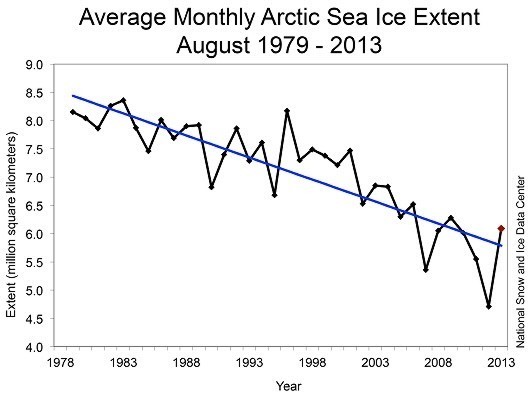
I got your 27% increase, right here you ignorant deluded douchebag.

What the fuck is wrong with you? Are you really this stupid?
You are just plain fucking WRONG. Got it? Get over it and move on.

2013110701000800900038092_59_20131107155702.jpg
 
Simply because it can be reached by a search engine because it is a sub-domain of NASA does not imply that the website maintained by university graduate students has any type of confidence from NASA employees.

I expect that we will see it taken down within the next three years so avoid further embarrassment.

True enough. And anyone can create a website, like whatsupwiththat.

But why would NASA take their climate pages down?
 
Yes we have. How many times do we need to outline the data measurements showing increasing ice.

Or should we just wait for another ship with a 'global warming research team' gets stuck in the Antarctic ice providing amusement for everyone.


Do you know how to read a chart asshole? Of course not.

ice-antarctic.gif


1374266033526.jpg

Source: I. Velicogna, “Increasing rates of ice mass loss from the Greenland and Antarctic ice sheets revealed by GRACE,” Geophys. Res. Lett., 2009, 36, L19503, doi:10.1029/2009GL040222, © American Geophysical Union, 0094-8276/09/2009GL040222
 
One must also be careful how you interpret trends in Antarctic sea ice. Currently this ice is increasing overall and has been for years but is this the smoking gun against climate change? Not quite. Antarctic sea ice is gaining because of many different reasons but the most accepted recent explanations are listed below:

i) Ozone levels over Antarctica have dropped causing stratospheric cooling and increasing winds which lead to more areas of open water that can be frozen (Gillet 2003, Thompson 2002, Turner 2009).

and

ii) The Southern Ocean is freshening because of increased rain and snowfall as well as an increase in meltwater coming from the edges of Antarctica's land ice (Zhang 2007, Bintanga et al. 2013). Together, these change the composition of the different layers in the ocean there causing less mixing between warm and cold layers and thus less melted sea and coastal land ice.

All the sea ice talk aside, it is quite clear that really when it comes to Antarctic ice and sea levels, sea ice is not the most important thing to measure. In Antarctica, the largest and most important ice mass is the land ice of the West Antarctic and East Antarctic ice sheets.

Therefore, how is Antarctic land ice doing?

F5.large.jpg


Figure 2: Estimates of total Antarctic land ice changes and approximate sea level contributions using a combination of different measurement techniques (Shepherd, 2012). Shaded areas represent the estimate uncertainty (1-sigma).
 
much of the findings from the grace studies are now very dicey and probably wrong.
I just pointed that out a few posts ago.

you need to update your science.

Do you know how to read a chart asshole? Of course not.

ice-antarctic.gif


1374266033526.jpg

Source: I. Velicogna, “Increasing rates of ice mass loss from the Greenland and Antarctic ice sheets revealed by GRACE,” Geophys. Res. Lett., 2009, 36, L19503, doi:10.1029/2009GL040222, © American Geophysical Union, 0094-8276/09/2009GL040222
 
Back
Top
