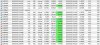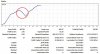
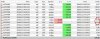
When Trade Setup A resulted in two losing trades, I set about designing a revised set of rules, which appear below.
In all probability, my Price Anomaly Channel is more than likely destined to be relegated to the annals of my trading history in that I am very much pleased with the accuracy and objectivity of my new bias/sentiment lower-panel indicator, which totally eliminates any subjectivity I might inject into the process of attempting to ascertain the true direction of price.
NEW TRADE SETUP A
- Watch for the short-term trend to pull back to the “wrong” side of SMA 1 during periods when SMA 2, SMA 3, and the lower panel bias/sentiment indicator are all three aligned.
- Enter a position when the short-term trend hooks back toward SMA 1.
- Set the stop loss at the 1st level of support/resistance as represented by the inner band of Envelope A located opposite the trend. (This is a theoretical setting. Due to the inaccuracy of the platform, in practical terms, the stop loss will need to be a minimum of 10 pips.)
- If trading ambitiously, set the take profit target at the 2nd level of support/resistance as represented by the outer band of Envelope A located on the side of the envelope matching the direction of the trend, or if trading conservatively, simply set the take profit target to match the size of the stop loss.
NEW TRADE SETUP B
- Enter positions when the short-term trend reverses direction to bring the lower panel indicator back into agreement with SMA 3 after a momentary divergence in the lower panel indicator, and/or when the short-term trend reverses direction to begin forming candlesticks on the “correct” side of SMA 3 after temporarily drawing them on the “wrong” side.
- Set the stop loss at the local high or low, as appropriate.
- Set the take-profit target to at least match the size of the stop loss.
- Enter positions when SMA 1 and SMA 2 reverse direction to come back into alignment with the lower panel bias/sentiment indicator and SMA 3 (after their temporary divergence from these two primary trend indicators).
- Set the stop loss at the local high or low, as appropriate.
- Set the take-profit target to at least match the size of the stop loss.

 ))
))