
Juneteenth (short for “June Nineteenth”) marks the day when federal troops arrived in Galveston, Texas in 1865 to take control of the state and ensure that all enslaved people be freed.
https://www.history.com/juneteenth
Economics
While American slaves in 1809 were sold for around $40,000 (in inflation adjusted dollars), a slave nowadays can be bought for just $90, making replacement more economical than providing long-term care.[359] Slavery is a multibillion-dollar industry with estimates of up to $35 billion generated annually.[360]
Trafficking

A world map showing countries by prevalence of female trafficking
Victims of human trafficking are typically recruited through deceit or trickery (such as a false job offer, false migration offer, or false marriage offer), sale by family members, recruitment by former slaves, or outright abduction. Victims are forced into a "debt slavery" situation by coercion, deception, fraud, intimidation, isolation, threat, physical force, debt bondage or even force-feeding with drugs to control their victims.[361]
"Annually, according to U.S. government-sponsored research completed in 2006, approximately 800,000 people are trafficked across national borders, which does not include millions trafficked within their own countries.
Approximately 80% of transnational victims are women and girls, and up to 50% are minors, reports the U.S. State Department in a 2008 study.[362]
While the majority of trafficking victims are women who are forced into prostitution (in which case the practice is called sex trafficking), victims also include men, women and children who are forced into manual labour.[363]
Because of the illegal nature of human trafficking, its extent is unknown. A U.S. government report, published in 2005, estimates that about 700,000 people worldwide are trafficked across borders each year.
This figure does not include those who are trafficked internally.[363] Another research effort revealed that roughly 1.5 million individuals are trafficked either internally or internationally each year, of which about 500,000 are sex trafficking victims.[56]
Slavery From Wikipedia

Relief depicting slaves in chains in the Roman Empire, at Smyrna, 200 CE
Part of a series on

Slavery has existed, in one form or another, throughout recorded human history – as have, in various periods, movements to free large or distinct groups of slaves.
Contemporary Slavery
Historical
By country or region
Religion
Opposition and resistance
Related
Slavery and enslavement are both the state and the condition of being a slave,[1][2] who is someone forbidden to quit their service for an enslaver, and who is treated by the enslaver as their property.[3] Slavery typically involves the enslaved person being made to perform some form of work while also having their location or residence dictated by the enslaver. Many historical cases of enslavement occurred when the enslaved broke the law, became indebted, or suffered a military defeat; other forms of slavery were instituted along demographic lines such as race. The duration of a person's enslavement might be for life, or for a fixed period of time, after which freedom would be granted.[4] Although most forms of slavery are explicitly involuntary and involve the coercion of the enslaved, there also exists voluntary slavery, entered into by the enslaved to pay a debt or obtain money. In the course of human history, slavery was a typical feature of civilization,[5] legal in most societies, but it is now outlawed in most countries of the world, except as a punishment for a crime.[6][7]
In chattel slavery, the enslaved person is legally rendered the personal property (chattel) of the slave owner. In economics, the term de facto slavery describes the conditions of unfree labour and forced labour that most slaves endure.[8]
In 2019, approximately 40 million people, of whom 26 percent were children, were enslaved throughout the world despite it being illegal. In the modern world, more than 50 percent of enslaved people provide forced labour, usually in the factories and sweatshops of the private sector of a country's economy.[9] In industrialised countries, human trafficking is a modern variety of slavery; in non-industrialised countries, enslavement by debt bondage is a common form of enslaving a person,[8] such as captive domestic servants, forced marriage, and child soldiers.[10]
Contents
The word slave arrived in English via the Old French sclave. In Medieval Latin the word was sclavus and in Byzantine Greek σκλάβος.[11] Use of the word arose during the Early Medieval Period, when Slavs from Central and Eastern Europe (Saqaliba) were frequently enslaved by Moors from the Iberian Peninsula and North Africa.[12][13][14]
There is a dispute among historians about whether terms such as "unfree labourer" or "enslaved person", rather than "slave", should be used when describing the victims of slavery. According to those proposing a change in terminology, slave perpetuates the crime of slavery in language by reducing its victims to a nonhuman noun instead of "carry[ing] them forward as people, not the property that they were". Other historians prefer slave because the term is familiar and shorter, or because it accurately reflects the inhumanity of slavery, with person implying a degree of autonomy that slavery does not allow.[15]
Chattel slavery
As a social institution, chattel slavery classes slaves as chattels (personal property) owned by the enslaver; like livestock, they can be bought and sold at will.[16] While some form of slavery was common throughout human history, the specific notion of chattel slavery reached its modern extreme in the Americas during European colonization.[17] Beginning in the 18th century, a series of abolitionist movements saw slavery as a violation of the slaves' rights as people ("all men are created equal"), and sought to abolish it. Abolitionism encountered extreme resistance but was eventually successful; the last Western country to abolish slavery, Brazil, did so in 1888.[18] The last third-world country to abolish slavery, Mauritania, did not do so until 1981.[19]
Bonded labour
Main article: Debt bondage
See also: Money marriage and Chukri System
Indenture, otherwise known as bonded labour or debt bondage, is a form of unfree labour under which a person pledges himself or herself against a loan. The services required to repay the debt, and their duration, may be undefined. Debt bondage can be passed on from generation to generation, with children required to pay off their progenitors' debt.[20] It is the most widespread form of slavery today.[21] Debt bondage is most prevalent in South Asia.[20] Money marriage refers to a marriage where a girl, usually, is married off to a man to settle debts owed by her parents.[22] The Chukri System is a debt bondage system found in parts of Bengal where a female can be coerced into prostitution in order to pay off debts.[23]
Dependents
The word "slavery" has also been used to refer to a legal state of dependency to somebody else.[24][25] For example, in Persia, the situations and lives of such slaves could be better than those of common citizens.[26]
Forced labour
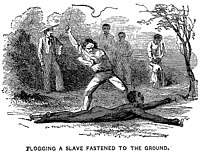
Flogging a slave fastened to the ground, illustration in an 1853 anti-slavery pamphlet
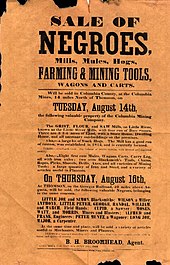
A poster for a slave auction in Georgia, U.S., 1860
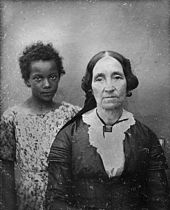
Portrait of an older woman in New Orleans with her enslaved servant girl in the mid-19th century
Main article: Unfree labour
See also: Human trafficking
Forced labour, or unfree labour, is sometimes used to describe an individual who is forced to work against their own will, under threat of violence or other punishment, but the generic term "unfree labour" is also used to describe chattel slavery, as well as any other situation in which a person is obliged to work against their own will, and a person's ability to work productively is under the complete control of another person.[citation needed] This may also include institutions not commonly classified as slavery, such as serfdom, conscription and penal labour. While some unfree labourers, such as serfs, have substantive, de jure legal or traditional rights, they also have no ability to terminate the arrangements under which they work and are frequently subject to forms of coercion, violence, and restrictions on their activities and movement outside their place of work.[citation needed]
Human trafficking primarily involves women and children forced into prostitution and is the fastest growing form of forced labour, with Thailand, Cambodia, India, Brazil and Mexico having been identified as leading hotspots of commercial sexual exploitation of children.[27][28]
Child soldiers and child labor
Main article: Child slavery
See also: Child labour and Military use of children
In 2007, Human Rights Watch estimated that 200,000 to 300,000 children served as soldiers in then-current conflicts.[29] More girls under 16 work as domestic workers than any other category of child labour, often sent to cities by parents living in rural poverty[30] as with the Haitian restaveks.
Forced marriage
See also: Marriage by abduction and Child marriage
Forced marriages or early marriages are often considered types of slavery.[citation needed] Forced marriage continues to be practiced in parts of the world including some parts of Asia and Africa and in immigrant communities in the West.[31][32][33][34] Sacred prostitution is where girls and women are pledged to priests or those of higher castes, such as the practice of Devadasi in South Asia or fetish slaves in West Africa.[citation needed] Marriage by abduction occurs in many places in the world today, with a 2003 study finding a national average of 69% of marriages in Ethiopia being through abduction.[35]
Other uses of the term
The word slavery is often used as a pejorative to describe any activity in which one is coerced into performing. Some argue that military drafts and other forms of coerced government labour constitute "state-operated slavery."[36][37] Some libertarians and anarcho-capitalists view government taxation as a form of slavery.[38]
"Slavery" has been used by some anti-psychiatry proponents to define involuntary psychiatric patients, claiming there are no unbiased physical tests for mental illness and yet the psychiatric patient must follow the orders of the psychiatrist. They assert that instead of chains to control the slave, the psychiatrist uses drugs to control the mind.[39] Drapetomania was a pseudoscientific psychiatric diagnosis for a slave who desired freedom; "symptoms" included laziness and the tendency to flee captivity.[40][41]
Some proponents of animal rights have applied the term slavery to the condition of some or all human-owned animals, arguing that their status is comparable to that of human slaves.[42]
The labour market, as institutionalized under contemporary capitalist systems, has been criticized by mainstream socialists and by anarcho-syndicalists, who utilise the term wage slavery as a pejorative or dysphemism for wage labour.[43][44][45] Socialists draw parallels between the trade of labour as a commodity and slavery. Cicero is also known to have suggested such parallels.[46]
Characteristics
Private versus state-owned slaves
Slaves have been owned privately by individuals but have also been under state ownership. For example, the kisaeng were women from low castes in pre modern Korea, who were owned by the state under government officials known as hojang and were required to provide entertainment to the aristocracy; in the 2020s some are denoted Kippumjo (the pleasure brigades of North Korea — serving as the concubines of the rulers of the state).[47] "Tribute labor" is compulsory labor for the state and has been used in various iterations such as corvée, mit'a and repartimiento. The internment camps of totalitarian regimes such as the Nazis and the Soviet Union placed increasing importance on the labor provided in those camps, leading to a growing tendency among historians to designate such systems as slavery.[48]
Economics
Economists have modeled the circumstances under which slavery (and variants such as serfdom) appear and disappear. One observation is that slavery becomes more desirable for landowners where land is abundant but labour is scarce, such that rent is depressed and paid workers can demand high wages. If the opposite holds true, then it is more costly for landowners to guard the slaves than to employ paid workers who can demand only low wages because of the degree of competition.[49] Thus, first slavery and then serfdom gradually decreased in Europe as the population grew. They were reintroduced in the Americas and in Russia as large areas of land with few inhabitants became available.[50]
Slavery is more common when the tasks are relatively simple and thus easy to supervise, such as large-scale monocrops such as sugarcane and cotton, in which output depended on economies of scale. This enables systems of labour, such as the gang system in the United States, to become prominent on large plantations where field hands toiled with factory-like precision. Then, each work gang was based on an internal division of labour that assigned every member of the gang to a task and made each worker's performance dependent on the actions of the others. The enslaved chopped out the weeds that surrounded the cotton plants as well as excess sprouts. Plow gangs followed behind, stirring the soil near the plants and tossing it back around the plants. Thus, the gang system worked like an assembly line.[51]
Since the 18th century, critics have argued that slavery retards technological advancement because the focus is on increasing the number of slaves doing simple tasks rather than upgrading their efficiency. For example, it is sometimes argued that, because of this narrow focus, technology in Greece – and later in Rome – was not applied to ease physical labour or improve manufacturing.[52]

The work of the Mercedarians was in ransoming Christian slaves held in North Africa (1637).
Scottish economist Adam Smith stated that free labour was economically better than slave labour, and that it was nearly impossible to end slavery in a free, democratic, or republican form of government since many of its legislators or political figures were slave owners, and would not punish themselves. He further stated that slaves would be better able to gain their freedom under centralized government, or a central authority like a king or church.[53][54] Similar arguments appeared later in the works of Auguste Comte, especially given Smith's belief in the separation of powers, or what Comte called the "separation of the spiritual and the temporal" during the Middle Ages and the end of slavery, and Smith's criticism of masters, past and present. As Smith stated in the Lectures on Jurisprudence, "The great power of the clergy thus concurring with that of the king set the slaves at liberty. But it was absolutely necessary both that the authority of the king and of the clergy should be great. Where ever any one of these was wanting, slavery still continues..."[55]
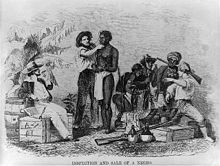
Sale and inspection of slaves
Even after slavery became a criminal offense, slave owners could get high returns. According to researcher Siddharth Kara, the profits generated worldwide by all forms of slavery in 2007 were $91.2 billion. That was second only to drug trafficking, in terms of global criminal enterprises. At the time the weighted average global sales price of a slave was estimated to be approximately $340, with a high of $1,895 for the average trafficked sex slave, and a low of $40 to $50 for debt bondage slaves in part of Asia and Africa. The weighted average annual profits generated by a slave in 2007 was $3,175, with a low of an average $950 for bonded labour and $29,210 for a trafficked sex slave. Approximately 40% of slave profits each year were generated by trafficked sex slaves, representing slightly more than 4% of the world's 29 million slaves.[56]
Identification
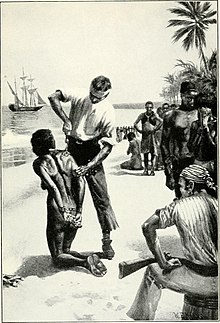
Branding of a female slave
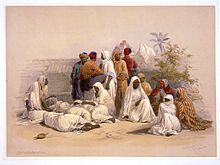
Barefooted slaves depicted in David Roberts' Egypt and Nubia, issued between 1845 and 1849
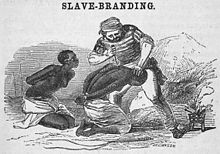
Slave branding, c. 1853
Throughout history, slaves were clothed in a distinctive fashion, particularly with respect to the frequent lack of footwear, as they were rather commonly forced to go barefoot. This was partly for economic reasons, but also served as a distinguishing feature, especially in South Africa and South America. For example, the Cape Town slave code stated that "Slaves must go barefoot and must carry passes."[57] It also puts slaves at a physical disadvantage because of the lack of protection against environmental conditions and in confrontations, thereby making it more difficult to escape or to rebel against their owners.
This was the case in the majority of states. Most images from the respective historical period suggest that slaves were barefoot.[58] Brother Riemer stated, "[the slaves] are, even in their most beautiful suit, obliged to go barefoot. Slaves were forbidden to wear shoes. This was a prime mark of distinction between the free and the bonded and no exceptions were permitted."[59]
According to the Bible, shoes have been considered badges of freedom since antiquity: "But the father said to his servants, Bring forth the best robe, and put [it] on him; and put a ring on his hand, and shoes on [his] feet" (Luke 15:22). This aspect can be viewed as an informal law in areas where slavery existed as any person sighted barefoot in public was assumed to be a slave.
In certain societies this rule continues. The Tuareg still unofficially practice slavery and force their slaves to remain barefoot.[60]
Another widespread practice was branding, either to explicitly mark slaves as property or as punishment.
Legal rights
Depending upon the era and the country, slaves sometimes had a limited set of legal rights. For example, in the Province of New York, people who deliberately killed slaves were punishable under a 1686 statute.[61] And, as already mentioned, certain legal rights attached to the nobi in Korea, to enslaved people in various African societies, and to black female slaves in the French colony of Louisiana. Giving slaves legal rights has sometimes been a matter of morality, but also sometimes a matter of self-interest. For example, in ancient Athens, protecting slaves from mistreatment simultaneously protected people who might be mistaken for slaves, and giving slaves limited property rights incentivized slaves to work harder to get more property.[62] In the southern United States prior to the extirpation of slavery in 1865, a proslavery legal treatise reported that slaves accused of crimes typically had a legal right to counsel, freedom from double jeopardy, a right to trial by jury in graver cases, and the right to grand jury indictment, but they lacked many other rights such as white adults’ ability to control their own lives.[63]
History
Main article: History of slavery
Some scholars differentiate ancient forms of slavery from the largely race-based slavery. The first type of slavery, sometimes called "just title servitude", was inflicted on prisoners of war, debtors, and other vulnerable people. Race-based slavery grew to immense proportions starting in the 14th century.[64] It was argued even by some contemporary writers to be intrinsically immoral.[65][66][67]
Early history
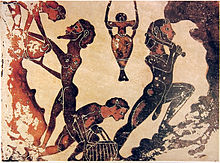
Corinthian black-figure terra-cotta votive tablet of slaves working in a mine, dated to the late seventh century BC
Slavery predates written records and has existed in many cultures.[5] Slavery is rare among hunter-gatherer populations because it requires economic surpluses and a substantial population density. Thus, although it has existed among unusually resource-rich hunter gatherers, such as the American Indian peoples of the salmon-rich rivers of the Pacific Northwest coast, slavery became widespread only with the invention of agriculture during the Neolithic Revolution about 11,000 years ago.[68]
In the earliest known records, slavery is treated as an established institution. The Code of Hammurabi (c. 1760 BC), for example, prescribed death for anyone who helped a slave escape or who sheltered a fugitive.[69] The Bible mentions slavery as an established institution.[5] Slavery was practiced in almost every ancient civilization.[5] Such institutions included debt bondage, punishment for crime, the enslavement of prisoners of war, child abandonment, and the enslavement of slaves' offspring.[70]
Classical antiquity
Main article: Slavery in antiquity
Africa
Main article: Slavery in ancient Egypt
Slavery existed in Pharaonic Egypt, but studying it is complicated by terminology used by the Egyptians to refer to different classes of servitude over the course of history. Interpretation of the textual evidence of classes of slaves in ancient Egypt has been difficult to differentiate by word usage alone.[71][72] The three apparent types of enslavement in Ancient Egypt: chattel slavery, bonded labour, and forced labour.[73][74][75]
Asia
Slavery existed in ancient China as early as the Shang dynasty.[76] Slavery was employed largely by governments as a means of maintaining a public labour force.[77][78]
Europe
Ancient Greece and Rome
Main article: Slavery in ancient Rome

Ishmaelites purchase Joseph, by Schnorr von Carolsfeld, 1860
Records of slavery in Ancient Greece date begin with Mycenaean Greece. Classical Athens had the largest slave population, with as many as 80,000 in the 6th and 5th centuries BC.[79] As the Roman Republic expanded outward, entire populations were enslaved, across Europe and the Mediterranean. Slaves were used for labour, as well as for amusement (e.g. gladiators and sex slaves). This oppression by an elite minority eventually led to slave revolts (see Roman Servile Wars); the Third Servile War was led by Spartacus.

Slave Market in Ancient Rome, by Jean-Léon Gérôme
By the late Republican era, slavery had become an economic pillar of Roman wealth, as well as Roman society.[80] It is estimated that 25% or more of the population of Ancient Rome was enslaved, although the actual percentage is debated by scholars and varied from region to region.[81][82] Slaves represented 15–25% of Italy's population,[83] mostly war captives,[83] especially from Gaul[84] and Epirus. Estimates of the number of slaves in the Roman Empire suggest that the majority were scattered throughout the provinces outside of Italy.[83] Generally, slaves in Italy were indigenous Italians.[85] Foreigners (including both slaves and freedmen) born outside of Italy were estimated to have peaked at 5% of the total in the capital, where their number was largest. Those from outside of Europe were predominantly of Greek descent. Jewish slaves never fully assimilated into Roman society, remaining an identifiable minority. These slaves (especially the foreigners) had higher death rates and lower birth rates than natives and were sometimes subjected to mass expulsions.[86] The average recorded age at death for the slaves in Rome was seventeen and a half years (17.2 for males; 17.9 for females).[87]
Middle Ages
Africa
See also: Slavery in Africa
Slavery was widespread in Africa, which pursued both internal and external slave trade.[88] In the Senegambia region, between 1300 and 1900, close to one-third of the population was enslaved. In early Islamic states of the western Sahel, including Ghana, Mali, Segou, and Songhai, about a third of the population were enslaved.[89]

13th-century slave market in Yemen.[90]
During the trans-Saharan slave trade, slaves from West Africa were transported across the Sahara desert to North Africa to be sold to Mediterranean and Middle eastern civilizations. The Indian Ocean slave trade, sometimes known as the east African slave trade, was multi-directional. Africans were sent as slaves to the Arabian Peninsula, to Indian Ocean islands (including Madagascar), to the Indian subcontinent, and later to the Americas. These traders captured Bantu peoples (Zanj) from the interior in present-day Kenya, Mozambique and Tanzania and brought them to the coast.[91][92] There, the slaves gradually assimilated in rural areas, particularly on Unguja and Pemba islands.[93]
Americas
Slavery in Mexico can be traced back to the Aztecs.[94] Other Amerindians, such as the Inca of the Andes, the Tupinambá of Brazil, the Creek of Georgia, and the Comanche of Texas, also practiced slavery.[5]
Slavery in Canada was practiced by First Nations and by European settlers.[95] Slave-owning people of what became Canada were, for example, the fishing societies, such as the Yurok, that lived along the Pacific coast from Alaska to California,[96] on what is sometimes described as the Pacific or Northern Northwest Coast. Some of the indigenous peoples of the Pacific Northwest Coast, such as the Haida and Tlingit, were traditionally known as fierce warriors and slave-traders, raiding as far as California. Slavery was hereditary, the slaves being prisoners of war and their descendants were slaves.[97] Some nations in British Columbia continued to segregate and ostracize the descendants of slaves as late as the 1970s.[98]
Asia
Slavery also existed in India, Japan and Vietnam.
China
See also: Slavery in China
Many Han Chinese were enslaved in the process of the Mongol invasion of China proper.[99] According to Japanese historians Sugiyama Masaaki (杉山正明) and Funada Yoshiyuki (舩田善之), Mongolian slaves were owned by Han Chinese during the Yuan dynasty.[100][101]
Korea
Slavery in Korea existed since before the Three Kingdoms of Korea period, c. 0.[102] Slavery has been described as "very important in medieval Korea, probably more important than in any other East Asian country, but by the 16th century, population growth was making [it] unnecessary".[103] Slavery went into decline around the 10th century but came back in the late Goryeo period when Korea also experienced multiple slave rebellions.[102]
In the Joseon period of Korea, members of the slave class were known as nobi. The nobi were socially indistinct from freemen (i.e., the middle and common classes) other than the ruling yangban class, and some possessed property rights, and legal and civil rights. Hence, some scholars argue that it is inappropriate to call them "slaves",[104] while some scholars describe them as serfs.[105][106] The nobi population could fluctuate up to about one-third of the total, but on average the nobi made up about 10% of the total population.[102] In 1801, the majority of government nobi were emancipated,[107] and by 1858, the nobi population stood at about 1.5 percent of the Korean population.[108]
Europe
Main articles: Barbary slave trade and Slavery in the Byzantine Empire
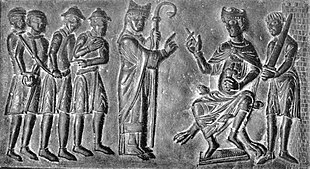
Adalbert of Prague pleads with Boleslaus II, Duke of Bohemia for the release of slaves
Large-scale trading in slaves was mainly confined to the South and East of early medieval Europe: the Byzantine Empire and the Muslim world were the destinations, while pagan Central and Eastern Europe (along with the Caucasus and Tartary) were important sources. Viking, Arab, Greek, and Radhanite Jewish merchants were all involved in the slave trade during the Early Middle Ages.[109][110][111] The trade in European slaves reached a peak in the 10th century following the Zanj Rebellion which dampened the use of African slaves in the Arab world.[112][113]
Slavery in early medieval Europe was so common that the Catholic Church repeatedly prohibited it, or at least the export of Christian slaves to non-Christian lands, as for example at the Council of Koblenz (922), the Council of London (1102) (which aimed mainly at the sale of English slaves to Ireland)[114] and the Council of Armagh (1171). Serfdom, on the contrary, was widely accepted. In 1452, Pope Nicholas V issued the papal bull Dum Diversas, granting the kings of Spain and Portugal the right to reduce any "Saracens (Muslims), pagans and any other unbelievers" to perpetual slavery, legitimizing the slave trade as a result of war.[115] The approval of slavery under these conditions was reaffirmed and extended in his Romanus Pontifex bull of 1455.
Britain
In Britain, slavery continued to be practiced following the fall of Rome, and sections of Hywel the Good's laws dealt with slaves in medieval Wales. The trade particularly picked up after the Viking invasions, with major markets at Chester[116] and Bristol[117] supplied by Danish, Mercian, and Welsh raiding of one another's borderlands. At the time of the Domesday Book, nearly 10% of the English population were slaves.[118] William the Conqueror introduced a law preventing the sale of slaves overseas.[119] According to historian John Gillingham, by 1200 slavery in the British Isles was non-existent.[120]
Slavery had never been authorized by statute within England and Wales, and in 1772, in the case Somerset v Stewart, Lord Mansfield declared that it was also unsupported within England by the common law. The slave trade was abolished by the Slave Trade Act 1807, although slavery remained legal in possessions outside Europe until the passage of the Slavery Abolition Act 1833 and the Indian Slavery Act, 1843.[121]
However, when England began to have colonies in the Americas, and particularly from the 1640s, African slaves began to make their appearance in England and remained a presence until the eighteenth century. In Scotland, slaves continued to be sold as chattels until late in the eighteenth century (on the 2nd May, 1722, an advertisement appeared in the Edinburgh Evening Courant, announcing that a stolen slave had been found, who would be sold to pay expenses, unless claimed within two weeks).[122]
For nearly two hundred years in the history of coal mining in Scotland, miners were bonded to their "maisters" by a 1606 Act "Anent Coalyers and Salters". The Colliers and Salters (Scotland) Act 1775 stated that "many colliers and salters are in a state of slavery and bondage" and announced emancipation; those starting work after 1 July 1775 would not become slaves, while those already in a state of slavery could, after 7 or 10 years depending on their age, apply for a decree of the Sheriff's Court granting their freedom. Few could afford this, until a further law in 1799 established their freedom and made this slavery and bondage illegal.[122][123]
Ottoman Empire
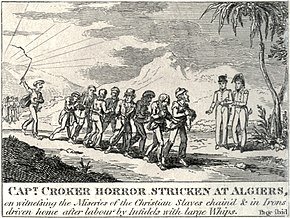
A British captain witnessing the miseries of slaves in Ottoman Algeria, 1815
The Byzantine-Ottoman wars and the Ottoman wars in Europe brought large numbers of slaves into the Islamic world.[124] To staff its bureaucracy, the Ottoman Empire established a janissary system which seized hundreds of thousands of Christian boys through the devşirme system. They were well cared for but were legally slaves owned by the government and were not allowed to marry. They were never bought or sold. The empire gave them significant administrative and military roles. The system began about 1365; there were 135,000 janissaries in 1826, when the system ended.[125]
After the Battle of Lepanto, 12,000 Christian galley slaves were recaptured and freed from the Ottoman fleet.[126] Eastern Europe suffered a series of Tatar invasions, the goal of which was to loot and capture slaves for selling them to Ottomans as jasyr.[127] Seventy-five Crimean Tatar raids were recorded into Poland–Lithuania between 1474 and 1569.[128]
Juneteenth
https://www.dogpile.com/serp?q=Juneteenth&sc=Fmvr1s6d9tR710
https://www.history.com/juneteenth
Economics
While American slaves in 1809 were sold for around $40,000 (in inflation adjusted dollars), a slave nowadays can be bought for just $90, making replacement more economical than providing long-term care.[359] Slavery is a multibillion-dollar industry with estimates of up to $35 billion generated annually.[360]
Trafficking

A world map showing countries by prevalence of female trafficking
Victims of human trafficking are typically recruited through deceit or trickery (such as a false job offer, false migration offer, or false marriage offer), sale by family members, recruitment by former slaves, or outright abduction. Victims are forced into a "debt slavery" situation by coercion, deception, fraud, intimidation, isolation, threat, physical force, debt bondage or even force-feeding with drugs to control their victims.[361]
"Annually, according to U.S. government-sponsored research completed in 2006, approximately 800,000 people are trafficked across national borders, which does not include millions trafficked within their own countries.
Approximately 80% of transnational victims are women and girls, and up to 50% are minors, reports the U.S. State Department in a 2008 study.[362]
While the majority of trafficking victims are women who are forced into prostitution (in which case the practice is called sex trafficking), victims also include men, women and children who are forced into manual labour.[363]
Because of the illegal nature of human trafficking, its extent is unknown. A U.S. government report, published in 2005, estimates that about 700,000 people worldwide are trafficked across borders each year.
This figure does not include those who are trafficked internally.[363] Another research effort revealed that roughly 1.5 million individuals are trafficked either internally or internationally each year, of which about 500,000 are sex trafficking victims.[56]
Slavery From Wikipedia

Relief depicting slaves in chains in the Roman Empire, at Smyrna, 200 CE
Part of a series on

Slavery has existed, in one form or another, throughout recorded human history – as have, in various periods, movements to free large or distinct groups of slaves.
Contemporary Slavery
Historical
By country or region
Religion
Opposition and resistance
Related
Slavery and enslavement are both the state and the condition of being a slave,[1][2] who is someone forbidden to quit their service for an enslaver, and who is treated by the enslaver as their property.[3] Slavery typically involves the enslaved person being made to perform some form of work while also having their location or residence dictated by the enslaver. Many historical cases of enslavement occurred when the enslaved broke the law, became indebted, or suffered a military defeat; other forms of slavery were instituted along demographic lines such as race. The duration of a person's enslavement might be for life, or for a fixed period of time, after which freedom would be granted.[4] Although most forms of slavery are explicitly involuntary and involve the coercion of the enslaved, there also exists voluntary slavery, entered into by the enslaved to pay a debt or obtain money. In the course of human history, slavery was a typical feature of civilization,[5] legal in most societies, but it is now outlawed in most countries of the world, except as a punishment for a crime.[6][7]
In chattel slavery, the enslaved person is legally rendered the personal property (chattel) of the slave owner. In economics, the term de facto slavery describes the conditions of unfree labour and forced labour that most slaves endure.[8]
In 2019, approximately 40 million people, of whom 26 percent were children, were enslaved throughout the world despite it being illegal. In the modern world, more than 50 percent of enslaved people provide forced labour, usually in the factories and sweatshops of the private sector of a country's economy.[9] In industrialised countries, human trafficking is a modern variety of slavery; in non-industrialised countries, enslavement by debt bondage is a common form of enslaving a person,[8] such as captive domestic servants, forced marriage, and child soldiers.[10]
Contents
- 1 Terminology
- 2 Characteristics
- 3 History
- 4 Contemporary slavery
- 5 Abolitionism
- 6 Apologies
- 7 Media
- 8 See also
- 9 References
- 10 Bibliography
- 11 Further reading
- 12 External links
The word slave arrived in English via the Old French sclave. In Medieval Latin the word was sclavus and in Byzantine Greek σκλάβος.[11] Use of the word arose during the Early Medieval Period, when Slavs from Central and Eastern Europe (Saqaliba) were frequently enslaved by Moors from the Iberian Peninsula and North Africa.[12][13][14]
There is a dispute among historians about whether terms such as "unfree labourer" or "enslaved person", rather than "slave", should be used when describing the victims of slavery. According to those proposing a change in terminology, slave perpetuates the crime of slavery in language by reducing its victims to a nonhuman noun instead of "carry[ing] them forward as people, not the property that they were". Other historians prefer slave because the term is familiar and shorter, or because it accurately reflects the inhumanity of slavery, with person implying a degree of autonomy that slavery does not allow.[15]
Chattel slavery
As a social institution, chattel slavery classes slaves as chattels (personal property) owned by the enslaver; like livestock, they can be bought and sold at will.[16] While some form of slavery was common throughout human history, the specific notion of chattel slavery reached its modern extreme in the Americas during European colonization.[17] Beginning in the 18th century, a series of abolitionist movements saw slavery as a violation of the slaves' rights as people ("all men are created equal"), and sought to abolish it. Abolitionism encountered extreme resistance but was eventually successful; the last Western country to abolish slavery, Brazil, did so in 1888.[18] The last third-world country to abolish slavery, Mauritania, did not do so until 1981.[19]
Bonded labour
Main article: Debt bondage
See also: Money marriage and Chukri System
Indenture, otherwise known as bonded labour or debt bondage, is a form of unfree labour under which a person pledges himself or herself against a loan. The services required to repay the debt, and their duration, may be undefined. Debt bondage can be passed on from generation to generation, with children required to pay off their progenitors' debt.[20] It is the most widespread form of slavery today.[21] Debt bondage is most prevalent in South Asia.[20] Money marriage refers to a marriage where a girl, usually, is married off to a man to settle debts owed by her parents.[22] The Chukri System is a debt bondage system found in parts of Bengal where a female can be coerced into prostitution in order to pay off debts.[23]
Dependents
The word "slavery" has also been used to refer to a legal state of dependency to somebody else.[24][25] For example, in Persia, the situations and lives of such slaves could be better than those of common citizens.[26]
Forced labour

Flogging a slave fastened to the ground, illustration in an 1853 anti-slavery pamphlet

A poster for a slave auction in Georgia, U.S., 1860

Portrait of an older woman in New Orleans with her enslaved servant girl in the mid-19th century
Main article: Unfree labour
See also: Human trafficking
Forced labour, or unfree labour, is sometimes used to describe an individual who is forced to work against their own will, under threat of violence or other punishment, but the generic term "unfree labour" is also used to describe chattel slavery, as well as any other situation in which a person is obliged to work against their own will, and a person's ability to work productively is under the complete control of another person.[citation needed] This may also include institutions not commonly classified as slavery, such as serfdom, conscription and penal labour. While some unfree labourers, such as serfs, have substantive, de jure legal or traditional rights, they also have no ability to terminate the arrangements under which they work and are frequently subject to forms of coercion, violence, and restrictions on their activities and movement outside their place of work.[citation needed]
Human trafficking primarily involves women and children forced into prostitution and is the fastest growing form of forced labour, with Thailand, Cambodia, India, Brazil and Mexico having been identified as leading hotspots of commercial sexual exploitation of children.[27][28]
Child soldiers and child labor
Main article: Child slavery
See also: Child labour and Military use of children
In 2007, Human Rights Watch estimated that 200,000 to 300,000 children served as soldiers in then-current conflicts.[29] More girls under 16 work as domestic workers than any other category of child labour, often sent to cities by parents living in rural poverty[30] as with the Haitian restaveks.
Forced marriage
See also: Marriage by abduction and Child marriage
Forced marriages or early marriages are often considered types of slavery.[citation needed] Forced marriage continues to be practiced in parts of the world including some parts of Asia and Africa and in immigrant communities in the West.[31][32][33][34] Sacred prostitution is where girls and women are pledged to priests or those of higher castes, such as the practice of Devadasi in South Asia or fetish slaves in West Africa.[citation needed] Marriage by abduction occurs in many places in the world today, with a 2003 study finding a national average of 69% of marriages in Ethiopia being through abduction.[35]
Other uses of the term
The word slavery is often used as a pejorative to describe any activity in which one is coerced into performing. Some argue that military drafts and other forms of coerced government labour constitute "state-operated slavery."[36][37] Some libertarians and anarcho-capitalists view government taxation as a form of slavery.[38]
"Slavery" has been used by some anti-psychiatry proponents to define involuntary psychiatric patients, claiming there are no unbiased physical tests for mental illness and yet the psychiatric patient must follow the orders of the psychiatrist. They assert that instead of chains to control the slave, the psychiatrist uses drugs to control the mind.[39] Drapetomania was a pseudoscientific psychiatric diagnosis for a slave who desired freedom; "symptoms" included laziness and the tendency to flee captivity.[40][41]
Some proponents of animal rights have applied the term slavery to the condition of some or all human-owned animals, arguing that their status is comparable to that of human slaves.[42]
The labour market, as institutionalized under contemporary capitalist systems, has been criticized by mainstream socialists and by anarcho-syndicalists, who utilise the term wage slavery as a pejorative or dysphemism for wage labour.[43][44][45] Socialists draw parallels between the trade of labour as a commodity and slavery. Cicero is also known to have suggested such parallels.[46]
Characteristics
Private versus state-owned slaves
Slaves have been owned privately by individuals but have also been under state ownership. For example, the kisaeng were women from low castes in pre modern Korea, who were owned by the state under government officials known as hojang and were required to provide entertainment to the aristocracy; in the 2020s some are denoted Kippumjo (the pleasure brigades of North Korea — serving as the concubines of the rulers of the state).[47] "Tribute labor" is compulsory labor for the state and has been used in various iterations such as corvée, mit'a and repartimiento. The internment camps of totalitarian regimes such as the Nazis and the Soviet Union placed increasing importance on the labor provided in those camps, leading to a growing tendency among historians to designate such systems as slavery.[48]
Economics
Economists have modeled the circumstances under which slavery (and variants such as serfdom) appear and disappear. One observation is that slavery becomes more desirable for landowners where land is abundant but labour is scarce, such that rent is depressed and paid workers can demand high wages. If the opposite holds true, then it is more costly for landowners to guard the slaves than to employ paid workers who can demand only low wages because of the degree of competition.[49] Thus, first slavery and then serfdom gradually decreased in Europe as the population grew. They were reintroduced in the Americas and in Russia as large areas of land with few inhabitants became available.[50]
Slavery is more common when the tasks are relatively simple and thus easy to supervise, such as large-scale monocrops such as sugarcane and cotton, in which output depended on economies of scale. This enables systems of labour, such as the gang system in the United States, to become prominent on large plantations where field hands toiled with factory-like precision. Then, each work gang was based on an internal division of labour that assigned every member of the gang to a task and made each worker's performance dependent on the actions of the others. The enslaved chopped out the weeds that surrounded the cotton plants as well as excess sprouts. Plow gangs followed behind, stirring the soil near the plants and tossing it back around the plants. Thus, the gang system worked like an assembly line.[51]
Since the 18th century, critics have argued that slavery retards technological advancement because the focus is on increasing the number of slaves doing simple tasks rather than upgrading their efficiency. For example, it is sometimes argued that, because of this narrow focus, technology in Greece – and later in Rome – was not applied to ease physical labour or improve manufacturing.[52]

The work of the Mercedarians was in ransoming Christian slaves held in North Africa (1637).
Scottish economist Adam Smith stated that free labour was economically better than slave labour, and that it was nearly impossible to end slavery in a free, democratic, or republican form of government since many of its legislators or political figures were slave owners, and would not punish themselves. He further stated that slaves would be better able to gain their freedom under centralized government, or a central authority like a king or church.[53][54] Similar arguments appeared later in the works of Auguste Comte, especially given Smith's belief in the separation of powers, or what Comte called the "separation of the spiritual and the temporal" during the Middle Ages and the end of slavery, and Smith's criticism of masters, past and present. As Smith stated in the Lectures on Jurisprudence, "The great power of the clergy thus concurring with that of the king set the slaves at liberty. But it was absolutely necessary both that the authority of the king and of the clergy should be great. Where ever any one of these was wanting, slavery still continues..."[55]

Sale and inspection of slaves
Even after slavery became a criminal offense, slave owners could get high returns. According to researcher Siddharth Kara, the profits generated worldwide by all forms of slavery in 2007 were $91.2 billion. That was second only to drug trafficking, in terms of global criminal enterprises. At the time the weighted average global sales price of a slave was estimated to be approximately $340, with a high of $1,895 for the average trafficked sex slave, and a low of $40 to $50 for debt bondage slaves in part of Asia and Africa. The weighted average annual profits generated by a slave in 2007 was $3,175, with a low of an average $950 for bonded labour and $29,210 for a trafficked sex slave. Approximately 40% of slave profits each year were generated by trafficked sex slaves, representing slightly more than 4% of the world's 29 million slaves.[56]
Identification
_-_men_and_women_eminent_in_the_evolution_of_the_American_of_African_descent_(1914)_(14597416438).jpg)
Branding of a female slave

Barefooted slaves depicted in David Roberts' Egypt and Nubia, issued between 1845 and 1849

Slave branding, c. 1853
Throughout history, slaves were clothed in a distinctive fashion, particularly with respect to the frequent lack of footwear, as they were rather commonly forced to go barefoot. This was partly for economic reasons, but also served as a distinguishing feature, especially in South Africa and South America. For example, the Cape Town slave code stated that "Slaves must go barefoot and must carry passes."[57] It also puts slaves at a physical disadvantage because of the lack of protection against environmental conditions and in confrontations, thereby making it more difficult to escape or to rebel against their owners.
This was the case in the majority of states. Most images from the respective historical period suggest that slaves were barefoot.[58] Brother Riemer stated, "[the slaves] are, even in their most beautiful suit, obliged to go barefoot. Slaves were forbidden to wear shoes. This was a prime mark of distinction between the free and the bonded and no exceptions were permitted."[59]
According to the Bible, shoes have been considered badges of freedom since antiquity: "But the father said to his servants, Bring forth the best robe, and put [it] on him; and put a ring on his hand, and shoes on [his] feet" (Luke 15:22). This aspect can be viewed as an informal law in areas where slavery existed as any person sighted barefoot in public was assumed to be a slave.
In certain societies this rule continues. The Tuareg still unofficially practice slavery and force their slaves to remain barefoot.[60]
Another widespread practice was branding, either to explicitly mark slaves as property or as punishment.
Legal rights
Depending upon the era and the country, slaves sometimes had a limited set of legal rights. For example, in the Province of New York, people who deliberately killed slaves were punishable under a 1686 statute.[61] And, as already mentioned, certain legal rights attached to the nobi in Korea, to enslaved people in various African societies, and to black female slaves in the French colony of Louisiana. Giving slaves legal rights has sometimes been a matter of morality, but also sometimes a matter of self-interest. For example, in ancient Athens, protecting slaves from mistreatment simultaneously protected people who might be mistaken for slaves, and giving slaves limited property rights incentivized slaves to work harder to get more property.[62] In the southern United States prior to the extirpation of slavery in 1865, a proslavery legal treatise reported that slaves accused of crimes typically had a legal right to counsel, freedom from double jeopardy, a right to trial by jury in graver cases, and the right to grand jury indictment, but they lacked many other rights such as white adults’ ability to control their own lives.[63]
History
Main article: History of slavery
Some scholars differentiate ancient forms of slavery from the largely race-based slavery. The first type of slavery, sometimes called "just title servitude", was inflicted on prisoners of war, debtors, and other vulnerable people. Race-based slavery grew to immense proportions starting in the 14th century.[64] It was argued even by some contemporary writers to be intrinsically immoral.[65][66][67]
Early history

Corinthian black-figure terra-cotta votive tablet of slaves working in a mine, dated to the late seventh century BC
Slavery predates written records and has existed in many cultures.[5] Slavery is rare among hunter-gatherer populations because it requires economic surpluses and a substantial population density. Thus, although it has existed among unusually resource-rich hunter gatherers, such as the American Indian peoples of the salmon-rich rivers of the Pacific Northwest coast, slavery became widespread only with the invention of agriculture during the Neolithic Revolution about 11,000 years ago.[68]
In the earliest known records, slavery is treated as an established institution. The Code of Hammurabi (c. 1760 BC), for example, prescribed death for anyone who helped a slave escape or who sheltered a fugitive.[69] The Bible mentions slavery as an established institution.[5] Slavery was practiced in almost every ancient civilization.[5] Such institutions included debt bondage, punishment for crime, the enslavement of prisoners of war, child abandonment, and the enslavement of slaves' offspring.[70]
Classical antiquity
Main article: Slavery in antiquity
Africa
Main article: Slavery in ancient Egypt
Slavery existed in Pharaonic Egypt, but studying it is complicated by terminology used by the Egyptians to refer to different classes of servitude over the course of history. Interpretation of the textual evidence of classes of slaves in ancient Egypt has been difficult to differentiate by word usage alone.[71][72] The three apparent types of enslavement in Ancient Egypt: chattel slavery, bonded labour, and forced labour.[73][74][75]
Asia
Slavery existed in ancient China as early as the Shang dynasty.[76] Slavery was employed largely by governments as a means of maintaining a public labour force.[77][78]
Europe
Ancient Greece and Rome
Main article: Slavery in ancient Rome

Ishmaelites purchase Joseph, by Schnorr von Carolsfeld, 1860
Records of slavery in Ancient Greece date begin with Mycenaean Greece. Classical Athens had the largest slave population, with as many as 80,000 in the 6th and 5th centuries BC.[79] As the Roman Republic expanded outward, entire populations were enslaved, across Europe and the Mediterranean. Slaves were used for labour, as well as for amusement (e.g. gladiators and sex slaves). This oppression by an elite minority eventually led to slave revolts (see Roman Servile Wars); the Third Servile War was led by Spartacus.

Slave Market in Ancient Rome, by Jean-Léon Gérôme
By the late Republican era, slavery had become an economic pillar of Roman wealth, as well as Roman society.[80] It is estimated that 25% or more of the population of Ancient Rome was enslaved, although the actual percentage is debated by scholars and varied from region to region.[81][82] Slaves represented 15–25% of Italy's population,[83] mostly war captives,[83] especially from Gaul[84] and Epirus. Estimates of the number of slaves in the Roman Empire suggest that the majority were scattered throughout the provinces outside of Italy.[83] Generally, slaves in Italy were indigenous Italians.[85] Foreigners (including both slaves and freedmen) born outside of Italy were estimated to have peaked at 5% of the total in the capital, where their number was largest. Those from outside of Europe were predominantly of Greek descent. Jewish slaves never fully assimilated into Roman society, remaining an identifiable minority. These slaves (especially the foreigners) had higher death rates and lower birth rates than natives and were sometimes subjected to mass expulsions.[86] The average recorded age at death for the slaves in Rome was seventeen and a half years (17.2 for males; 17.9 for females).[87]
Middle Ages
Africa
See also: Slavery in Africa
Slavery was widespread in Africa, which pursued both internal and external slave trade.[88] In the Senegambia region, between 1300 and 1900, close to one-third of the population was enslaved. In early Islamic states of the western Sahel, including Ghana, Mali, Segou, and Songhai, about a third of the population were enslaved.[89]

13th-century slave market in Yemen.[90]
During the trans-Saharan slave trade, slaves from West Africa were transported across the Sahara desert to North Africa to be sold to Mediterranean and Middle eastern civilizations. The Indian Ocean slave trade, sometimes known as the east African slave trade, was multi-directional. Africans were sent as slaves to the Arabian Peninsula, to Indian Ocean islands (including Madagascar), to the Indian subcontinent, and later to the Americas. These traders captured Bantu peoples (Zanj) from the interior in present-day Kenya, Mozambique and Tanzania and brought them to the coast.[91][92] There, the slaves gradually assimilated in rural areas, particularly on Unguja and Pemba islands.[93]
Americas
Slavery in Mexico can be traced back to the Aztecs.[94] Other Amerindians, such as the Inca of the Andes, the Tupinambá of Brazil, the Creek of Georgia, and the Comanche of Texas, also practiced slavery.[5]
Slavery in Canada was practiced by First Nations and by European settlers.[95] Slave-owning people of what became Canada were, for example, the fishing societies, such as the Yurok, that lived along the Pacific coast from Alaska to California,[96] on what is sometimes described as the Pacific or Northern Northwest Coast. Some of the indigenous peoples of the Pacific Northwest Coast, such as the Haida and Tlingit, were traditionally known as fierce warriors and slave-traders, raiding as far as California. Slavery was hereditary, the slaves being prisoners of war and their descendants were slaves.[97] Some nations in British Columbia continued to segregate and ostracize the descendants of slaves as late as the 1970s.[98]
Asia
Slavery also existed in India, Japan and Vietnam.
China
See also: Slavery in China
Many Han Chinese were enslaved in the process of the Mongol invasion of China proper.[99] According to Japanese historians Sugiyama Masaaki (杉山正明) and Funada Yoshiyuki (舩田善之), Mongolian slaves were owned by Han Chinese during the Yuan dynasty.[100][101]
Korea
Slavery in Korea existed since before the Three Kingdoms of Korea period, c. 0.[102] Slavery has been described as "very important in medieval Korea, probably more important than in any other East Asian country, but by the 16th century, population growth was making [it] unnecessary".[103] Slavery went into decline around the 10th century but came back in the late Goryeo period when Korea also experienced multiple slave rebellions.[102]
In the Joseon period of Korea, members of the slave class were known as nobi. The nobi were socially indistinct from freemen (i.e., the middle and common classes) other than the ruling yangban class, and some possessed property rights, and legal and civil rights. Hence, some scholars argue that it is inappropriate to call them "slaves",[104] while some scholars describe them as serfs.[105][106] The nobi population could fluctuate up to about one-third of the total, but on average the nobi made up about 10% of the total population.[102] In 1801, the majority of government nobi were emancipated,[107] and by 1858, the nobi population stood at about 1.5 percent of the Korean population.[108]
Europe
Main articles: Barbary slave trade and Slavery in the Byzantine Empire

Adalbert of Prague pleads with Boleslaus II, Duke of Bohemia for the release of slaves
Large-scale trading in slaves was mainly confined to the South and East of early medieval Europe: the Byzantine Empire and the Muslim world were the destinations, while pagan Central and Eastern Europe (along with the Caucasus and Tartary) were important sources. Viking, Arab, Greek, and Radhanite Jewish merchants were all involved in the slave trade during the Early Middle Ages.[109][110][111] The trade in European slaves reached a peak in the 10th century following the Zanj Rebellion which dampened the use of African slaves in the Arab world.[112][113]
Slavery in early medieval Europe was so common that the Catholic Church repeatedly prohibited it, or at least the export of Christian slaves to non-Christian lands, as for example at the Council of Koblenz (922), the Council of London (1102) (which aimed mainly at the sale of English slaves to Ireland)[114] and the Council of Armagh (1171). Serfdom, on the contrary, was widely accepted. In 1452, Pope Nicholas V issued the papal bull Dum Diversas, granting the kings of Spain and Portugal the right to reduce any "Saracens (Muslims), pagans and any other unbelievers" to perpetual slavery, legitimizing the slave trade as a result of war.[115] The approval of slavery under these conditions was reaffirmed and extended in his Romanus Pontifex bull of 1455.
Britain
In Britain, slavery continued to be practiced following the fall of Rome, and sections of Hywel the Good's laws dealt with slaves in medieval Wales. The trade particularly picked up after the Viking invasions, with major markets at Chester[116] and Bristol[117] supplied by Danish, Mercian, and Welsh raiding of one another's borderlands. At the time of the Domesday Book, nearly 10% of the English population were slaves.[118] William the Conqueror introduced a law preventing the sale of slaves overseas.[119] According to historian John Gillingham, by 1200 slavery in the British Isles was non-existent.[120]
Slavery had never been authorized by statute within England and Wales, and in 1772, in the case Somerset v Stewart, Lord Mansfield declared that it was also unsupported within England by the common law. The slave trade was abolished by the Slave Trade Act 1807, although slavery remained legal in possessions outside Europe until the passage of the Slavery Abolition Act 1833 and the Indian Slavery Act, 1843.[121]
However, when England began to have colonies in the Americas, and particularly from the 1640s, African slaves began to make their appearance in England and remained a presence until the eighteenth century. In Scotland, slaves continued to be sold as chattels until late in the eighteenth century (on the 2nd May, 1722, an advertisement appeared in the Edinburgh Evening Courant, announcing that a stolen slave had been found, who would be sold to pay expenses, unless claimed within two weeks).[122]
For nearly two hundred years in the history of coal mining in Scotland, miners were bonded to their "maisters" by a 1606 Act "Anent Coalyers and Salters". The Colliers and Salters (Scotland) Act 1775 stated that "many colliers and salters are in a state of slavery and bondage" and announced emancipation; those starting work after 1 July 1775 would not become slaves, while those already in a state of slavery could, after 7 or 10 years depending on their age, apply for a decree of the Sheriff's Court granting their freedom. Few could afford this, until a further law in 1799 established their freedom and made this slavery and bondage illegal.[122][123]
Ottoman Empire

A British captain witnessing the miseries of slaves in Ottoman Algeria, 1815
The Byzantine-Ottoman wars and the Ottoman wars in Europe brought large numbers of slaves into the Islamic world.[124] To staff its bureaucracy, the Ottoman Empire established a janissary system which seized hundreds of thousands of Christian boys through the devşirme system. They were well cared for but were legally slaves owned by the government and were not allowed to marry. They were never bought or sold. The empire gave them significant administrative and military roles. The system began about 1365; there were 135,000 janissaries in 1826, when the system ended.[125]
After the Battle of Lepanto, 12,000 Christian galley slaves were recaptured and freed from the Ottoman fleet.[126] Eastern Europe suffered a series of Tatar invasions, the goal of which was to loot and capture slaves for selling them to Ottomans as jasyr.[127] Seventy-five Crimean Tatar raids were recorded into Poland–Lithuania between 1474 and 1569.[128]
Juneteenth
https://www.dogpile.com/serp?q=Juneteenth&sc=Fmvr1s6d9tR710


._Molla_Nasreddin.jpg)

