July 4 Barbecue Costs Climb to Record

How much is inflation driving this equation?

You know, I was stunned when I looked into what was really driving the price. I had figured that energy would have a far greater impact than it actually had. Energy is an input, of course, in plant overhead, packaging (plastics and the like), but the real big drivers of input cost inflation was in proteins. Meats, poultry, etc - huge drivers of our price. Other things like tomatoes or cocoa have been real problems in the recent past as well. We used to have a department that hedged a lot of this, now we only hedge a few key ingredients.

I did a presentation awhile back on how CPG companies used to be able to tolerate input cost increase well because it was gradual and not volatile. As costs continued to increase throughout the years, we could take standard price increases every 24 months or so and stay ahead of it. But ever since 2000 or so, the volatility of commodities has been killer - CPG companies cannot tolerate vast swings of price both up (mostly) and down (like in 2008). We're not set up to handle that type of adjustments regularly. When input cost inflation comes, we now panic and take action instantly. When they drop, we no longer believe it's a drop that will stick, so we hold price and resist pressure to lower. We're afraid to give back hard won ground because we've been burned so many times when that temporary cost drop didn't become permanent.

I attribute the last 14 or so years in commodity volatility to the Fed and cheap money. Sure, there have been some pestilence or crop issues, but on the whole, it's too much money sloshing about.
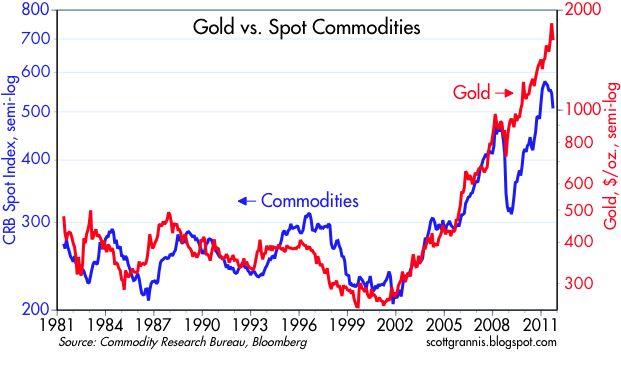
 
Here's a chart to think about. Yeah, I know it has gold - ignore that part and focus on the CRB index. Look at the action since around 2002. People like Ricter argue that prices are driven purely by pig flu, or crop yield, etc. You mean to tell me that these issues only started happening in 2002 and that there was no famine, or drought, etc before that? What a joke.

saupload_Gold_vs_CRB_Spot.jpg
 
You know, I was stunned when I looked into what was really driving the price. I had figured that energy would have a far greater impact than it actually had. Energy is an input, of course, in plant overhead, packaging (plastics and the like), but the real big drivers of input cost inflation was in proteins. Meats, poultry, etc - huge drivers of our price. Other things like tomatoes or cocoa have been real problems in the recent past as well. We used to have a department that hedged a lot of this, now we only hedge a few key ingredients.

I did a presentation awhile back on how CPG companies used to be able to tolerate input cost increase well because it was gradual and not volatile. As costs continued to increase throughout the years, we could take standard price increases every 24 months or so and stay ahead of it. But ever since 2000 or so, the volatility of commodities has been killer - CPG companies cannot tolerate vast swings of price both up (mostly) and down (like in 2008). We're not set up to handle that type of adjustments regularly. When input cost inflation comes, we now panic and take action instantly. When they drop, we no longer believe it's a drop that will stick, so we hold price and resist pressure to lower. We're afraid to give back hard won ground because we've been burned so many times when that temporary cost drop didn't become permanent.

Very interesting.

Although I continue to purchase products that I have done so for years, I've actually stopped others that I really liked when the reductions really started showing up. The ones I continue to purchase, I do so only because the alternative is worse, or because I can get two for ones, buy one get half off 2nd, and other such deals on them. I'll stay with my old favorites, at least the products I think quality hasn't been overly compromised. My old favorites list is shrinking rapidly, though. Seems like this trend is intensifying...but it also seems that they can't go much further, at least in some reductions, without compromising safety.

I should add, though my wife and I shop this way, most people I see just grab shit off the shelf and throw it in their cart. They don't know one way or another there has been a subtle, and sometimes not so subtle change to their product. I don't expect they care. I'm one of those guys who reads the label not only for total content, but for fat, carb, protein, sugar, sodium, and other content as well.
 
That's the essence of inflation and currency debasement... regardless of what the government tells us and hopes we believe.

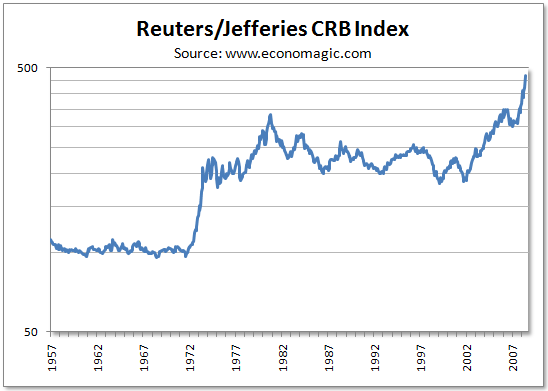
Of course. Here's the CRB index going back to the 50s. Remember the period of high inflation in the 70s? How can you look at this chart and NOT believe the Fed's sole purpose should be defeating inflation and managing price?

saupload_08_07_08c_crb_log.png
 
Of course. Here's the CRB index going back to the 50s. Remember the period of high inflation in the 70s? How can you look at this chart and NOT believe the Fed's sole purpose should be defeating inflation and managing price?

saupload_08_07_08c_crb_log.png

Fed claims to "fight inflation"... when in fact, it PROMOTES IT!!
 
Very interesting.

Although I continue to purchase products that I have done so for years, I've actually stopped others that I really liked when the reductions really started showing up. The ones I continue to purchase, I do so only because the alternative is worse, or because I can get two for ones, buy one get half off 2nd, and other such deals on them. I'll stay with my old favorites, at least the products I think quality hasn't been overly compromised. My old favorites list is shrinking rapidly, though. Seems like this trend is intensifying...but it also seems that they can't go much further, at least in some reductions, without compromising safety.

So when you go for those BOGOs (buy one get one) or other similar deals, that's the manufacturer using trade dollars to buy down price in order to stimulate volume bursts during a particular period. In some cases, like the BOGO, this actually drives enough volume to pay for the trade spent - for example, Pepsi deals that occur at Superbowl time. Or hot dogs around July 4th. Big promotions on seasonal items as well - these tend to pay for the trade dollars spent in volume increases.

Other grocery channels, like walmart, prefer an EDLP (Every Day Low Price). They tell manufacturers "give us all your trade and marketing dollars in our cost - we'll list you lower". This is a strategy that works well on some products, but not necessarily all products, because those seasonal bursts don't occur (people see hot dogs as the same price all year). There are only a few grocery outlets that actually put their own money (by lowering their margins) into the promotion to drive price even lower. These folks see big deals when they do it, but it's costly. But they "comp shop" each other all the time. For example, here in Florida Publix will often complain to us "Why can Walmart put your product at $$ price when we can't do that? Are you giving them a better deal?" Then we go through the churn of showing them the differences in what Walmart is doing (taking their own margin down to promote traffic) and tell Publix "if you want to do that, you can have that price, too!" It's a lot of "fun".

The largest line on any CPG's P+L outside of COGS, is their trade.
 
So when you go for those BOGOs (buy one get one) or other similar deals, that's the manufacturer using trade dollars to buy down price in order to stimulate volume bursts during a particular period. In some cases, like the BOGO, this actually drives enough volume to pay for the trade spent - for example, Pepsi deals that occur at Superbowl time. Or hot dogs around July 4th. Big promotions on seasonal items as well - these tend to pay for the trade dollars spent in volume increases.

Other grocery channels, like walmart, prefer an EDLP (Every Day Low Price). They tell manufacturers "give us all your trade and marketing dollars in our cost - we'll list you lower". This is a strategy that works well on some products, but not necessarily all products, because those seasonal bursts don't occur (people see hot dogs as the same price all year). There are only a few grocery outlets that actually put their own money (by lowering their margins) into the promotion to drive price even lower. These folks see big deals when they do it, but it's costly. But they "comp shop" each other all the time. For example, here in Florida Publix will often complain to us "Why can Walmart put your product at $$ price when we can't do that? Are you giving them a better deal?" Then we go through the churn of showing them the differences in what Walmart is doing (taking their own margin down to promote traffic) and tell Publix "if you want to do that, you can have that price, too!" It's a lot of "fun".

The largest line on any CPG's P+L outside of COGS, is their trade.

Speaking of Wal-Mart (BTW, I'm also in FL), I like the fact that they will match deals on certain foods down here at the consumer level. Comes in handy when items run out at Publix or Winn-Dixie when on sale. I don't believe I've ever seen WD or Publix match each other's best prices during sales. I've found it interesting that they often put the same cuts of beef on sale at the same time, though not at the same prices.
 
Speaking of Wal-Mart (BTW, I'm also in FL), I like the fact that they will match deals on certain foods down here at the consumer level. Comes in handy when items run out at Publix or Winn-Dixie when on sale. I don't believe I've ever seen WD or Publix match each other's best prices during sales. I've found it interesting that they often put the same cuts of beef on sale at the same time, though not at the same prices.

Yes, that's a product of comp shopping, and they know that sometimes they miss stuff so they'll try to attract a shopper to their store if their competitor doesn't have it. They're trying to increase trips/channels. There are lots of studies out there in the industry that correlate the amount of stores a shopper will go to in order to search for a deal with the price of gas.
 
"... There are lots of studies out there in the industry that correlate the amount of stores a shopper will go to in order to search for a deal with the price of gas.

What about the concept, "if Target, Home Depot or Costco doesn't have it, you don't need it"?

Discount Clubs... what a concept! I've spent an estimated $200K at Costco during the years I've been a member... believe I've saved $60K+ in the process.
 
Back
Top