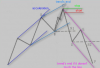
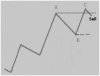
I can understand tactic 2 but I'm lost for tactic 3. For example, when price pulls back to D and does not run any further up past D for both tactics, the actions are different? For tactic 2, you trail the low whereas for tactic 3, you put a sell stop at D? For tactic 3, which trendline are you referring to? I don't understand the phrase "price turns back in the direction of the trend line break without running much further" for tactic 3.
This chart pattern offers a full array of technical price action trades that produce a profit equal to the maximum necessary risk more often than not. (If you're looking for something that works almost all the time, ditch trading and get a job where other people pay you on regular basis.)
For tactic 3, I'm referring to the Lower Trend Line (LTL) of the uptrend in progress at the start of the pattern as illustrated below. Keep in mind that the initial break of a trend line in a defined trend tends to fail (#1 on the chart). With-trend traders will initiate or add to a position on a pullback to a trend line. The "weak hands" will have stops just below the trend line and if the trend line breaks weakly (as illustrated at B) they will often chase the market to get back in long and the early shorts who sold the initial TL break will buy to limit their losses when they realize they're trapped. Initial breaks of a trend line that break weakly more often than not result in a test of (and usually a break of) the previous high (assuming an uptrend). On the chart, the initial break of the TL resulted in a new high (C).
For tactic 2, I begin trailing a sell stop (almost always using a smaller bar interval than my main trading bar interval) once the pullback price reaches B (#4 on the chart showing previous support now becoming resistance at E).
I also frequently use tactic 1 and simply place a limit order to sell B or tick below B. When it works you get an awesome entry price near the turn and when it fails, you can exit with a small loss.
(I also frequently enter at the 2nd break of the trend line if the last new high was fairly weak compared to the previous new highs. Al Brooks refers to this as "shrinking stairs". See #2 on the chart)
If for some reason I didn't enter on the 2nd TL break or later using tactic 1 or 2, I will place a sell stop just below D, treat it as a breakout trade, meaning it needs to break with conviction, and use an initial profit target based on a move equal to the move from C to D.
As for stop placement:
Early entry (#2) = stop just above C
Tactic 1 (#4) = stop of $50-$70 per contract
Tactic 2 (entry somewhere between price E and midway to D) = stop above E
Tactic 3 (break of price D) = stop of $50-$70 per contract or immediate scratch if price beaks only by a few ticks