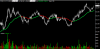
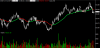
Great analysis. I'm also of the opinion that the market is in constant flux. Hence detecting the underlying market rhythm is so important. I just want to add that it's worth noting that the market moves from one extreme to the opposite extreme. There is no middle ground where the bulls and the bears can compromise. It's always "my way or the highway". With that in mind, it becomes clear why bull trap and bear trap are such an effective trading strategy.I was thinking about your question a little more. Here is an another interpretation of the topping corkscrew pattern:-

As you said, you could think of the corkscrew as two patterns. On the left (rising flag), there are these consecutive HHs and HLs, price in clear uptrend, and a degree of regularity. The herd is long. The desire to be right means that the only game in town for the masses is playing the uptrend.
But then the sudden drop from highs, which takes out the three prior lows, changes everything. Momentarily at least, buying vanished. What happened there? The regularity is no longer there and confusion reigns. So we get this chaotic type behavior with the formation of an ascending triangle. The market is grappling for new direction, but without conviction. So you get these false breaks in both directions, and an increase in volatility. The up trend has finished but the market is still in a transition phase.
However, the rising volatility eventually puts the herd under enough pressure so that they start to throw in the towel. The prior state was regularity and an uptrend. The new state is irregularity and a transition towards a downtrend. When the price fails to reach the extreme highs and the rally fizzles out, the transition has completed and a more regular downtrend will start to emerge.

You are using an out of date browser. It may not display this or other websites correctly.
You should upgrade or use an alternative browser.
You should upgrade or use an alternative browser.
It's the Pattern, Stupid!
- Thread starter schizo
- Start date

If by W pattern you mean a double top, that is not what it is.(eg. the second leg of the W pattern).
Oops!The example is a sell, not a buy.

But then again, you have both lower low and higher high (perhaps reverse triangle or half diamond formation, which is usually continuation pattern??). That completely throws me off.
This is the perfect example of the Trader Vic 1-2-3 (or the Ross Hook, depending on your preference).When I realised that it's pointless holding for a runner today I switched to 1 minute entry/target and this was one of the trades. Self explanatory.
View attachment 159186
I think you are trying to find patterns within the price movement when the DTRP is a pattern in itself.Oops!
But then again, you have both lower low and higher high (perhaps reverse triangle or half diamond formation, which is usually continuation pattern??). That completely throws me off.
One question I'd like to throw out there (especially with respect to the patterns discussed in this thread) is: how do you use volume and time in your analysis?
Anecdotally at least, I've always noticed volume spikes at turning points. Is this a requirement for a reversal or am I just seeing what I want to see, ignoring all of those when you get a reversal and there isn't a volume spike at the lows? Or even those times when you get a volume spike and what initially appears to be a reversal is more of a pullback prior to a trend continuation.
I've seen experienced traders on this forum (such as IamNobody) post that they didn't find volume useful at all when they built their system.
Bear in mind that the (filtered) data feed I use in my charting comes from Interactive Brokers, so I don't even know how reliable the real time volume data I'm using is versus a specialized unfiltered feed such as IQFeed or from some other provider. Curious to know if anyone has made the comparison in real time and found that better data generates different signals, or if the tiny differences in volume etc don't make any difference in the big scheme of things.
Anecdotally at least, I've always noticed volume spikes at turning points. Is this a requirement for a reversal or am I just seeing what I want to see, ignoring all of those when you get a reversal and there isn't a volume spike at the lows? Or even those times when you get a volume spike and what initially appears to be a reversal is more of a pullback prior to a trend continuation.
I've seen experienced traders on this forum (such as IamNobody) post that they didn't find volume useful at all when they built their system.
Bear in mind that the (filtered) data feed I use in my charting comes from Interactive Brokers, so I don't even know how reliable the real time volume data I'm using is versus a specialized unfiltered feed such as IQFeed or from some other provider. Curious to know if anyone has made the comparison in real time and found that better data generates different signals, or if the tiny differences in volume etc don't make any difference in the big scheme of things.

Tactic 1) Once D occurs, you can place a limit sell order at B. This is an anticipatory entry method, meaning you anticipate that previous support (B) in the uptrend channel will become resistance after the lower trend line breaks with some conviction.
Tactic 2) Once D occurs, you wait for a retrace to B and if price doesn't run much further, you beginning trailing a sell stop 1 tick below the low of each upward moving price bar to initiate a short position when price turns back downward. If the retrace to B keeps running up through level B with conviction, you wait for clarity.
Tactic 3) Once D occurs, and price pulls back to B, if price turns back in the direction of the trend line break without running much further, you place a sell stop just below D.
With the first method, you use a tight stop.
With the other two methods, you place the stop above the swing high off the price turn back downward.
Nodoji, LOL.
It is always enjoyable to see the amateur Bull (who bought at the "retracement" at D) run for cover and sell their shirt when their SL hit at S2 which is just below D.
Their miserable provide a free ride for my short at D.
Last edited: