Thanks for all your help. I have plenty to keep me busy for a while now. If I'm not pushing my luck, I had two more things I was wondering about.
Assume I get daily data for currencies and daily dv01's for the past year. When I'm doing research, would it be useful to change the coefficient for the spread for each day in the past year or is it not worth the effort?
How do you feel about shorter term spreads like IB v bank bill, Eurodollar v bank bill, bank bill v aussie 3 year? Are these a viable or do I need something that moves a bit more intraday?
Important note: There is no book on this. You have to suck it out of someones ass. I had to figure this out by myself because higher-ups never wanted me to learn about this.
Now, the co-efficient will not change every single day. And if it does, it is so small. There is only a real change when you notice that the Bonds have moved quite a bit off some fundamental data. Play around with tiny changes in the co-efficient to see yourself.
I check them once every few weeks to every month. They don't change and you don't need to be scared of them shifting. You want your edge to be so refined that a few ticks here and there, or slippage, isn't enough to take you down. This is my mentality.
Regarding Shorter Term Spreads
IB v Bank Bill - Can suck my ass.
Eurodollar v Bank Bill (do you mean Australia?) - A great trade if you know what you're doing. Do you know how to plot out the Australian curve and look at different bellies of it? Also, are you willing to hold through various Tier 1 announcements? I am developing this as part of my trades, but it's going to take some time because you need to grab a juicy contract. You can't just be throwing money in the 8th Eurodollar when the 8th Aussie Bill doesn't do much volume for fills at night time for example.
To be honest, stay away from this trash for now. Let spastics like me waste time on this. I've given you other things which move based on research. It's very hard for you to go back in time and pound informational research on cross-country Billspreads because of so many moving variables. Spend your time wisely.
Bank Bill vs. Aussie 3yr - Can suck my ass. You are trading a 1bp spread on HTS to a 1bp spread to a Bank Bill. The ASX needs to reprice these stupid clunky things for you to get some more movement. For now, if you trade this, it is an absolute requirement that;
a. You know what the short-end Bills are doing (mainly the first 4)
b. You know your time-frame (multiple days)
c. You don't fade this based off 'predicted volatility'
d. You know that Australia's interest rate slump will keep slumping for a f*cking long time.
People are in the middle of losing their careers right now because they are praying for the interest rate cycle to turn. U.S. CPI just came out a few hours ago and it's weak, they removed the 4th rate hike price-in for 2017. This is bad, bad news for inflation world-wide and especially Australia.
By the way all products I mentioned are viable, of course, but what are you approaching the trade with and how long is your time-frame? If you're day-trading, forget it.
I want volatility to go up like everyone else, but if I keep fighting the facts then I will be bankrupt.
The hardest part of the Australian short-end is that they are open 23-hours a day for trading, which means there is never a panic to get something done. This is the nail in the coffin during a slow interest rate market.
For comparison; the BXA (Canada bills) do 180k volume a day, just like the Aussie Bills. But Canada is only open for half of the time, and during American timezone too! You can guess which has more activity... and they're both pretty ASS.
About the co-efficient pricing:
You don't need to be specific. The (1/10) is the same placing as (0.096). It's just a rough aproximation. The [1] and the [10] are explained.
About your charting:
It's in-correct because you have to respect how CQG prices the product. The HXS moves in "1 basis point increments" but it's QUOTED in half-ticks. This means it's 1*HXS-0.096*CB
You have to check how the pricing mechanism is formed for the product first. For example, the S&P500 moves in "singular points" but its QUOTED in quarter-ticks. If I want to chart SPI-MINI full ratio, I will do AP-2.4*EP which means for every Mini's POINT (4 quarter ticks) moved, I'll get 2.4 spi ticks out of it.
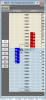
Remember if I charted the HXS-(1/10)*CB it means that for every 1-tick increment in the Canadian Bond, the HXS will move 1/10th of its increment... of FULL-POINT pricing... so if the CB moves 10-ticks we will move (1/10th) * 10 = 1 basis Point. Here's a picture of the Canadian Bond ladder. It's a "runner" just like the Bund, Gilt etc.
This is confusing, I know. In fact, I traded so many spreads over the years not knowing how to truly understand them.
I know these spreads better than a hooker knows her vag.
Unfortunately, there's no guidance anywhere and everyone's a secretive scum f@ggot so I don't blame you.
A trick on CQG and how to check if your charting is near correct:
What I would do is use the yield function to roughly check my pricing. Now, the yielding is wrong because CQG use some sort of price information somewhere, but what I would do is (for example):
If I wanted to test the yield chart of HXS v CB then you chart the following:
YIELD(CB)-YIELD(HXS)
Yes, that's the correct quoting form. It puts HXS in-front. If you chart this you get:
Now when I tested your chart calculation (Price = HXS-0.2*CB) I get this bum fuk:
But when I chart my one, I get:
Sometimes, I will play around with the yield function just to triple-check I am on the right path.
How to think about Spreads and charts:
=====
sommi's cheat sheet:
Note: Charting Only. Do not bring currency into this. Do not bring tick VALUE into this. Do not bring dollars into this. We just want to refine the price quote in the same language.
Australia Bonds (HTS, HXS) = Quoted in basis point pricing just like Bills
HXS-(1/dv01)*Product
The Bund current DV01 FRSK on Bloomberg is (139). What is the Aussie 10yr to Bund chart?
HXS-(1/13.9)*DB
Why? The FRSK tells you the Dollar value made (divide 139 by 10 euros a tick)
The Canada 10yr is 104. What is the chart for this?
HXS-(1/10.4)*CB
Runner Bonds (Bund, Gilt, Canada etc.) =
Runner-(DV01.Runner/DV01.Follower)*Follower
STIRS (HBS, BXA, QEA, EDA, QSA) =
Yield for Yield, no quoting change needed or currency manipulation.
Example: Australia 8th bill to Eurodollar 8th bill = HBS?8-EDA?8
====
Ratio calculation
Theoretical experiment; if I made 1 basis point in Leg A but got bum-fuckt in Leg B, what is going to make me be exactly neutral?
Step #1 Find out what a basis point movement is, in ticks
Step #2 Find out what you made or lost based on the currency
Step 3# Make one of the currencies into the other
Step 4# Equate them and think "Alright, what's going to make my ratio perfectly matched?"
====
Australia and Canada
Step #1
If the HXS moves 2 ticks, it's 1 bp. If the Canadian Bond moves 10.4 ticks, it's a basis point.
Step #2
HXS = 2 ticks = 2 x $50/1-lot = $100 Aussie
Step #3
CB = 10.4 ticks = 10.4 x $10.C/1-lot = $104 Canadian
$104 Canadian is about $103 Aussie (Convert using the currency)
Step #4
Alright.. I lost $103 but I made $104 on my Canadian... so I know if I had a 1-lot in the Aussie I'm okay with the 1-lot in Canadian.
In another world, if I made $100 in my Aussie leg but lost $200 in my Canadian leg, I would need 2 Aussie's to 1 Canadian as a ratio
Final Note
This is a toolbox for whipping out a spread. The most important part is your research and informational edge.