
You are using an out of date browser. It may not display this or other websites correctly.
You should upgrade or use an alternative browser.
You should upgrade or use an alternative browser.
It is so hot due to CO2 and the global warming religion that.......
- Thread starter WeToddDid2
- Start date



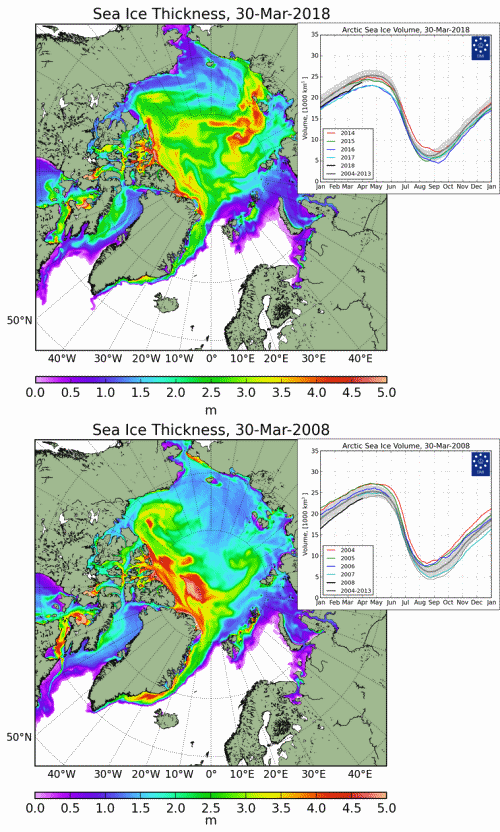
Arctic Sea Ice Missed a Record
Low This Winter. Barely.
The disappearing sea ice is a key indicator of a warming Arctic. And the consequences of a warming Arctic can be felt further south. A growing number of researchers are linking the changes up north to unusual winter weather in North America and Europe.
In recent weeks, the Northeastern United States faced four nor'easters in as many weeks, and Western Europe encountered subzero temperatures that were far lower than at the North Pole.
These weather patterns are influenced by the jet stream, the river of wind that encircles the Northern Hemisphere, said Jennifer A. Francis, an Arctic researcher at Rutgers University. Temperature differences between the Arctic and the lower latitudes help create the jet stream. Because the Arctic is warming twice as fast as the rest of the Earth, that temperature difference is getting smaller. As a result, the jet stream is getting weaker and shifting its behavior, sending cold air south from the Arctic and pumping warm air north.
The weakening jet stream also helps keep weather patterns locked in place, Dr. Francis said. “We’ve been in this pattern along the East Coast that is very conducive to the formation of nor’easter-type storms,” she said. “Part of the reason for that is because we’ve had this pattern in the jet stream that’s been so persistent.”
Low This Winter. Barely.
The disappearing sea ice is a key indicator of a warming Arctic. And the consequences of a warming Arctic can be felt further south. A growing number of researchers are linking the changes up north to unusual winter weather in North America and Europe.
In recent weeks, the Northeastern United States faced four nor'easters in as many weeks, and Western Europe encountered subzero temperatures that were far lower than at the North Pole.
These weather patterns are influenced by the jet stream, the river of wind that encircles the Northern Hemisphere, said Jennifer A. Francis, an Arctic researcher at Rutgers University. Temperature differences between the Arctic and the lower latitudes help create the jet stream. Because the Arctic is warming twice as fast as the rest of the Earth, that temperature difference is getting smaller. As a result, the jet stream is getting weaker and shifting its behavior, sending cold air south from the Arctic and pumping warm air north.
The weakening jet stream also helps keep weather patterns locked in place, Dr. Francis said. “We’ve been in this pattern along the East Coast that is very conducive to the formation of nor’easter-type storms,” she said. “Part of the reason for that is because we’ve had this pattern in the jet stream that’s been so persistent.”

Arctic Sea Ice Missed a Record
Low This Winter. Barely.
The disappearing sea ice is a key indicator of a warming Arctic. And the consequences of a warming Arctic can be felt further south. A growing number of researchers are linking the changes up north to unusual winter weather in North America and Europe.
In recent weeks, the Northeastern United States faced four nor'easters in as many weeks, and Western Europe encountered subzero temperatures that were far lower than at the North Pole.
These weather patterns are influenced by the jet stream, the river of wind that encircles the Northern Hemisphere, said Jennifer A. Francis, an Arctic researcher at Rutgers University. Temperature differences between the Arctic and the lower latitudes help create the jet stream. Because the Arctic is warming twice as fast as the rest of the Earth, that temperature difference is getting smaller. As a result, the jet stream is getting weaker and shifting its behavior, sending cold air south from the Arctic and pumping warm air north.
The weakening jet stream also helps keep weather patterns locked in place, Dr. Francis said. “We’ve been in this pattern along the East Coast that is very conducive to the formation of nor’easter-type storms,” she said. “Part of the reason for that is because we’ve had this pattern in the jet stream that’s been so persistent.”
Post in your thread, don't bump their ridiculous propaganda threads
Post in your thread, don't bump their ridiculous propaganda threads
It doesn't really matter, but you are right.
Post in your thread, don't bump their ridiculous propaganda threads
You are the propagandist.Post in your thread, don't bump their ridiculous propaganda threads
Oil companies knew all along. Internal emails..........blahahahahahahaha
Just say no to fake news.