
You are using an out of date browser. It may not display this or other websites correctly.
You should upgrade or use an alternative browser.
You should upgrade or use an alternative browser.
Is this true?
- Thread starter bearice
- Start date
Quote from bearice:
The $9 Trillion bailouts printed by Barack Obama and donated to bankrupt companies is causing high inflation in USA and other countries.
bearice, I normally root for the underdog. I see people hating on you in this forum and I feel for you. But come on man... this is high school economics class stuff.

Quote from stopnlimits:
bearice, I normally root for the underdog. I see people hating on you in this forum and I feel for you. But come on man... this is high school economics class stuff.
Bearice brings up alot of good topics, but his fact checking skills are so bad that even the national enquirer would not give him a job.

Quote from bearice:
The $9 Trillion bailouts printed by Barack Obama and donated to bankrupt companies is causing high inflation in USA and other countries.
Rising stock markets cause inflation and Obama's multi Trillion dollars donation was directed to save stock markets.
Is this true?
You are truly nuts. I don't put you on ignore because you are the source of endless fascination.
Quote from bearice:
The $9 Trillion bailouts printed by Barack Obama and donated to bankrupt companies is causing high inflation in USA and other countries.
Rising stock markets cause inflation and Obama's multi Trillion dollars donation was directed to save stock markets.
Is this true?
First it was not Barack Obama that caused these problems. If you want to look at this there are many parties. The real problem is the American government and the Treasury.
Look at it as follows:
America is running a huge deficit, really huge deficit. I would argue it is Greece size percentage wise. Look at what investors are demanding of Greek bonds; 15 to 20% returns because there is a fear of default. This puts Greece in a death spiral where they need to cut and pay more to service their debt.
America on the other hand has Bernanke! If America did not have Bernanke America would have to pay much higher interest rates on the bonds that it issues. The treasury buys the bonds and doles out the cash by printing it. This is why people talk about the huge Fed balance book. The printed money is accounted for by the bonds that the Fed holds.
But this is a game of ponzi in that the Fed could just as easily say, "hey remember that debt, who cares don't pay it back." This is the free money part.
Because the Fed is holding the interest rates low it means people like me who have IB can partake in carry trades. Right now I borrow money from the Fed at peanuts and stick it into the stock market. This causes a stock market rise because I am borrowing on leverage.
The easy money policy was not started in the US, it was started in Japan. I remember writing a blog entry about 4 years ago where I said the easy Japan money policy and its zero interest will flood the market with money. Guess what happened, the market was flooded and the rest is history.
Thus to say Obama is at fault is like coping out of the bigger overall picture...
Instead of putting bearice on ignore, wouldn't it be fun if the entire ET boycott bearice's thread? Every thread he start would get zero responds ...... I wonder if he will kill himself.Quote from piezoe:
You are truly nuts. I don't put you on ignore because you are the source of endless fascination.
bearice is the kind that will start a thread with "what do you think of Osama's speech?". And foolishly someone will entertain him and grow the thread out of a mindless topic. If we boycott bearice, it will be alot of fun. Don't put him on ignore, just don't reply his thread and see how he jumps.
I see a LOT of opinion pieces that say that the government is printing money.
i have not however seen any actual official statistics . . .
so I looked them up.
Here are a few graphs that will help you understand exactly what is happening. first, let's compare purchasing power to money supply:
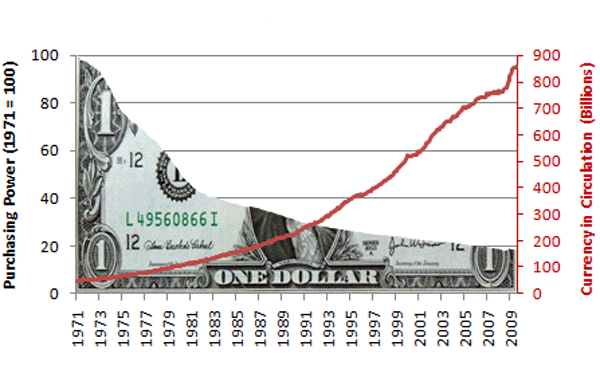
so you can see, roughly, that purchasing power of the dollar does go down with an increase in money circulation. this means that back when we could buy a candy bar for a nickle, there was less actual money in circulation back then.
So let's look to see if the money in circulation has increased lately, I'm using two graphs here because one might be misleading:

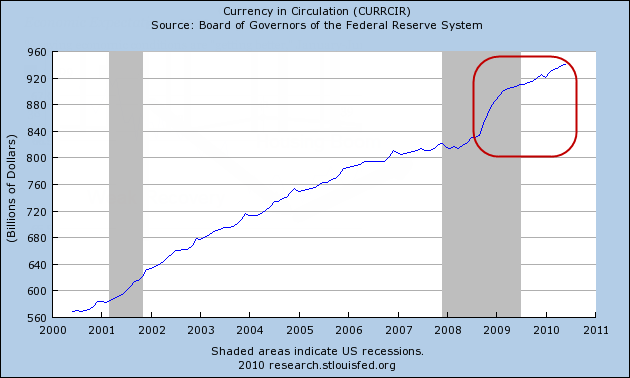
Make sure you look at the years at the bottom of those graphs okay?
So, now we know that *circulation* is increasing; if money were blood, this would be blood pressure. the pressure has build up and it's leaving less room for prices. Or, with more money in circulation each person has more money, but the number of goods being sold remain the same, to keep things balanced the price will rise.
But let's look at just one more thing, because "curculation" is a big word:

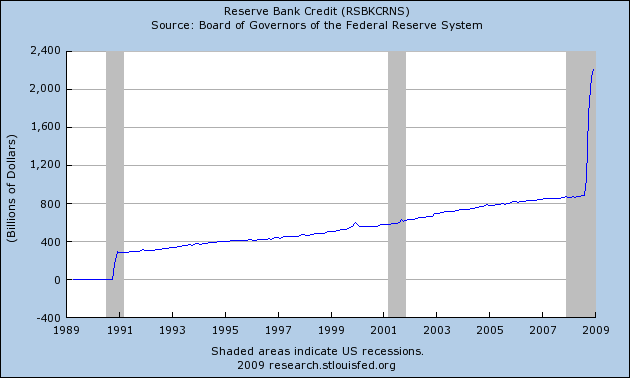
two graphs again, but they show the same thing. The big increase recently was in reserve bank credit. You've heard of this, it's called the fed rate.
The Fed rate is when the fed gov't loans money. Simple. except here's the thing: right now the fed rate is lower than inflation or banking interest rates. Uh? that means that if the bank can make as much money as inflation then it is making a profit by borrowing money. So the banks buy more credit, because it means they make more money.
If you don't understand that, suffice to say that the money being provided in the market is a loan to the banks-they will have to pay it back, but at a devalued rate (one that doesn't match inflation).
After the banks get it, in order to make money, they loan it out to you (the banks are not eligible for it unless they have started running out of money, so to make money this way they have to be more in debt than they are out of it).
Once the money gets to you, you spend it, you pay back the bank, they make money, they pay back the fed, the fed loses [normative]money. The banks make money at the expense of the tax payer, who loses money as both the customer and the . . . well the relationship between the fed and the tax payer is complex, but the fed "pays taxes", which could lower your taxes, but won't because it's losing normative dollars.
the fed, by printing money, which it loans at a loss to banks, is causing an increase in the supply of money, in the form of consumer debt, which causes inflation.
And to put all this into perspective, here's one more chart:

[this explanation may be distributed, please give credit to doctor100]
i have not however seen any actual official statistics . . .
so I looked them up.
Here are a few graphs that will help you understand exactly what is happening. first, let's compare purchasing power to money supply:
so you can see, roughly, that purchasing power of the dollar does go down with an increase in money circulation. this means that back when we could buy a candy bar for a nickle, there was less actual money in circulation back then.
So let's look to see if the money in circulation has increased lately, I'm using two graphs here because one might be misleading:
Make sure you look at the years at the bottom of those graphs okay?
So, now we know that *circulation* is increasing; if money were blood, this would be blood pressure. the pressure has build up and it's leaving less room for prices. Or, with more money in circulation each person has more money, but the number of goods being sold remain the same, to keep things balanced the price will rise.
But let's look at just one more thing, because "curculation" is a big word:
two graphs again, but they show the same thing. The big increase recently was in reserve bank credit. You've heard of this, it's called the fed rate.
The Fed rate is when the fed gov't loans money. Simple. except here's the thing: right now the fed rate is lower than inflation or banking interest rates. Uh? that means that if the bank can make as much money as inflation then it is making a profit by borrowing money. So the banks buy more credit, because it means they make more money.
If you don't understand that, suffice to say that the money being provided in the market is a loan to the banks-they will have to pay it back, but at a devalued rate (one that doesn't match inflation).
After the banks get it, in order to make money, they loan it out to you (the banks are not eligible for it unless they have started running out of money, so to make money this way they have to be more in debt than they are out of it).
Once the money gets to you, you spend it, you pay back the bank, they make money, they pay back the fed, the fed loses [normative]money. The banks make money at the expense of the tax payer, who loses money as both the customer and the . . . well the relationship between the fed and the tax payer is complex, but the fed "pays taxes", which could lower your taxes, but won't because it's losing normative dollars.
the fed, by printing money, which it loans at a loss to banks, is causing an increase in the supply of money, in the form of consumer debt, which causes inflation.
And to put all this into perspective, here's one more chart:
[this explanation may be distributed, please give credit to doctor100]