
You are using an out of date browser. It may not display this or other websites correctly.
You should upgrade or use an alternative browser.
You should upgrade or use an alternative browser.
Is this always true?
- Thread starter TimtheEnchanter
- Start date
LOL, dude.......
http://blog.poweropt.com/2015/04/02/balance-risk-vs-reward/
http://blog.poweropt.com/2015/04/02/balance-risk-vs-reward/

Yes, the scenario is from an old blog. So what?
What was applicable then probably broke since then. You'd need to look at current prices for the stock and the options in order to get a real time answer. I could go back 4 years, look at the chart from now to then, and pick a killer trade to enter. Using 4 year old quotes in a question now just don't work.
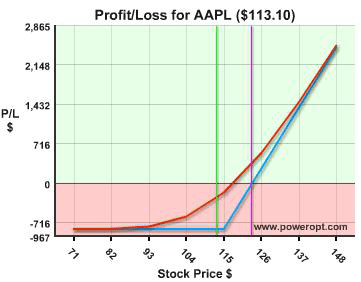
Married puts, as the example showed did not change that much. Whether AAPL was $115/share or $360, is just numbers. After all, the options adjust to the change in underlying. I am talking about philosophically if this (married puts or married calls) are indeed safer and better strategies? True, the upside is unlimited with limited risk. The key is, I suspect - they are good strategies if we can pick up options a cheaper in the money, and the stock moves in the direction we envision.
Last edited:
Well, OK. Volatility has increased the premium of options. The same scenario today, buy AAPL at $364 then buy 6 month out(January, 2021) $370 put at $35. That's about a 10% cost, and you'd have to do it twice a year. 20% annual insurance. If you think it's a good deal, then I suppose to you, it is.
Plug the numbers into your formula, see how it comes out.
Plug the numbers into your formula, see how it comes out.
Last edited:

In general, it seems to me that a large leverage can be used only when working with fundamental analysis.
And that's why we shouldn't hurry here, this is really the format that is not used on a permanent basis. Rather, it is a strategy or approach that is used only in the most profitable and profitable situations. Well, as for the fact that it should be "tried on" - it's true.
In fact, there are many original approaches in the market - it is scalping, hedging, etc. But not all traders use it.
To understand what can help you in your work from all this variety, you need to try it and only after that make final conclusions. You don't need to rush into the market.
And that's why we shouldn't hurry here, this is really the format that is not used on a permanent basis. Rather, it is a strategy or approach that is used only in the most profitable and profitable situations. Well, as for the fact that it should be "tried on" - it's true.
In fact, there are many original approaches in the market - it is scalping, hedging, etc. But not all traders use it.
To understand what can help you in your work from all this variety, you need to try it and only after that make final conclusions. You don't need to rush into the market.

Unfortunately, many traders understand that large leverage is a good income prospect, but they do forget that it is also an increased risk that can lead to large losses of capital. Especially if you work with a small amount and do not leave enough free margin. In fact, all you have to do is to do a good job of making the calculations so that you can distribute the capital correctly on the market and not engage the whole amount at once. For starters, I would recommend practicing on a demo to see how much you can afford to use in an order, so you can see how much the price can sink and what level of stop loss is allowed in this situation.

"With credit spreads, consider that for every $100 of income you make on a spread, you are risking $800 to $1,000. One maximum loss will wipe out the profits from the last 8 profitable trades."
I can't buy this...I watch my position closely and if it is in danger I wiggle out usually minimal loss. What do you think?
wiggle out? Let me ask you what strike are you selling and which are you buying?
if your risking 1k to make 100 I’m assuming you are selling DOTM? in that case what’s the probability of touching your short strike? Most likely it’s probably >50%.
In addition, I have a different question on a safer option play. Married put. Here is a scenario. How is this safer? APPL may go up and down a lot never making a new major bull run, in today's climate, you have spent a thousand for the option/insurance. Even with a dividend-paying stock, this is just as dubious.
the conservative options approach:
You are long a call, why don't you just buy the call?