Is it possible to increase the mathematical expectation?

Theoretical example:
Let’s say I create a strategy with a take profit to stop loss ratio of 1:3, which would result in having a win-rate of 75%. That’s a edgeless(Zero expected value) strategy, just like almost every strategy.
1. Taking this same trade in 4 different uncorrelated assets simultaneously and
2. Practicing some anti-martingale technique by reducing lot size after 2 successful trades.
Could this result in a long term positive trade? I doubt but …
Note: The probability of losing all 4 uncorrelated trades(with win-rates equal to 75% each) should be very low. However, there could be streaks of consecutive gains and losses in trading just like gambling.

You could also try this...
https://www.elitetrader.com/et/posts/5679262/
 
Is it mathematical possible to turn a trading strategy with zero expected value(but a high win-rate), to a long-term profitable strategy by using certain risk/money management techniques such as:

You want something that works for years and years but risks blowing up once every ten years.
Then trade it with other peoples money (OPM) and collect big fees for the years it works.
Like LTCM/Niderhoffer/ARKK etc.
So you increase your profit expectation by managing OPM, which means you get to collect fees which you then don't have to give back when you eventually blowup.
Hopefully the blowup isn't 100%. Only 80% or something and your investors don't lose too much of their original investments.
 
Last edited:
You want something that works for years and years but risks blowing up once every ten years.
Then trade it with other peoples money (OPM) and collect big fees for the years it works.
Like LTCM/Niderhoffer/ARKK etc.
So you increase your profit expectation by managing OPM, which means you get to collect fees which you then don't have to give back when you eventually blowup.
Hopefully the blowup isn't 100%. Only 80% or something and your investors don't lose too much of their original investments.

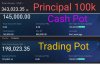
Or you could set aside the original principal and play with the house$ only... rebalancing now and then... Working on this concept since May this year...
GridArt_20221003_154245129~3.jpg
 
:thumbsup:
No that's like can I take the unpopular quirky girl in highschool and make her prom queen by shrinking her ten size smaller (smaller position size) or make her go with someone else who's prettier (diversification). With the adjustment in position size, she's still not going to get any dates but the impact is smaller because no one will notice her and through diversification, she might end up getting some attention but the prettier girl that she is going with might end up losing some potential dates because some people are put off by the fact that she's with a quirky girl.

The quirky girl is actually very pretty and funny and smart (very high win rate)but somewhat she always ends up just being unpopular and nobody wants to be with her (zero expected value). So the most obvious thing to do here is still find out why a girl like her who has such high win rate still ends up with a zero expected value and fix that so she will end up with higher expected value.
Woww, what an example :D:D:D
 
If the win rate is so high, why is the final expected value zero? There is obviously something wrong there. One should find out what's wrong there, what's causing a high win rate to result in a zero expected value at the end and go from there.
I believe every randomly entered trade(buy or sell) of an asset or option is objectively a zero expected value trade(fair pricing). If that’s not the case, why would anyone enter the market and take the opposite side of your trade?

Ofcourse, we can say some form of technical/fundamental analysis gives us an edge by timing our entry(instead of random) but that is just subjective. Simply put, I see the market as an almost complete random walk. It’s hard to prove that timed market entry is any better than a random coin flip.

Example: I buy eurusd(randomly) with a take profit of 25pips and Stop loss of 75pips. Are you telling my win-rate would still be 50/50? I expected my win rate to be 75%, bring me expected value to zero.
{25pips*75%-75pips*25%=0 pips}
Well someone might say that based on TA, that by not entering trades randomly, the above trade is still a 50/50 win-rate but again that’s subjective.

Now imagine I have a coin that heads have a 75% chance of showing up(biased). I bet on heads and every time I loose $1 or make $1, why would anyone take the other side of that bet? That’s similar to my eurusd example above(random work), isn’t it? I am looking at the market from same perspective .

I don’t know if you understand my point?

 
Last edited:
I believe every randomly entered trade(buy or sell) of an asset or option is objectively a zero expected value trade(fair pricing). If that’s not the case, why would anyone enter the market and take the opposite side of your trade?

Fear and greed push prices out of fair pricing.
 
:D
You want something that works for years and years but risks blowing up once every ten years.
Then trade it with other peoples money (OPM) and collect big fees for the years it works.
Like LTCM/Niderhoffer/ARKK etc.
So you increase your profit expectation by managing OPM, which means you get to collect fees which you then don't have to give back when you eventually blowup.
Hopefully the blowup isn't 100%. Only 80% or something and your investors don't lose too much of their original investments.
This is criminal:D:D:D. Well planned heist, just criminal :D
 
Back
Top