Is it important to define your edge mathematically? If so, how do you go about finding one?

two questions

  1. Is it important to define your edge mathematically?
  2. How.......
%%
Not really, even though others + IRS want some numbers.:D:D
[2]Some process very well with pictures + graphs. Most us were not smart enough to start+ learn with one share LOL.
Loving what you do may help. A calendar+ plan may help.
That worked real well with Mr. Ed McGivern: Field & Stream magazine figured he did more practice than any man alive.
[Delayed edit; a coin toss is much better than a coin flip] Hope this helps, it helps me.
 
There is only one true mathematical edge which will last forever or is the last edge that would disappear. That is compounding on Euler figure. You can use a trailing stop to scale in when you are in profits. That way you can make for a standard 3:1 Reward-Risk-Trade a 2.7^(3)=~20:1 RR trade. In that way you can make much more money than loosing it, without having a big edge. You only need to scale in when you are in profits and a (fixed points or same distance as percentage) trailing stop. Best way here is to make an excel sheet as I have done it, to calculate how much you can add to your winning position without increasing the initial risk. So you basically have the same initial risk through the whole trade but you can can gain multiple times more because you increased your overall position on small steps when you made more profit within that trade. Just for imagination that a good 7:1 RR trade would translate with scaling in on small steps with the law of compounding on Euler Figure which is 2.71828, here ~2.72^(7)=1100 RR times your initial risk as profit what you could make here. The law of compounding is also described elsewhere as the 8th world wunder according to Albert Einstein and other famous people. This is a true mathematical edge you can always use in your favor. Just get familiar with it. This I can recommend to every (new) trader as it is very powerful concept!
so are you a trillionaire yet? such a simple tool there must be many trillionaires doing this...
 
so are you a trillionaire yet? such a simple tool there must be many trillionaires doing this...
You do not know basic limitations. As the leverage you need is not until infinity possible I strongly guess. Second there is of course a market limitation as you cannot handle more position size than the market can handle. So with bigger sizes you need to run on the larger wheel and then it takes much more time. You must be ironic or you think I am fool, but I am not. I know the limitations. But do/did you know this ?

{In most cases it gets already difficult at 8 figures. 9 figures is very hard, even in Spot Forex. if you trade stocks or even SP Futures you do not get that much intraday leverage. And then you need to repeat and repeat this can take long. And overnight margin for larger wheels on SP Future you do not get it cheap. And with stocks you cannot do that much size. If you need to go overnight you do not get that much leverage that you can profit from compounding any fast. The margins are prohibitive to make you rich fast here. It is just not possible here. But in theory everybody can be a multi-millionaire following compounding. That is why it is called the 8th world wunder, or how to get rich (as one possible way, because there are many of course).}

And last, I did not know this early when I started. I discovered this last year totally but I knew it to some extent earlier but not with that clarity. Pity (for me). But I work hard. I an looking for a best suitable strategy for that compounding implementation myself, but I am not ready here. This is only a tool and not a complete strategy of course, you should know this. With scaling in you also need to have good running trades based on suitable strategy for that. Believe it or not. Sometimes the solution can be nearer than you think despite you are working on many other aspects of trading. This was the case with me. The key in trading or the most important aspect of trading is position sizing to get big. This is by far the most impotant single factor. If you are familiar with different position sizing methods this is your chance to complete your trading endeavor or the chances you will be a small fish forever are large.

Of course if you are good at marketing and can attract many billions of capital to trade with you just can focus how to get big your fund. But I do not rely myself on third party money here or do not want that. It is totally different game and you need to fullfill other requirements to satisfy investors so you are not that free. But all in all it is not needed to take anyone else his money to get big. It is just another elegant way what I described. But of course if you want to follow the path of Blackrock for example and want to manage as much money from third parties, it is also a way. But this is more selling or sales rather than trading. This forum is about trading and not getting big money for own funds to trade with.

Your way of creating an own fund to attract outside investors is not my way as it would be only distracting me from my own trading. I do not want to be involved in investors relationships and discussion and all the other legal work you need to do when you run your own fund. I only want to trade. That's it for me. Do not forget this forum is about trading and not about sales or how to do pitches to investors or any other marketing stuff as you are doing and letting us know this in your previous posts (in other threads).
 
Last edited:
two questions
  1. Is it important to define your edge mathematically?
  2. How do you go about trying to find an edge?
That's smart!
How would you define using mathmatics in trading?
OP failed to reply, my guess is OP started a thread and doesn't understand his own question.

It's like asking a technical question, if you have no experience in that, when you get replies, you can't understand them either so the question is in vain in the first place.

If you can't discuss your question, how are you going to discuss or comprehend the answers?
 
You must be ironic or you think I am fool, but I am not.
In my posts I describe and discuss trading and strategies to generate a pnl, based upon my experience and research, as a portfolio manager and trader. Whether I work at a hedge fund or trade my own capital does not change my view on how to generate alpha and pnl.

You might not be a fool but you might be confused for one by mistaking the certainty of euler and compounding with risk in the market. To be clear, the underlying assumption of your strategy is that your trades will be consistently profitable. Only in that scenario does increasing your position not simultaneously increase your risk. That your strategy is entirely based on being right all the time is the problem that I'm calling out. Any strategy that "works" because you're right all the time is not a tradeable strategy lol. Simulating the payoff of a call option is not an edge.
 
Last edited:
OP failed to reply, my guess is OP started a thread and doesn't understand his own question.

It's like asking a technical question, if you have no experience in that, when you get replies, you can't understand them either so the question is in vain in the first place.

If you can't discuss your question, how are you going to discuss or comprehend the answers?
Dude, what's your problem?

I have an outside life and a full-time job. I don't spend 24/7 on the board. I post questions and when I have time to reply, I will.

Sorry I didn't reply to your comment in the timeframe you expected.
 
Dude, what's your problem?
I have an outside life and a full-time job. I don't spend 24/7 on the board. I post questions and when I have time to reply, I will.
Sorry I didn't reply to your comment in the timeframe you expected.
Yeah but you have time inbetween to start new threads with more questions.
Mate, if you want to ask questions and expect replies but too 'busy' to reply when someone asks you a question on your own thread, then you are not worth the time of day, you're full of bs.
 
two questions

  1. Is it important to define your edge mathematically?

  2. How do you go about trying to find an edge?
Trading edge mathematically allows you to objectively assess and measure how effective your strategy is. By using mathematical calculations , such as win rate you can determine if your strategy has a higher probability of making profits. This approach provides a clear framework for evaluating and improving your trading strategy.
 
Trading edge mathematically allows you to objectively assess and measure how effective your strategy is. By using mathematical calculations , such as win rate you can determine if your strategy has a higher probability of making profits. This approach provides a clear framework for evaluating and improving your trading strategy.

Is that you, ChatGPT? :)

Win rate as an isolated metric is meaningless.

The only thing that matters is if your profit more than you lose and that can come about in very different ways.

High win rate strategies generally have an inverse R/R relationship as you'll risk the same or more than you win. In practice, this can mean periods of good performance, but where a slump in performance takes away a lot of prior profits as you simply lose a lot more than you win.

Lower win rate strategies generally have (or should have) a positive R/R relationship where you'll risk far less than you stand to gain.

Of course, optimal trading have a high win rate and a positive R/R relationship, but this is out of grasp for most and usually leads to disappointment where one could have actually been profitable if one accepted a lower win rate.

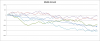
Risk 50/gain 150 with a 30 % win rate:

upload_2023-5-27_13-45-51.png


Risk 50/gain 50 with a 55 % win rate and you're not really going anywhere:

upload_2023-5-27_13-47-22.png


Risk 50/gain 50 with a 75 % win rate and it looks better:

upload_2023-5-27_13-48-12.png


Now, most scalpers typically risk more than they gain to win, so maybe this is more realistic.

Risk 75/gain 50 with a 55 % win rate and your expectancy is negative:

upload_2023-5-27_13-49-30.png


You'd need a 70 % win rate with this R/R to just have a fighting chance:

upload_2023-5-27_13-50-16.png


With an 80 % win rate risking 75/gain 50 it looks pretty good. Now, can you sustain a 80 % win rate? Most can't.

upload_2023-5-27_13-51-5.png


The conclusion from my POV is that most people are better off making sure they as a minimum risk the same as they stand to gain, but preferrably make sure they only risk half of what they stand to gain. That way, you can succeed without always getting it right.

 

Attachments

  • upload_2023-5-27_13-50-5.png
    upload_2023-5-27_13-50-5.png
    70.6 KB · Views: 3
Is that you, ChatGPT? :)

Win rate as an isolated metric is meaningless.

The only thing that matters is if your profit more than you lose and that can come about in very different ways.

High win rate strategies generally have an inverse R/R relationship as you'll risk the same or more than you win. In practice, this can mean periods of good performance, but where a slump in performance takes away a lot of prior profits as you simply lose a lot more than you win.

Lower win rate strategies generally have (or should have) a positive R/R relationship where you'll risk far less than you stand to gain.

Of course, optimal trading have a high win rate and a positive R/R relationship, but this is out of grasp for most and usually leads to disappointment where one could have actually been profitable if one accepted a lower win rate.

Risk 50/gain 150 with a 30 % win rate:

View attachment 315853

Risk 50/gain 50 with a 55 % win rate and you're not really going anywhere:

View attachment 315854

Risk 50/gain 50 with a 75 % win rate and it looks better:

View attachment 315855

Now, most scalpers typically risk more than they gain to win, so maybe this is more realistic.

Risk 75/gain 50 with a 55 % win rate and your expectancy is negative:

View attachment 315856

You'd need a 70 % win rate with this R/R to just have a fighting chance:

View attachment 315858

With an 80 % win rate risking 75/gain 50 it looks pretty good. Now, can you sustain a 80 % win rate? Most can't.

View attachment 315859

The conclusion from my POV is that most people are better off making sure they as a minimum risk the same as they stand to gain, but preferrably make sure they only risk half of what they stand to gain. That way, you can succeed without always getting it right.
Did you do a monte carlo sim for this? The charts are very helpful to see the #s play out visually.
 
Back
Top