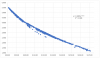
Is 100 a good enter point for TLT ?

its a JPMC self direct account and I'm only going to short cash secured put, my question is would TLT really goes to zero?
The lowest value was around 80, so it's very unrealistic that it falls below that.
Just watch the 5+ years chart...
At 80 your loss would be $17.65, that is about 18%.

It seems you want to preserve your wealth, ie. protect it against inflation etc.
If you tell more about your objective, then people here can show you better alternatives with more profit and less risk.
 
Last edited:
The lowest value was around 80, so it's very unrealistic that it falls below that.
Just watch the 5+ years chart...
At 80 your loss would be $17.65, that is about 18%.

It seems you want to preserve your wealth, ie. protect it against inflation etc.
If you tell more about your objective, then people here can show you better alternatives with more profit and less risk.
I and my wife have a chase mutual checking account which we constantly have about 100k as emergency fund and want it to stay with chase, the deposit saving rate with chase is currently .01%, and any purchase of CD need to make a phone call which is a great hassle. My goal is to archieve some return like 1-3%, but really limiting the downside risk. I don't mind to constantly monitor and adjust my position but don't want to see the account suddenly swing by -12% which will give my wife an heart attack.
 
I and my wife have a chase mutual checking account which we constantly have about 100k as emergency fund and want it to stay with chase, the deposit saving rate with chase is currently .01%, and any purchase of CD need to make a phone call which is a great hassle. My goal is to archieve some return like 1-3%, but really limiting the downside risk. I don't mind to constantly monitor and adjust my position but don't want to see the account suddenly swing by -12% which will give my wife an heart attack.
Then you better go safe and trade spreads, like Bull Put Spread.
Here's more info: https://www.investopedia.com/terms/b/bullputspread.asp
The risk is predetermined, so no surprise is possible.
 
Last edited:
I and my wife have a chase mutual checking account which we constantly have about 100k as emergency fund and want it to stay with chase, the deposit saving rate with chase is currently .01%, and any purchase of CD need to make a phone call which is a great hassle. My goal is to archieve some return like 1-3%, but really limiting the downside risk. I don't mind to constantly monitor and adjust my position but don't want to see the account suddenly swing by -12% which will give my wife an heart attack.

You're currently paying $1,350 per year to keep that 100K with Chase.
CIT Bank has a "Savings Connect" account that allows transfers to a CIT "eChecking" account.
Put 99K in the savings @ 1.35% and 1K in the eChecking. Transfer if/when needed for an emergency. ***This if for eChecking only though so no paper checks. Might not work for your situation. Many payments though are online now so should work for most bills.
I recently moved my emergency funds to CIT out of Wells Fargo for the same reason.

Also, there are several online-only banks that currently pay 1.5-1.8% in a savings account. Connect the account to Chase for free ACH transfers. This transfer takes about 3 days though.

***Everything can be done online without phone calls.

CIT.png
 
Look at the weekly chart of tlt head and shoulder pattern
I think it's heading to 135 and if it fails you will see $100 in no time. Right now buy tlt toll 135.
 
You could place your money now in TBF and wait until the US Fed has finished increasing the interest rate. By that time you could consider to move out of TBF and into TLT.
TBF is the inverse of TLT; this is the weekly chart:
tbftlt.png
 
What about the following trade? It's based on market data on last Friday 30 minutes before market close:

Covered Put (aka Cash-Secured Put):
ticker=BBBY ExpDate=2024-01-19 (DTE=560 days) Stock=5.09 Strike=8.00 Premium=5.26 (IV=129)
If stockprice stays the same at expiration then PL=+85% (up to max +192% possible if at expiration stock is higher).
This means annualized PL=+50% if stock stays at same level at expiration (up to max +101% if stock is higher).
Break/Even at spot=2.70 (that's -47% off from current spot).

Here's the P/L diagram:
https://optioncreator.com/studbhh

One can additionally buy a Long Put (for example Strike=1.00) to make it a Bull Put Spread. By this, the risk gets (further) reduced.

The following data is "as of now" (ie. pre-market data on today Monday):

BBBY_Put_2024-01-19_as_of_2022-07-11-Mo-BM.png


And that's the underlying stock data & chart:

BBBY_stock.png
 
Last edited:
Formulas used in above example:
Code:
With Covered Put (aka Cash-Secured Put) the basis for PL calculation is of course this formula:
  CostBasis = Strike - Premium
In the above example it's 8.00 - 5.26 = 2.74

PL at same spot (5.09) at expiration is (see optioncreator page) $2.35

PLpct = PL   / CostBasis * 100
      = 2.35 / 2.74      * 100
      = 85.76 %

And the formula for annualized PLpct is:
  PLpctAnn = 100 * pow(1 + PLpct / 100, 365 / DTE) - 100
           = 100 * pow(1 + 85.76 / 100, 365 / 560) - 100
           = 49.72 %

Above it was calculated as 50%. This is due to rounding effects by human calculator.
 
Last edited:
$100 is certainly a good price. I've been selling laddered puts across the board at the $90, 95, and 100 strikes.

This is all a play on rates. At $100, the 30 year Treasury yields ~4%. Around $85 the yield hits 5%. We will enter recession before yields hit 5%, in which case long duration Treasuries will be one of the best assets to own.
 

Attachments

  • Capture.PNG
    Capture.PNG
    27.6 KB · Views: 12
$100 is certainly a good price. I've been selling laddered puts across the board at the $90, 95, and 100 strikes.

This is all a play on rates. At $100, the 30 year Treasury yields ~4%. Around $85 the yield hits 5%. We will enter recession before yields hit 5%, in which case long duration Treasuries will be one of the best assets to own.

This is the insight I'm looking for, but how do you know TLT = 100 is equivalent to 4% yield?
 
Back
Top