
You are using an out of date browser. It may not display this or other websites correctly.
You should upgrade or use an alternative browser.
You should upgrade or use an alternative browser.
Investing in stock market indices via option spreads beats buffet?
- Thread starter Trading Education Buyer
- Start date


Nice curve fitting...
It is an exercise to see which option spreads /deltas perform the best , for investing in long options in s and p.
This makes 3,000 ticks in 20 years , it is equivalent to 150 ticks a year .3,000 ticks a year is almost 3 times the size of S and P
Last edited:
JackRab, it doesn't sound like he grasps that concept, among other fundamental ideas.It is an exercise to see which option spreads /deltas perform the best , for investing in long options in s and p.
This makes 3,000 ticks in 20 years , it is equivalent to 150 ticks a year .3,000 ticks a year is almost 3 times the size of S and P
View attachment 167624
If you want to claim to "beat Buffet" you need to show that you achieved a higher return with a lower risk, not simply that you had higher returns. Any jackass can throw together an options "strategy" that will give a higher return than Buffet, that's absolutely meaningless. I'd recommend the OP read up on the concept of risk adjusted return and then get back to us.
This is for geeks , I only understand drawdowns , probabilities and risk reward on options trading .......but in simple layman's terms .
There is nothing to compare with similar methods .
Investing in stock market indices via option spreads beats buffet?
http://www.investopedia.com/articles/optioninvestor/02/071702.asp
An S&P 500 Bull Put Spread
If you look at the September 2002 put options on S&P 500 futures, you will see there were some very fat premium to sell at that point. We could have establish a put spread using the 800 x 750 strike price, which is about 12% out of the money. Exhibit 1 below contains the prices for such a spread, which are based on settlement of September futures on July 12, 2002, at 917.30.
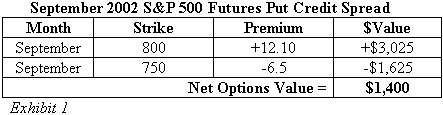
Bear in mind that the amount of premium collected is for one spread only. Each point of premium is worth $250. We were selling the September put at the 800 strike for $3,025 and buying the September put at the 750 strike for $1,625, which left a net credit in our trading account, or a net options value equal to $1,400. If we had done nothing and this trade expired fully in the money (September futures at or below 750), the maximum risk would have been $12,500 minus the initial premium collected, or $11,100. If the spread had expired worthless, we would've been able to keep as profit the entire premium amount collected. Keep in mind this example is exclusive of any commissions or fees since they can vary by account size or brokerage firm.
An S&P 500 Bull Put Spread
If you look at the September 2002 put options on S&P 500 futures, you will see there were some very fat premium to sell at that point. We could have establish a put spread using the 800 x 750 strike price, which is about 12% out of the money. Exhibit 1 below contains the prices for such a spread, which are based on settlement of September futures on July 12, 2002, at 917.30.
Bear in mind that the amount of premium collected is for one spread only. Each point of premium is worth $250. We were selling the September put at the 800 strike for $3,025 and buying the September put at the 750 strike for $1,625, which left a net credit in our trading account, or a net options value equal to $1,400. If we had done nothing and this trade expired fully in the money (September futures at or below 750), the maximum risk would have been $12,500 minus the initial premium collected, or $11,100. If the spread had expired worthless, we would've been able to keep as profit the entire premium amount collected. Keep in mind this example is exclusive of any commissions or fees since they can vary by account size or brokerage firm.
Trading Education Buyer,
You took the trouble to offer us your strategies and I felt I owed it to you to try understand what you were trying to say. So I read and reread all your posts on this thread several times and now I actually understand what you were trying to say.
Very interesting concepts. Have you made those trades with real money and were the outcome as you expected?
Regards,
You took the trouble to offer us your strategies and I felt I owed it to you to try understand what you were trying to say. So I read and reread all your posts on this thread several times and now I actually understand what you were trying to say.
Very interesting concepts. Have you made those trades with real money and were the outcome as you expected?
Regards,
Trading Education Buyer,
You took the trouble to offer us your strategies and I felt I owed it to you to try understand what you were trying to say. So I read and reread all your posts on this thread several times and now I actually understand what you were trying to say.
Very interesting concepts. Have you made those trades with real money and were the outcome as you expected?
Regards,
live calls here
technical analysis dax signal
You should read my other threads on the edge
I make money on my strategies
There are issues , let us say stock markets drop 10/20% , premiums for buying options will rise , so you just have to sit patiently for cheap options
This is also how I trade sometimes
why don''t people just sell options instead of trading minis?
why don''t people just sell options instead of trading minis?