"Inflation has risen largely due to transitory factors" -- J. Powell

Just-in-Time-Delivery isn't quite finished trying to kill us yet.

Those shipping costs and scheduling uncertainties propagate into the economy in ways that aren't completely clear yet because we haven't seen anything like this in the industrial age.

I guess I just experience inflation more directly because I'm buying marine plywood and resins etc and prices for those have exploded. I notice inflation at the grocery store but its just anecdotal. Gas went up a little here but nothing crazy.


Two different friends went to Home Depot and the price of wood practically doubled. PE waxes and resins have seen a surge in raw material costs due to shortages (some refineries have not been able to produce as much and demand has spiked). Wood costs is mostly inland transportation but also a surge in demand as people are doing more building and construction too.. It will keep going like this for several months.
 
Not all shipping costs are universal and producers still have to be competitive with their price points if they want to stay in business. What may happen is a lot of goods just end up sitting, collecting dust at the ports too.

We saw a large jump in Q1 because it is a YOY measurement and the previous year’s Q1 was a deflationary quarter. I think a lot of people took the headline, are pissed at their grocery bill and can’t get passed the inflation monster.

It’s my opinion and I think you’re a considerate person but I’m just saying I think a lot of people are looking for things to go one way and they are going to go another. Also, deflation in a lot of ways can be much worse than inflation.


With logistics costs, it is affecting everyone across the board so competitiveness does not matter when everyone is raising prices. It is not 100% the reason for the inflation but the reason why it is so large and looks seasonal. Deflation is not coming because the cost to bring things in is still so high and demand is 3x or 4x what it was last year during COVID..... every market I serve is seeing demands like never before so there is no need to lower prices.
 
My wife states that costo food runs that used to cost 400 about 2 years ago here in San Diego are now 600 or more. (and I have heard others share similar analysis.)


I have noticed that a burgers at fast food burger places are up at 20 percent or more in the last 2 years. (not "in and out" but others)


Look at COSCTO water... was like $2-$3 for their large case of kirkland water and now it is $4 - $6. Not a big deal since that is still cheap for 36 or 40 bottles of water but water is not more expensive totally...... shipping is.
 
  • Like
Reactions: jem
With logistics costs, it is affecting everyone across the board so competitiveness does not matter when everyone is raising prices. It is not 100% the reason for the inflation but the reason why it is so large and looks seasonal. Deflation is not coming because the cost to bring things in is still so high and demand is 3x or 4x what it was last year during COVID..... every market I serve is seeing demands like never before so there is no need to lower prices.

Ok. We’ll see soon enough.
 
Ok. We’ll see soon enough.


There are other factors playing into inflation such as the market surge and labor market coming back and economy chugging along but in the immediate short term the spike in supply chain costs is going to raise prices on everything everywhere and it already started at the end of Q1 and shows no signs of slowing down all year.
 
There are other factors playing into inflation such as the market surge and labor market coming back and economy chugging along but in the immediate short term the spike in supply chain costs is going to raise prices on everything everywhere and it already started at the end of Q1 and shows no signs of slowing down all year.
shipping.jpg


Yup... people think I am exaggerating but there is a price increase surge coming down through the supply chain since March and it is going to lead to some significant short-term inflation.

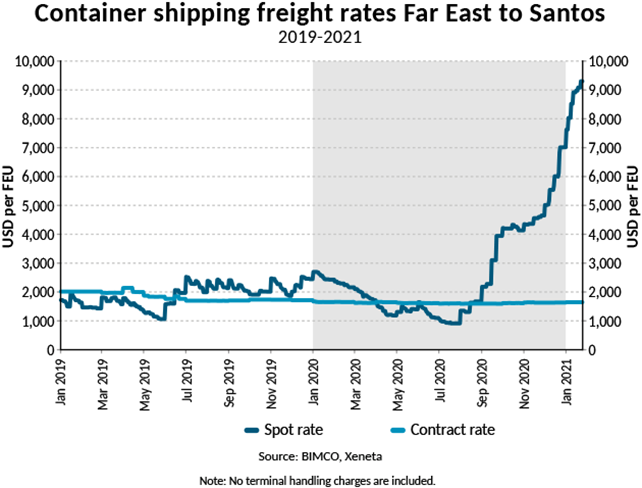
It startedd in SEPT - NOV when economies started opening up and the demand for the XMAS season put a strain on space and equipment but that was not filtering down. BUt since March......freight rates alone to the U.S. from Asia which were $3000 a container are hitting $12,000 a container in June. That is a huge meatball that is no longer being absorbed but being passed on from importer to distributor to supplier to customer.

I am in the import export biz and this is expected to stay tight until 1Q 2022....
 
https%3A%2F%2Fd6c748xw2pzm8.cloudfront.net%2Fprod%2F780f07d0-55b3-11eb-8ad2-0fd063927e05-standard.png


Started getting higher after November really...

The below chart is Asia to Brazil which grew 250% but this same surge is happening ASIA to U.S. and Latin America.

chart1bimco-28f3.png
 
Maybe it's not so "transitory"

Economic growth projections signal multiyear container shipping upturn

...

But what about demand? Looking at the past decade after the financial crisis, global container demand has grown basically in line with global economic growth as measured by GDP. Looking at any individual year, such a link is not always very accurate — and tends to fluctuate quite a bit — but seen over a longer time span, the growth trends match relatively well. In the “old days,” there was a multiplier effect driven by the waves of outsourcing and the containerization process itself, but that effect basically came to a natural conclusion more than a decade ago.

Given this link between the global economy and the container trade and the latest GDP data from the International Monetary Fund in its April 2021 World Economic Outlook, we can project global container volumes to grow approximately 18 percent from 2021 to 2024.

In other words, demand will still grow faster (18 percent) than capacity (14 to 15 percent) over the next several years.

Let us not forget that in this period, we will also see vessels scrapped to make way for newer, larger, more efficient ships. A container vessel typically has a lifespan of 25 years. Simplistically, this should imply a 4 percent demolition rate per year, but that would be misleading, as old vessels are also relatively small. It is therefore more reasonable to expect a 1 to 2 percent scrapping rate in terms of actual capacity. But even using the lower value of only 1 percent scrapping would lead to a net fleet growth of just 10 percent in the near term against demand growth of 18 percent.

Hence, what the numbers are telling us “co-drivers” is that around the curve, we are looking into a market in which demand is growing faster than capacity, indicating a cyclical upturn. The carriers could, of course, start to order even more vessels, but anything ordered now won’t be delivered until late 2023 at the earliest. That signals a strong market in favor of the carriers for at least the next couple of years, unless demand growth falters significantly, which is unlikely given expected global economic growth

 
Port of Los Angeles has not managed to clear the ships anchored outside the harbor and say they only have 2 gangs per ship. The union there is going to train up a bunch of people to skilled positions. Opportunity of a lifetime for some of those people to make good money.

Oakland is screwed more than any other port on the west coast. They won't be able to clear the backlog before the seasonal increase and its going to be a real mess there. They are also understaffed and hiring.

As mentioned, increased fees will be passed onto to consumers but you can't deliver products when you don't have parts so expect some products to be unavailable this summer. Things are supposed to recover in the fall.

Its gonna be a long, hot and expensive summer. I happen to believe in the pent-up-demand theory so the inflation contribution from this sector is going to be significant.
 
Back
Top