What will be the result of the unlimited Fed money printing?
I think it is important to understand that the primary money Printing step occurs when the Fed must add a net amount to the Treasuries Reserve Account in order for the Treasury's checks to clear. Keep in mind that this is a purely functionary Role that the Fed plays, and they can not use any discretion in playing this role. The Treasury is obligated by the U.S. Constitution to pay all the Federal Treasury obligations. The amounts of Treasury spending are strictly determined by fiscal policy as dictated by Congress. The Fed has no flexibility in this matter.
The Fed's only flexibility is in regard to monetary policy. The Fed can itself appear to create money when it wants to buy bonds on the secondary market. But this operation is really simply exchanging one kind of money for another, and the bonds it buys (normally) are the same bonds the Treasury sold. When the Treasury sold those bonds, money flowed to the Treasury's reserve account. When the Fed buys those same bonds, Money flowed from the Fed's Account into the private sector and the private sectors bonds flowed back to the Fed. At the end of the accounting period any net profits of the Fed are transferred to the Treasury's reserve account. When you look at the consolidated books of the Treasury and the Federal Reserve side-by-side it is immediately obvious that the two are really one, and the only net money printing occurs when a deficit is created, and the deficit therefore equals to the penny the net money creation.
It soon will become clear to you that all of these bond operations, whether by Treasury or Fed, are simply an exchange of one kind of money for another, the other being an interest-paying kind of money, between the federal side and the private sector. The only net money creation step occurs when the Fed credits the Treasury Reserve Account to cover a net shortfall. The deficit is the "debt".
But there is really no Federal debt. Just a deficit which can be either too big or too small depending on circumstances. And it doesn't have to ever be "paid back", but it must be well managed. The net deficit is simply the same thing as the amount of net money furnished to the economy so that commerce can be carried out without excessive inflation or excessive deflation.
One constraint that needs long-term consideration is bond interest servicing, or what we mislabel as "debt" servicing. This is a type of non-discretionary spending that might crowd out discretionary spending if it is allowed to grow too large relative to the economy.
A further concern is the reserve status of the U.S. Dollar. The dollar is currently sharing this status with other currencies . If the Dollar becomes less and less used for international commerce, Central Banks will seek to reduce their dollar denominated assets and this could potentially have profound, rather negative impact on the Dollar.

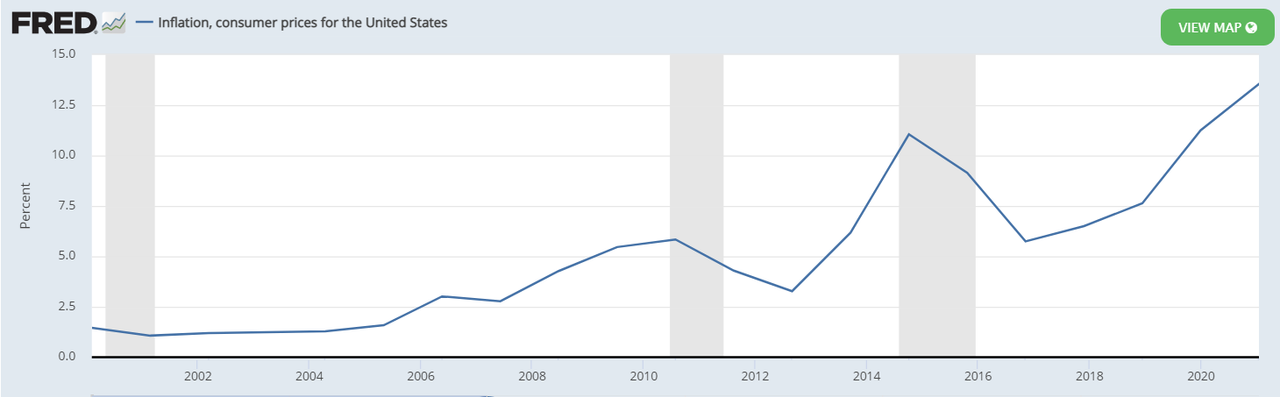
. it seems inflation is something we can live with for the time being. (yeah because the FED actions said so