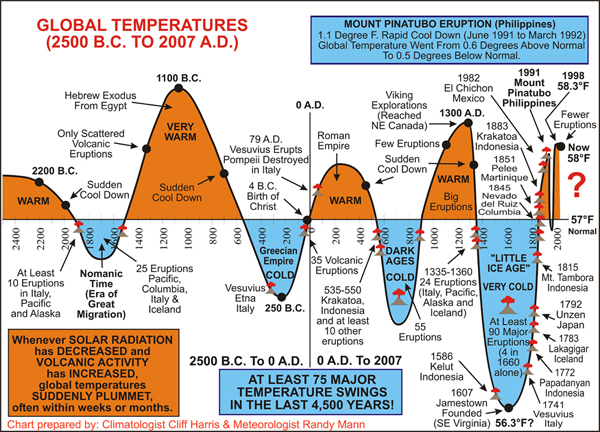
the arctic was warmer too....
http://www.co2science.org/subject/m/summaries/mwparctic.php
Medieval Warm Period (Arctic) -- Summary
...
Working concurrently on a floating platform in the middle of a small lake (Hjort So) on an 80-km-long by 10.5-km-wide island (Store Koldewey) just off the coast of Northeast Greenland,
Wagner et al. (2008) recovered two sediment cores of 70 and 252 cm length, the incremental portions of which they analyzed for grain-size distribution, macrofossils, pollen, diatoms, total carbon, total organic carbon, and several other parameters, the sequences of which were dated by accelerator mass spectrometry, with radiocarbon ages translated into calendar years before present. This work revealed, as they describe it, an "increase of the productivity-indicating proxies around 1,500-1,000 cal year BP, corresponding with the medieval warming," while adding that "after the medieval warming, renewed cooling is reflected in decreasing amounts of total organic carbon, total diatom abundance, and other organisms, and a higher abundance of oligotrophic to meso-oligotrophic diatom taxa."
And, as they continue, "this period, the Little Ice Age, was the culmination of cool conditions during the Holocene and is documented in many other records from East and Northeast Greenland, before the onset of the recent warming [that] started ca. 150 years ago."
In addition to the obvious importance of their finding evidence for the Medieval Warm Period, the six researchers' statement that the Little Ice Age was the
culmination, or most extreme sub-set, of cool conditions during the Holocene, suggests that it would not be at all unusual for such a descent into extreme coolness to be followed by some extreme warming, which further suggests there is nothing unusual about the degree of subsequent warming experienced over the 20th century, especially in light of the fact that the earth has not yet achieved the degree of warmth that held sway over most of the planet throughout large portions of that prior high-temperature period.
One year later, based on the use of a novel biomarker (IP25), which they described as a mono-unsaturated highly-branched isoprenoid that is synthesized by sea ice diatoms that have been shown to be stable in sediments below Arctic sea ice,
Vare et al. (2009) used this new climatic reconstruction tool - together with "proxy data obtained from analysis of other organic biomarkers, stable isotope composition of bulk organic matter, benthic foraminifera, particle size distributions and ratios of inorganic elements" - to develop a spring sea ice record for that part of the central Canadian Arctic Archipelago. And in doing so, they discovered evidence for a decrease in spring sea ice between approximately 1200 and 800 years before present (BP), which they associated with "the so-called Mediaeval Warm Period."
Contemporaneously,
Norgaard-Pedersen and Mikkelsen (2009), working with a sediment core retrieved in August 2006 from the deepest basin of Narsaq Sound in southern Greenland, analyzed several properties of the materials thus obtained from which they were able to infer various "glacio-marine environmental and climatic changes" that had occurred over the prior 8,000 years. This work revealed the existence of two periods (2.3-1.5 ka and 1.2-0.8 ka) that appeared to coincide roughly with the Roman and Medieval Warm Periods, while they identified the colder period that followed the Medieval Warm Period as the Little Ice Age and the colder period that preceded it as the Dark Ages Cold Period. And citing the works of Dahl-Jensen
et al. (1998), Andresen
et al. (2004), Jensen
et al. (2004) and Lassen
et al. (2004), the two Danish scientists said that the cold and warm periods identified in those researchers' studies "appear to be more or less synchronous to the inferred cold and warm periods observed in the Narsaq Sound record," providing ever more evidence for the reality of the
naturally-occurring phenomenon that governs this
millennial-scale oscillation of climate.
One year later,
Vinther et al. (2010) analyzed 20 ice core records from 14 different sites, all of which stretched at least 200 years back in time, as well as near-surface air temperature data from 13 locations along the southern and western coasts of Greenland that covered approximately the same time interval (1784-2005), plus a similar temperature data set from northwest Iceland (said by the authors to be employed "in order to have some data indicative of climate east of the Greenland ice sheet"). This work demonstrated that winter ð18O was "the best proxy for Greenland temperatures." And based on that determination and working with three longer ice core ð18O records (DYE-3, Crete and GRIP), they developed a temperature history that extended more than 1400 years back in time.
This history revealed, in the words of the seven scientists, that "temperatures during the warmest intervals of the Medieval Warm Period" - which they defined as occurring some 900 to 1300 years ago - "were as warm as or slightly warmer than present day Greenland temperatures." As for what this result implies, they state that further warming of present day Greenland climate "will result in temperature conditions that are warmer than anything seen in the past 1400 years," which, of course, has not happened yet. Furthermore, Vinther
et al. readily acknowledge that the independent "GRIP borehole temperature inversion suggests that central Greenland temperatures are still somewhat below the high temperatures that existed during the Medieval Warm Period."
About this same time,
Kobashi et al. (2010) had a paper published in which they had written that "in Greenland, oxygen isotopes of ice (Stuiver
et al., 1995) have been extensively used as a temperature proxy, but the data are noisy and do not clearly show multi-centennial trends for the last 1,000 years in contrast to borehole temperature records that show a clear 'Little Ice Age' and 'Medieval Warm Period' (Dahl-Jensen
et al., 1998)." However, they went on to note that nitrogen (N) and argon (Ar) isotopic ratios - 15N/14N and 40Ar/36Ar, respectively - can be used to construct a temperature record that "is not seasonally biased, and does not require any calibration to instrumental records, and resolves decadal to centennial temperature fluctuations."
much more...[/quote]