
Increases in CO2 - Causes Cooling

I have showed you this before..
when you go to powells website... he lists the papers...

read the titles...
comeback and tell us how many stated man made co2 causes warming.

you will see... less than one percent.


The first thing anyone who wishes to do a literature review needs to do is to decide what question they wish to answer. Many people seem to assume that my question was, “What percentage of scientists accept anthropogenic global warming [AGW]?” But that was not my question. Rather it was, “What fraction of peer-reviewed scientific papers reject AGW and what evidence do they present?” In other words, is there a scientific case against anthropogenic global warming? To answer that question, I needed to find peer-reviewed papers about global warming and review them sufficiently to judge whether they rejected anthropogenic global warming, or offered another alternative. One could go to the library and start reading articles, but that way would take a lifetime. Instead, I turned to the online Web of Science, a compendium of the peer-reviewed literature in all subjects. The WoS allows you to search articles by title, topic, author, date, journal, etc. in any combination.

Original Search

To find articles about global warming, one naturally uses the search term “global warming.” Some articles might be under the topic “global climate change,” so I also used that as a search term. This search produced 13,950 articles for the period 1991 through mid-November 2012. This number does not capture every article on global warming, nor every article that rejects AGW, since some might be under other keywords. What it does capture is the number and proportion of articles with topics “global warming” or “global climate change” that reject AGW as I define reject. It turns out to be a very small number and a very small proportion.

[Note: most recently, as explained on the home page, I searched for articles from 2013 with keywords "climate change." See 2013 Update II below.]

Procedures

Search the Web of Science [university access required] as follows:

Step 1
Search with:
Topic = "global climate change" (quotation marks essential)
Publication Year=1991
Document Type=Article
Enhanced Science Index only

On November 10, 2012 this gave 40 results.

Step 2
Repeat this search but substitute Topic="global warming". This gives 131 results.

But some articles will have used both "global warming" and "global climate change" and these must be subtracted otherwise they are counted twice.

Step 3
Search with Topic="global warming" AND Topic=" global climate change" in the second field. Use Publication Year=1991 and add a field for Articles or refine the search for articles only. This gives 11 results.

Therefore the total number of unique records for 1991 is 40 + 131 - 11 = 160

Repeat for each year. Or, an easier way is to do three searches for the entire period, 1991-2012, then combine the searches using the OR operator to remove the double counting. Still another way would be to export the records to Excel, then use Excel to identify and remove duplicates.

Read some combination of titles, abstracts, and entire papers as necessary to judge whether a paper rejects human-caused global warming or professes to have a better explanation of observations.

The Web of Science also lists the number of times each article has been cited, and much more. At the bottom of the search page, you can export the results to an Excel file.

Note that some papers that one might expect to find listed were classified as "Review" or "Editorial Material" by WoS. I did not count those.
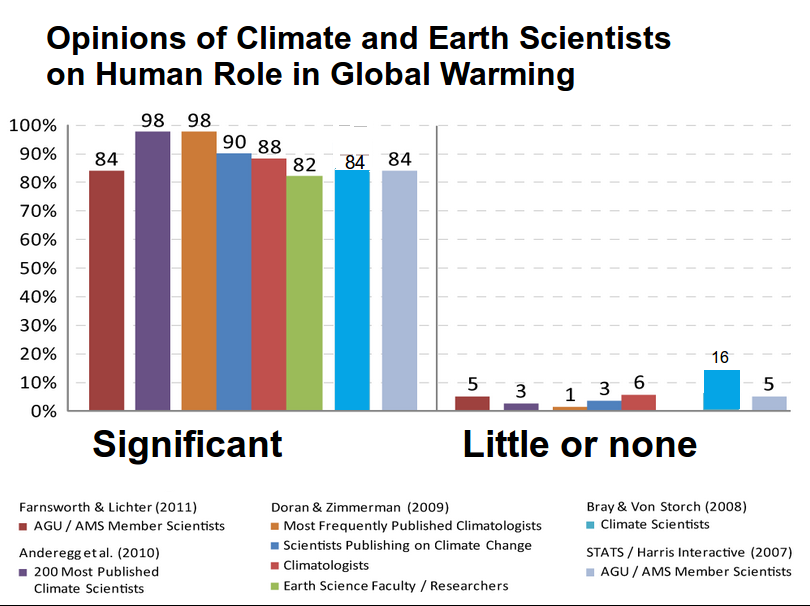
 
No jem. The number of papers denying AGW is vanishingly small. Your other statistic is meaningless. AGW is a fact in climate science and the papers will never expressly state it, just as biology papers don't expressly say evolution is true. We've been over this already, liar.
 
Climate_science_opinion2.png
 
how many times do I have to prove that you lie...

10000 papers?

I dare you to produce even 10 papers which identify science which shows man made co2 is causing warming.
 
I see you quoted Von Storch.... here is something far more recent from him... this is about 2 years old..

the models are still failing and you can say they have totally failed.


...
SPIEGEL: Yet it was climate researchers, with their apocalyptic warnings, who gave people these ideas in the first place.

Storch: Unfortunately, some scientists behave like preachers, delivering sermons to people. What this approach ignores is the fact that there are many threats in our world that must be weighed against one another. If I'm driving my car and find myself speeding toward an obstacle, I can't simple yank the wheel to the side without first checking to see if I'll instead be driving straight into a crowd of people. Climate researchers cannot and should not take this process of weighing different factors out of the hands of politics and society.

SPIEGEL: Hans Joachim Schellnhuber, director of the Potsdam Institute for Climate Impact Research, outside Berlin, is currently Chancellor Angela Merkel's climate adviser. Why does she need one?

Storch: I've never been chancellor myself. But I do think it would be unwise of Merkel to listen to just a single scientist. Climate research is made up of far too many different voices for that. Personally, though, I don't believe the chancellor has delved deeply into the subject. If she had, she would know that there are other perspectives besides those held by her environmental policy administrators.

SPIEGEL: Just since the turn of the millennium, humanity has emitted another 400 billion metric tons of CO2 into the atmosphere, yet temperatures haven't risen in nearly 15 years. What can explain this?

Storch: So far, no one has been able to provide a compelling answer to why climate change seems to be taking a break. We're facing a puzzle. Recent CO2 emissions have actually risen even more steeply than we feared. As a result, according to most climate models, we should have seen temperatures rise by around 0.25 degrees Celsius (0.45 degrees Fahrenheit) over the past 10 years. That hasn't happened. In fact, the increase over the last 15 years was just 0.06 degrees Celsius (0.11 degrees Fahrenheit) -- a value very close to zero. This is a serious scientific problem that the Intergovernmental Panel on Climate Change (IPCC) will have to confront when it presents its next Assessment Report late next year.

SPIEGEL: Do the computer models with which physicists simulate the future climate ever show the sort of long standstill in temperature change that we're observing right now?

Storch: Yes, but only extremely rarely. At my institute, we analyzed how often such a 15-year stagnation in global warming occurred in the simulations. The answer was: in under 2 percent of all the times we ran the simulation. In other words, over 98 percent of forecasts show CO2emissions as high as we have had in recent years leading to more of a temperature increase.

SPIEGEL: How long will it still be possible to reconcile such a pause in global warming with established climate forecasts?

Storch: If things continue as they have been, in five years, at the latest, we will need to acknowledge that something is fundamentally wrong with our climate models. A 20-year pause in global warming does not occur in a single modeled scenario. But even today, we are finding it very difficult to reconcile actual temperature trends with our expectations.

SPIEGEL: What could be wrong with the models?

Storch: There are two conceivable explanations -- and neither is very pleasant for us. The first possibility is that less global warming is occurring than expected because greenhouse gases, especially CO2, have less of an effect than we have assumed. This wouldn't mean that there is no man-made greenhouse effect, but simply that our effect on climate events is not as great as we have believed. The other possibility is that, in our simulations, we have underestimated how much the climate fluctuates owing to natural causes.

SPIEGEL: That sounds quite embarrassing for your profession, if you have to go back and adjust your models to fit with reality…

Storch: Why? That's how the process of scientific discovery works. There is no last word in research, and that includes climate research. It's never the truth that we offer, but only our best possible approximation of reality. But that often gets forgotten in the way the public perceives and describes our work.

SPIEGEL: But it has been climate researchers themselves who have feigned a degree of certainty even though it doesn't actually exist. For example, the IPCC announced with 95 percent certainty that humans contribute to climate change.

Storch: And there are good reasons for that statement. We could no longer explain the considerable rise in global temperatures observed between the early 1970s and the late 1990s with natural causes. My team at the Max Planck Institute for Meteorology, in Hamburg, was able to provide evidence in 1995 of humans' influence on climate events. Of course, that evidence presupposed that we had correctly assessed the amount of natural climate fluctuation. Now that we have a new development, we may need to make adjustments.
...


http://www.spiegel.de/international...lems-with-climate-change-models-a-906721.html


Back
Top