Increases in CO2 - Causes Cooling

You have no science. Only insanity. LOL CO2 does NOT cool the earth. You are an idiot.


this is science fraudcurrents... see the spike... that shows that when the solar flare arrived the co2 ejected some of the energy.

as NASA stated co2 is very efficient coolant.
I did not say it is only a coolant.

Scientists had papers saying co2 causes cooling.
Nasa Set up an experiment... and saw the earth bounce the solar flares energy back to space.

it really does not get more science than that... fraudcurrents.

both_spikes.jpg


http://science.nasa.gov/science-news/science-at-nasa/2012/22mar_saber/


Mlynczak is the associate principal investigator for the SABER instrument onboard NASA’s TIMED satellite. SABER monitors infrared emissions from Earth’s upper atmosphere, in particular from carbon dioxide (CO2) and nitric oxide (NO), two substances that play a key role in the energy balance of air hundreds of km above our planet’s surface.

“Carbon dioxide and nitric oxide are natural thermostats,” explains James Russell of Hampton University, SABER’s principal investigator. “When the upper atmosphere (or ‘thermosphere’) heats up, these molecules try as hard as they can to shed that heat back into space.”

That’s what happened on March 8th when a coronal mass ejection (CME) propelled in our direction by an X5-class solar flare hit Earth’s magnetic field. (On the “Richter Scale of Solar Flares,” X-class flares are the most powerful kind.) Energetic particles rained down on the upper atmosphere, depositing their energy where they hit. The action produced spectacular auroras around the poles and significant1 upper atmospheric heating all around the globe.

“The thermosphere lit up like a Christmas tree,” says Russell. “It began to glow intensely at infrared wavelengths as the thermostat effect kicked in.”

For the three day period, March 8th through 10th, the thermosphere absorbed 26 billion kWh of energy. Infrared radiation from CO2 and NO, the two most efficient coolants in the thermosphere, re-radiated 95% of that total back into space.
[/quote]
 
Now THIS is fascinating. The way the inverse subtext of the mesphenomena via the photochromatic ratio of the non-correlated Salby effect is causing variation in the stochastic of jem's brain cells. Just ask pie, he'll tell ya.

2010-04-16-PROPHET.png


now... in that article is an incredible comment... I would like to see the scientists debate this.. more.


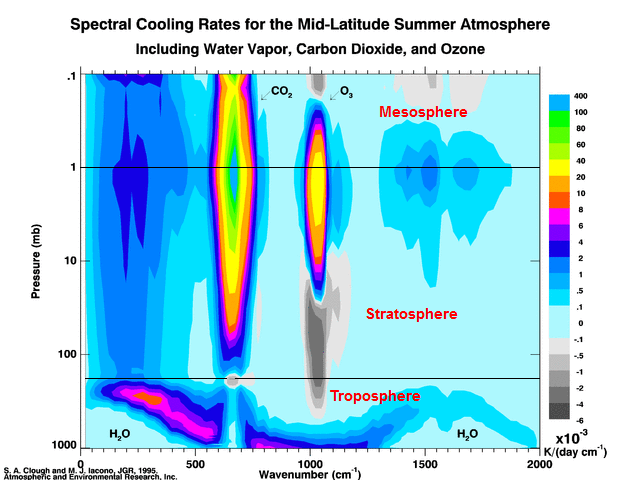
SpectralCoolingRates_zps27867ef4.png


Notice how CO2 has a cooling effect right from the lower stratosphere and up into the mesosphere, its peak cooling effect around the stratopause, while ozone has a clear warming effect in the lower stratosphere (and even into the troposphere) but a cooling effect like CO2 in the middle and upper stratosphere.

So depletion of stratospheric ozone would induce cooling (less warming) in the lower stratosphere (where most of the ozone is to be found). Cooling (enhanced) would also happen with an increase in stratospheric CO2, but here the effect would be stronger the further up the column you go.

Also worth noting from the diagram is how supremely important H2O is in cooling the troposphere (transporting absorbed heat from the sun up and away from the ground and back out towards space), and at the same time how insignificant CO2 is.

CO2 does its job in the stratosphere/mesosphere, H2O does its job in the troposphere.
 
fraudcurrents brain on crack...

Now THIS is fascinating. The way the inverse subtext of the mesphenomena via the photochromatic ratio of the non-correlated Salby effect is causing variation in the stochastic of jem's brain cells. Just ask pie, he'll tell ya.

2010-04-16-PROPHET.png
 
what warming? new paper...


Inconvenient: New paper finds the last interglacial was warmer than today – not simulated by climate models
Anthony Watts / 3 hours ago September 2, 2014
A new paper published in Climate of the Past compares temperature reconstructions of the last interglacial period [131,000-114,000 years ago] to climate model simulations and finds climate models significantly underestimated global temperatures of the last interglacial by ~0.67C on an annual basis and by ~1.1C during the warmest month.

This implies that climate models are unable to fully simulate natural global warming, and the error of the underestimation is about the same as the 0.7C global warming since the end of the Little Ice Age in ~1850. Thus, the possibility that present-day temperatures could be entirely the result of natural processes cannot be ruled out in comparison to the last interglacial period.

Further, during the last interglacial, Greenland temperatures were naturally up to 8C higher and sea levels up to 43 feet higher than today. And, during another interglacial, all of Greenland and West Antarctica melted & sea levels were 79 feet higher. Since this low-CO2 global warming occurred entirely naturally, there is no evidence that global warming during the present interglacial is unnatural or man-made.


ice_age_temperature.png

http://wattsupwiththat.com/2014/09/...r-than-today-not-simulated-by-climate-models/

here is a link to the paper...

http://www.clim-past.net/10/1633/2014/cp-10-1633-2014.html
 
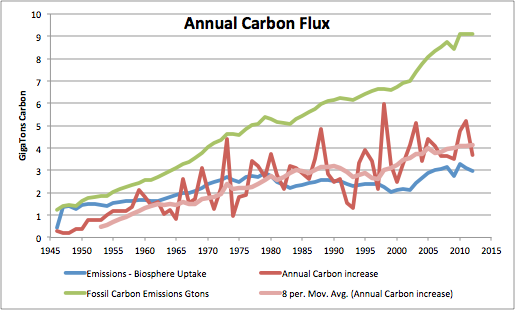
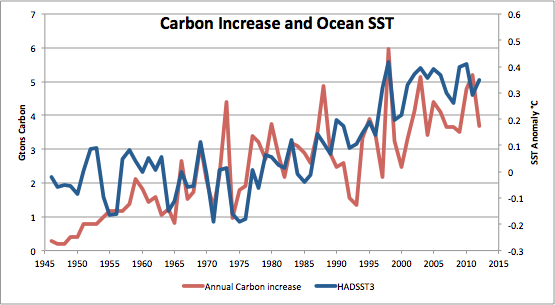
and when go more granula with your chart's data... we see...
co2 lags change in ocean temps by 12 months ... and change in air over land temps... by 9 mos.


6a010536b58035970c0177447d843a970d-pi


and we see the increase in the annual carbon matches up with naturally produced carbon... not man made carbon...
Which makes sense since as oceans warm they release co2.

so... oceans warm.. air warms... it can now hold more co2.


Caryl_11.png


Caryl_21.png


Back
Top