
You are using an out of date browser. It may not display this or other websites correctly.
You should upgrade or use an alternative browser.
You should upgrade or use an alternative browser.
Increases in CO2 - Causes Cooling
- Thread starter jem
- Start date

record cool in death valley... by 15 degrees.
http://www.washingtonpost.com/blogs...lley-was-cooler-than-missoula-mont-on-sunday/
On Saturday in Raleigh we had a new record low high temperature of a mere 70 degrees - breaking the record of 71 degrees set in 1916.
Yeah, this global warming is going to kill all of us.

Drop the methcrackinol. There is something seriously wrong with you.
Yeah, I was referred to your white paper in the American Journal of Unemployed Realtors.
Jeezus, another alias already? WTF?
Jeezus, another alias already? WTF?
Yes, JJ! Ain't it grand?
Global warming is the long-term, cumulative effect that greenhouse gases, primarily carbon dioxide and methane, have on Earth's temperature when they build up in the atmosphere and trap the sun's heat. It's also a hotly debated topic. Some wonder if it's really happening and, if it's real, is it the fault of human actions, natural causes or both?
When we talk about global warming, we're not talking about how this summer's temperatures were hotter than last year's. Instead, we're talking about climate change, changes that happen to our environment, atmosphere and weather over time. Think decades, not seasons. The term global warming itself is a bit deceptive because it implies we should expect things to get hotter -- not necessarily stormier, drier and even, in some instances, colder. Climate change impacts the hydrology and biology of the planet -- everything, including winds, rains and temperature, is linked. Scientists have obÂserved that the Earth's climate has a long history of variability, from the cold climes of the Ice Age to temperatures as hot as an Easy-Bake oven. These changes are sometimes noted over a few decades and sometimes stretch over thousands of years. What can we expect from a planet undergoing climate changes?
Scientists studying our climate have been able to observe and measure changes happening around us. For example, mountain glaciers are smaller now than they were 150 years ago, and in the last 100 years, the average global temperature has increased by roughly 1.4 degrees F (0.8 degrees C) [source: EPA ]. Computer modeling allows scientists to predict what could happen if the climate pattern continues on its current course, projecting, for instance, that temperatures could rise an average of 2 to 11.5 degrees F (1.1 to 6.4 degrees C) by the end of the 21st century [source: EPA ].
When we talk about global warming, we're not talking about how this summer's temperatures were hotter than last year's. Instead, we're talking about climate change, changes that happen to our environment, atmosphere and weather over time. Think decades, not seasons. The term global warming itself is a bit deceptive because it implies we should expect things to get hotter -- not necessarily stormier, drier and even, in some instances, colder. Climate change impacts the hydrology and biology of the planet -- everything, including winds, rains and temperature, is linked. Scientists have obÂserved that the Earth's climate has a long history of variability, from the cold climes of the Ice Age to temperatures as hot as an Easy-Bake oven. These changes are sometimes noted over a few decades and sometimes stretch over thousands of years. What can we expect from a planet undergoing climate changes?
Scientists studying our climate have been able to observe and measure changes happening around us. For example, mountain glaciers are smaller now than they were 150 years ago, and in the last 100 years, the average global temperature has increased by roughly 1.4 degrees F (0.8 degrees C) [source: EPA ]. Computer modeling allows scientists to predict what could happen if the climate pattern continues on its current course, projecting, for instance, that temperatures could rise an average of 2 to 11.5 degrees F (1.1 to 6.4 degrees C) by the end of the 21st century [source: EPA ].


I think we can now just ignore jerm. He's like the ranting homeless guy on the street corner.
Surveying Biscoe's western ridgeline, where gentoo numbers had risen by about a hundred since the last breeding season, Fraser looked like a person watching his block mutate into a slum.
"Man, oh, man, this is absolutely unbelievable," said Fraser, who works out of Palmer Station, a U.S. research base. "This whole area used to be Adélie colonies. Now the gentoos are using the same nesting sites. I think Biscoe will soon be Adélie free. These birds are doomed."
Just behind us, the Marr Ice Piedmont calved with a thunderous rumble, sending a wall of blue ice cascading into the ocean. This continual booming, I was beginning to understand, was the soundtrack accompanying the disappearance of Bill Fraser's Adélies.
"A century ago this was basically a polar environment," he said. "The area embodied Antarctica. Now we have this subantarctic system impinging. I've watched the confrontation over the past 30 years, and the polar system has really disintegrated at Palmer. I'm in awe that it has taken such a short time to happen. Lesson number one for me has been the realization that ecology and ecosystems can change"âhe snapped his fingersâ"like that. In geologic time it's a nanosecond."
The western Antarctic Peninsula has warmed so drastically because of a combination of rising global temperatures and regional shifts in ocean and air currents. Worldwide, temperatures have warmed far more slowlyâan average of one degree Fahrenheit (0.56 degrees Celsius) over the past centuryâyet even that relatively small change is rippling through the natural world. Fraser's painstaking studies on the Antarctic Peninsula provide clues to how rising temperatures can profoundly affect ecosystems all over the planet, where animals, plants, and insects are already adapting to moderate climate change by shifting their ranges, advancing migration dates, and altering times of mating and flowering.
http://environment.nationalgeographic.com/environment/global-warming/eco-signs/
"Man, oh, man, this is absolutely unbelievable," said Fraser, who works out of Palmer Station, a U.S. research base. "This whole area used to be Adélie colonies. Now the gentoos are using the same nesting sites. I think Biscoe will soon be Adélie free. These birds are doomed."
Just behind us, the Marr Ice Piedmont calved with a thunderous rumble, sending a wall of blue ice cascading into the ocean. This continual booming, I was beginning to understand, was the soundtrack accompanying the disappearance of Bill Fraser's Adélies.
"A century ago this was basically a polar environment," he said. "The area embodied Antarctica. Now we have this subantarctic system impinging. I've watched the confrontation over the past 30 years, and the polar system has really disintegrated at Palmer. I'm in awe that it has taken such a short time to happen. Lesson number one for me has been the realization that ecology and ecosystems can change"âhe snapped his fingersâ"like that. In geologic time it's a nanosecond."
The western Antarctic Peninsula has warmed so drastically because of a combination of rising global temperatures and regional shifts in ocean and air currents. Worldwide, temperatures have warmed far more slowlyâan average of one degree Fahrenheit (0.56 degrees Celsius) over the past centuryâyet even that relatively small change is rippling through the natural world. Fraser's painstaking studies on the Antarctic Peninsula provide clues to how rising temperatures can profoundly affect ecosystems all over the planet, where animals, plants, and insects are already adapting to moderate climate change by shifting their ranges, advancing migration dates, and altering times of mating and flowering.
http://environment.nationalgeographic.com/environment/global-warming/eco-signs/

In Effort To Fight Pollution, Beijing Plans To Ban All Coal Use By 2020
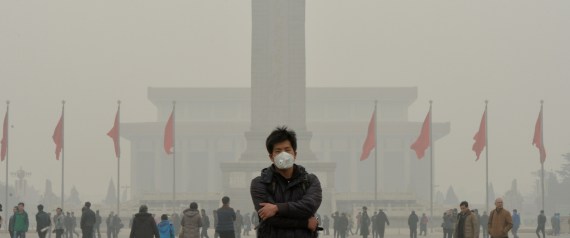
BEIJING (AP) â China's smog-plagued capital has announced plans to ban the use of coal by the end of 2020 as the country fights deadly levels of pollution, especially in major cities.
Beijing's Municipal Environmental Protection Bureau posted the plan on its website Monday, saying the city would instead prioritize electricity and natural gas for heating.
The official Xinhua News Agency said coal accounted for a quarter of Beijing's energy consumption in 2012 and 22 percent of the fine particles floating in the city's air. Motor vehicles, industrial production and general dust also contributed to pollution in the 21 million-person city.
Even with the Beijing ban, coal use is expected to soar in China. Coal-fired power and heating is a major generator of greenhouse gases and has helped turn China into the world's largest emitter of carbon and other heat-trapping gases.
Pressure is growing on China's central government to clean up the country's polluted environment, as discontent over smog and water and soil contamination increases among China's expanding middle class.
The central government recently listed environmental protection as one of the top criteria by which leaders will be judged.
In September, the government announced a prohibition on new coal-fired power plants around Beijing, Shanghai and Guangzhou.
BEIJING (AP) â China's smog-plagued capital has announced plans to ban the use of coal by the end of 2020 as the country fights deadly levels of pollution, especially in major cities.
Beijing's Municipal Environmental Protection Bureau posted the plan on its website Monday, saying the city would instead prioritize electricity and natural gas for heating.
The official Xinhua News Agency said coal accounted for a quarter of Beijing's energy consumption in 2012 and 22 percent of the fine particles floating in the city's air. Motor vehicles, industrial production and general dust also contributed to pollution in the 21 million-person city.
Even with the Beijing ban, coal use is expected to soar in China. Coal-fired power and heating is a major generator of greenhouse gases and has helped turn China into the world's largest emitter of carbon and other heat-trapping gases.
Pressure is growing on China's central government to clean up the country's polluted environment, as discontent over smog and water and soil contamination increases among China's expanding middle class.
The central government recently listed environmental protection as one of the top criteria by which leaders will be judged.
In September, the government announced a prohibition on new coal-fired power plants around Beijing, Shanghai and Guangzhou.