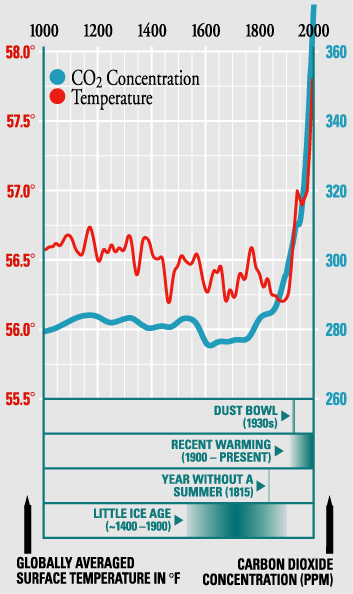
Increases in CO2 - Causes Cooling

Dr. Don Easterbrook: 'We've had 27 climate changes in the last 400 years: warm, cold, warm, cold. There have been four in this past century that have nothing to do with CO2, because CO2 wasn't a factor hundreds of thousands of years ago. We know that those are not at all related to CO2. So why would we expect climate change today to be related to CO2?'

Dr Easterbrook is a definitely an idiot. CO2 levels have always been the major determining factor of the earth's temps. Acting like the setting on the thermostat. Why should today be any different?

Why do you always choose the most obscure, minority and least qualified sources for your arguments?

Is it because you are a lying sack of shit? Of course it is. LOL
 
Myth 3: A carbon tax would destroy jobs.

If a carbon tax were scheduled to be gradually phased in once the economy recovered, its mere announcement would create jobs right away. As with any policy change, there would be winners and losers. But because an impending carbon tax would render many existing energy-using processes obsolete, it would create strong incentives for corporations to put their mountains of idle cash to work. Spending on development of more efficient processes, with attendant hiring, would be expected to begin immediately.

Myth 4: The cost of reducing CO2 emissions would be prohibitively high.


Because a steep tax on emissions would generate hundreds of billions of dollars in annual revenue, you might assume the policy would entail big costs for ordinary people. But every dollar raised by a carbon tax is a dollar by which other taxes can be reduced. The actual cost of reducing CO2 emissions would be only those costs associated with the cleaner processes we’re led to adopt, and they promise to be low. Experience in other countries, for example, suggests that a carbon tax that doubled the price of gasoline would result in cars that are more than twice as efficient as today’s.


The cost objection is further undermined by evidence that we’re already bearing high costs because of our failure to limit carbon emissions, as the White House declared in a report last week. The net cost of reducing emissions would properly include an adjustment for the corresponding reduction in weather damage.
 
Don J. Easterbrook (born January 29, 1935, in Sumas, Washington) is Professor Emeritus of Geology at Western Washington University. He has B.S., M.S. and PhD degrees from the University of Washington and has studied global climate change for five decades. Dr. Easterbrook holds that global warming is primarily caused by natural processes. He edited Evidence-Based Climate Science (2011), a book which contends that increased CO2 emissions are not the cause of climate change. He predicted lower global temperatures than the IPCC temperature projections.[1] He appeared on the Headline News Glenn Beck program[2] and has been interviewed for the New York Times.[3]


Dr Easterbrook is a definitely an idiot. CO2 levels have always been the major determining factor of the earth's temps. Acting like the setting on the thermostat. Why should today be any different?

Why do you always choose the most obscure, minority and least qualified sources for your arguments?

Is it because you are a lying sack of shit? Of course it is. LOL
 
By the way it makes sense that change in ocean temps leads change in co2.
as oceans warm they release co2.
as air warms it can hold more water vapor and co2.


"The maximum positive correlation between CO2 and temperature is found for CO2 lagging 11–12 months in relation to global sea surface temperature, 9.5-10 months to global surface air temperature, and about 9 months to global lower troposphere temperature. The correlation between changes in ocean temperatures and atmospheric CO2 is high, but do not explain all observed changes."

See: http://dx.doi.org/10.1016/j.gloplacha.2012.08.008

1-s2.0-S0921818112001658-gr5.jpg
 
By the way it makes sense that change in ocean temps leads change in co2.
as oceans warm they release co2.
as air warms it can hold more water vapor and co2.


"The maximum positive correlation between CO2 and temperature is found for CO2 lagging 11–12 months in relation to global sea surface temperature, 9.5-10 months to global surface air temperature, and about 9 months to global lower troposphere temperature. The correlation between changes in ocean temperatures and atmospheric CO2 is high, but do not explain all observed changes."

See: http://dx.doi.org/10.1016/j.gloplacha.2012.08.008

1-s2.0-S0921818112001658-gr5.jpg


Now I'm actually starting to worry about your mental health.
 
Myth 5: It’s pointless for Americans to reduce CO2 emissions, since unilateral action won’t solve global warming.

Although an effective solution will take global coordination, America’s inaction has been a major barrier to progress. If the United States and Europe each adopted a steep carbon tax, they could elicit broader cooperation through heavy tariffs on goods produced in countries that failed to do likewise. India and China need access to our markets, giving us enormous leverage.
 
Lets go back to the first post and learn about what happens when we put man made co2 into the atmosphere.


this is just what I have been concerned about.

CO2 causing Increased Cooling of Atmosphere

As demonstrated in Rescue from the Climate Saviors, increasing levels of CO2 and other IR-active gases in the atmosphere increase the natural cooling system of the earth. IR-active gases do not supply additional heating power to the earth and are not a cause of “global warming”. IR-active gases do not act “like a blanket” but rather “like a sunshade”. They keep a part of the solar energy away from the earth’s surface and act to cool the earth: 70% of the entire cooling power originates from these molecules. An increase in concentration only serves to increase the cooling efficiency, and now there is additional empirical evidence. A new paper shows that increased CO2 concentrations have increased the cooling efficiency of the upper atmosphere, and in combination with the 2008 solar minimum, resulted in the lowest upper atmospheric density recorded in 43 years.


(PhysOrg.com 6/21/10) -- A team of scientists from the Naval Research Laboratory and George Mason University reports that the Earth's upper atmosphere has recently experienced the lowest density in 43 years. The team has published its findings in a paper entitled "Record-low thermospheric density during the 2008 solar minimum" that appeared in Geophysical Research Letters in June 2010.


The team of Dr. John Emmert and Dr. Judith Lean from NRL's Space Science Division and Dr. Michael Picone from George Mason University were studying the Earth's upper atmosphere between 200 and 600 km altitude. Although the air density at these altitudes is only about one-billionth of that at the Earth's surface, it provides sufficient drag on Low Earth Orbit (LEO) objects to cause their eventual reentry. "An operational consequence of this important new finding is that LEO satellites, including debris, may remain in orbit longer than expected," explains Emmert.

To describe their results, the researchers pointed out that the air density at orbital altitudes is ultimately linked to the temperature of the upper atmosphere. A hotter upper atmosphere will expand in vertical extent and increase the air density at a given altitude. The two major factors that control upper atmosphere temperatures are heating via absorption of ultraviolet (UV) radiation from the Sun, and cooling via CO2 infrared emission.

The Sun was unusually quiet during the prolonged solar minimum of 2007-2009, and the research team found that the associated reduction in solar UV heating can partly explain the reduction in density. Increasing concentrations of CO2 near the Earth's surface are likely making their way into the upper atmosphere and are thus increasing the upper atmosphere cooling efficiency. However, it is not yet clear whether the combination of reduced solar UV heating and enhanced CO2 cooling can fully account for the occurrence of the anomalously low thermospheric density, and the researchers suggested that changes in upper atmospheric chemistry and composition may have also contributed to the record-low density.

 
when you drill down into your chart you see this.

co2 lags ocean warming and cooling.

You really need to understand this chart fraudcurrents. It will stop you dead in your lying shoes.

You will understand your side is all bullshit until they can explain this chart... or show something of their own... that can explain why co2 trails ocean warming up and down.
Is there some other cycle that shows co2 leading warming? With all the billions you nutters get for making models.. surely they can find a cycle showing co2 leading? right?


By the way it makes sense that change in ocean temps leads change in co2.
as oceans warm they release co2.
as air warms it can hold more water vapor and co2.


"The maximum positive correlation between CO2 and temperature is found for CO2 lagging 11–12 months in relation to global sea surface temperature, 9.5-10 months to global surface air temperature, and about 9 months to global lower troposphere temperature. The correlation between changes in ocean temperatures and atmospheric CO2 is high, but do not explain all observed changes."

See: http://dx.doi.org/10.1016/j.gloplacha.2012.08.008

1-s2.0-S0921818112001658-gr5.jpg
 
Back
Top