Increases in CO2 - Causes Cooling

3. here is a comment you may wish to ponder... as I think it sums up some of the issues that need to be resolved.

Scientifically speaking it is the temperature of the atmosphere that dictates how much water and carbon dioxide that the atmosphere will be able to hold in solution. As the temperature of the atmosphere goes up so the level of CO2 and H2O held in solution by the air will go up too. As the temperature of the atmosphere goes down so the level of CO2 and H2O held in solution by the air will go down too. The amount of CO2 in the atmosphere is of very little influence with regard to the retaining or discharging of solar energy. Water in the atmosphere is one hundred times more influencial than is CO2 with regard to retaining and discharging of solar energy. The most absorbent medium for retention and discharge of solar energy is the ocean and the ground. Certain rocks and materials are more absorbent whilst others are more reflective. Snow and Ice although actually water nevertheless reflect all the solar energy back into space. Where as liquid water in the oceans reflects very little and absorbs all of the solar energy. The oceans are blue only because the ocean surface is reflecting the colour of the atmosphere of Nitrogen above it. In actuality the oceans are in reality black. The atmosphere of the Earth is 85% Nitrogen.

the atomosphere is exceedingly complex and science just not understand it all yet.

<img src="http://johngushue.typepad.com/.a/6a00d83451f25369e201156fd7bce0970c-pi">


Anyway, that piece is mixing and matching, as it's considering "solar energy" as a single phenomenon when there are at least two interacting with the various entities mentioned: visible light and IR.

You could be on the right track towards a counter argument, using water vapor's ability to reflect visible light. I have not seen any reports recently on which way Earth's albedo is changing (if it is).
 
some physicists and some who claim to be physicists say co2 warms via its property as a gas and gas pressure and that the bit about emitting IR does very little.

I am sticking with NASA on this one for now... but I keep my mind open.

Yes, lot's of things do two different things. We usually are concerned with which is most important. Water is necessary for life and can also kill.

And CO2 DOES- not may - warm via the greenhouse effect. This is climate science 101 which you still have trouble grasping for some reason.

And yes it acts as a shield to block heat.
 
ricter more than one article states that more cme energy would reduce clouds which block visible light....

but this is a very good followup to the discussion about visible light.... from NOAA

I would say this just about seals the deal for my argument... that science does not know that adding man made co2 causes net warming there are far to many variables right now.


http://www.climate.gov/news-features/climate-qa/do-solar-storms-cause-heat-waves-earth

Sun and Climate Q&amp;A Banner

This is the first in a new series inspired by the Climate Q&A blog on NASA’s Earth Observatory
Although solar flares, and associated coronal mass ejections, can bombard Earth’s outermost atmosphere with tremendous amounts of energy, most of that energy is reflected back into space by the Earth’s magnetic field. Because the energy does not reach our planet’s surface, it has no measurable influence on surface temperature.

The heat wave that affected the eastern and central United States in March 2012 coincided with a flurry of solar eruptions, and it’s not unreasonable to wonder if such events are related. After all, the Sun’s energy is the source of Earth’s warmth.

But most of the energy released by solar storms like those on March 8-10 is not like the visible and ultraviolet light that penetrates Earth’s atmosphere and warms the surface. Instead, solar storms hurl bursts of electrically charged particles through space, and the particles aimed at the Earth encounter our planet’s magnetic field and upper atmosphere, the thermosphere.

The stream of energetic particles warms the thermosphere. Carbon dioxide and nitrogen oxide, coolants in the thermosphere, absorb the energy and then re-radiate heat back into space. A small fraction of the extra heat from the solar flare radiates to layers of the atmosphere below the thermosphere, but it is miniscule compared to the normal amount of heating the lower layers of the atmosphere already experience from incoming visible and ultraviolet sunlight.

Solar flares don’t cause heat waves, but they do have other impacts on Earth. Consequences include pretty auroras, as well as hazards. They can rain extra radiation on satellites, and increase the drag on satellites in low-Earth orbit. Increased electromagnetic activity due to solar storms can also disrupt power grids and radio communications. Passengers on commercial jets flying polar routes may be exposed to increased electromagnetic radiation.

Short-lived solar explosions don’t influence weather events like the March 2012 heat wave, but longer-term variations in solar output might affect Earth’s climate. The latter half of the seventeenth century experienced a decades-long stretch of minimal solar activity known as the Maunder Minimum, which many scientists suspect may have triggered the Little Ice Age—a cold spell that chilled the Northern Hemisphere from about 1650 to 1850.

Over the long term, however, multiple records indicate that the amount of energy the Earth receives from the Sun is quite stable. Astronomers have aimed telescopes at the Sun since the Scientific Revolution, and recent studies have reconstructed solar activity over the past three centuries. Satellites have observed the Sun since 1978, and found that solar activity varies on a roughly 11-year cycle by about one-tenth of one percent.

As for the solar storm in early March 2012, it released a substantial amount of energy, but almost all of it was re-radiated back into space, and very little penetrated the lower atmosphere. Martin Mlynczak, associate principal investigator for NASA’s Sounding of the Atmosphere using Broadband Emission Radiometry (SABER) instrument, says, “The extra energy from this storm is on the order of 100,000 times less than the energy we normally get at the Earth’s surface. It’s so small that you wouldn’t even notice it.”
 
The World Just Had Its Hottest June On Record
AP | By SETH BORENSTEIN
Posted: 07/21/2014 12:31 pm EDT

WASHINGTON (AP) — The globe is on a hot streak, setting a heat record in June. That's after the world broke a record in May.

The National Oceanic and Atmospheric Administration announced Monday that last month's average global temperature was 61.2 degrees, which is 1.3 degrees higher than the 20th century average. It beat 2010's old record by one-twentieth of a degree.

While one-twentieth of a degree doesn't sound like much, in temperature records it's like winning a horse race by several lengths, said NOAA climate monitoring chief Derek Arndt.

And that's only part of it. The world's oceans not only broke a monthly heat record at 62.7 degrees, but it was the hottest the oceans have been on record no matter what the month, Arndt said.

"We are living in the steroid era of the climate system," Arndt said.

Arndt said both the June and May records were driven by unusually hot oceans, especially the Pacific and Indian oceans.

Heat records in June broke on every continent but Antarctica, especially in New Zealand, northern South America, Greenland, central Africa and southern Asia.

The United States had only its 33rd hottest June.

All 12 of the world's monthly heat records have been set after 1997, more than half in the last decade. All the global cold monthly records were set before 1917.

And with a likely El Nino this year — the warming of the tropical Pacific which influences the world's weather and increases global temperatures — it is starting to look like another extra warm year, said University of Arizona climate scientist Jonathan Overpeck.

The first six months of the year are the third warmest first six months on record, coming behind 2010 and 1998, according to NOAA

Global temperature records go back to 1880 and this is the 352nd hotter than average month in a row.

"This is what global warming looks like," Overpeck said in an email. "Not record hot everywhere all the time, but certainly a reflection that the odds of record hot are going up everywhere around the planet."
 
I hope that means el nino is still on because we could use the water here in the Southwest U.S.

Plus I would not mind a few good powder winters.

The World Just Had Its Hottest June On Record
AP | By SETH BORENSTEIN
Posted: 07/21/2014 12:31 pm EDT

WASHINGTON (AP) — The globe is on a hot streak, setting a heat record in June. That's after the world broke a record in May.

The National Oceanic and Atmospheric Administration announced Monday that last month's average global temperature was 61.2 degrees, which is 1.3 degrees higher than the 20th century average. It beat 2010's old record by one-twentieth of a degree.

While one-twentieth of a degree doesn't sound like much, in temperature records it's like winning a horse race by several lengths, said NOAA climate monitoring chief Derek Arndt.

And that's only part of it. The world's oceans not only broke a monthly heat record at 62.7 degrees, but it was the hottest the oceans have been on record no matter what the month, Arndt said.

"We are living in the steroid era of the climate system," Arndt said.

Arndt said both the June and May records were driven by unusually hot oceans, especially the Pacific and Indian oceans.

Heat records in June broke on every continent but Antarctica, especially in New Zealand, northern South America, Greenland, central Africa and southern Asia.

The United States had only its 33rd hottest June.

All 12 of the world's monthly heat records have been set after 1997, more than half in the last decade. All the global cold monthly records were set before 1917.

And with a likely El Nino this year — the warming of the tropical Pacific which influences the world's weather and increases global temperatures — it is starting to look like another extra warm year, said University of Arizona climate scientist Jonathan Overpeck.

The first six months of the year are the third warmest first six months on record, coming behind 2010 and 1998, according to NOAA

Global temperature records go back to 1880 and this is the 352nd hotter than average month in a row.

"This is what global warming looks like," Overpeck said in an email. "Not record hot everywhere all the time, but certainly a reflection that the odds of record hot are going up everywhere around the planet."
 
I would say this just about seals the deal for my argument... that science does not know that adding man made co2 causes net warming there are far to many variables right now.

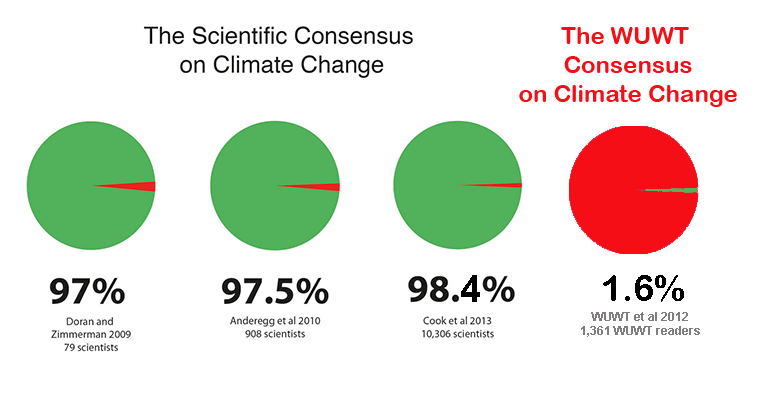
Total horseshit. The only thing that is sealed is this, science is in 97% agreement about this. You are a fucking retard.

It's very simple jerm --- you lying sack of shit --- CO2 is a GHG and we have raised it's levels 40% and that has caused the warming we are starting to see. Just starting.

Just shut the fuck up you insane lying sack of shit.

Seriously, just how fucking stupid are you?

You have three choices. Stupid. Liar. Stupid and a liar. Which one do you want?
 
there is no consensus.... when the papers were examined on 41 out of 11000 argued that man made co2 caused warming... and I read a few of them... and those were all based on failed models.

you want to have credibility start producing work like this...

and ocean temps lead co2... not the other way around...


Caryl_11.png


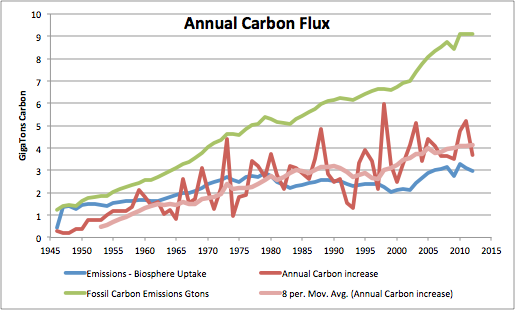
The shape of the annual carbon increase resembles the shape of the global sea surface temperature (HADSST3), especially after reliable CO2 measurements began by Keeling after March 1958. Several known events are visible. Counting backwards: the 1998 El Niño, the 1994-5 El Niño, Mt Pinatubo in 1991, the 1986-7 El Niño, Mt Ruiz in 1985, El Chichon eruption in 1982, the 1972-3 El Niño, etc. Every positive peak is an El Niño and every negative peak is associated with a major volcanic eruption.

As can be seen in Figure 1, there is no relationship between the fossil carbon emissions curve and the annual carbon increase curve. That is because all the fossil emissions carbon is taken up by the biosphere or by the oceans according to Henry’s Law, and then sequestered there. The carbon in the atmosphere is controlled by temperature. This has been described by Dr. Murry Salby in this presentations at Sydney and Hamburg. He compares the CO2 curve to the integral of temperature. Here, I am going the other way mathematically, taking the differential of the CO2 curve as temperature and comparing it to known temperature data, the HADSST3 data.

- See more at: http://notrickszone.com/2013/10/08/...-co2-and-not-vice-versa/#sthash.gBOX3Ftl.dpuf
 
...
As can be seen in Figure 1, there is no relationship between the fossil carbon emissions curve and the annual carbon increase curve. That is because all the fossil emissions carbon is taken up by the biosphere or by the oceans according to Henry’s Law, and then sequestered there.

Looks like a positive relationship to me, in spite of the volatility of the annual carbon increase. If carbon sequestration in the biosphere (and the oceans? I thought you said they out gas CO2 when they warm...) is the primary reason for the troughs in that line, I'd say it's not keeping up with our emissions.
 
there is no consensus.... when the papers were examined on 41 out of 11000 argued that man made co2 caused warming... and I read a few of them... and those were all based on failed models.

you want to have credibility start producing work like this...

and ocean temps lead co2... not the other way around...


Caryl_11.png


The shape of the annual carbon increase resembles the shape of the global sea surface temperature (HADSST3), especially after reliable CO2 measurements began by Keeling after March 1958. Several known events are visible. Counting backwards: the 1998 El Niño, the 1994-5 El Niño, Mt Pinatubo in 1991, the 1986-7 El Niño, Mt Ruiz in 1985, El Chichon eruption in 1982, the 1972-3 El Niño, etc. Every positive peak is an El Niño and every negative peak is associated with a major volcanic eruption.

As can be seen in Figure 1, there is no relationship between the fossil carbon emissions curve and the annual carbon increase curve. That is because all the fossil emissions carbon is taken up by the biosphere or by the oceans according to Henry’s Law, and then sequestered there. The carbon in the atmosphere is controlled by temperature. This has been described by Dr. Murry Salby in this presentations at Sydney and Hamburg. He compares the CO2 curve to the integral of temperature. Here, I am going the other way mathematically, taking the differential of the CO2 curve as temperature and comparing it to known temperature data, the HADSST3 data.

- See more at: http://notrickszone.com/2013/10/08/...-co2-and-not-vice-versa/#sthash.gBOX3Ftl.dpuf


Jerm, you are a lying sack of shit.

Ninety-seven percent of climate scientists agree that climate-warming trends over the past century are very likely due to human activities,1and most of the leading scientific organizations worldwide have issued public statements endorsing this position. The following is a partial list of these organizations, along with links to their published statements and a selection of related resources.


AMERICAN SCIENTIFIC SOCIETIES
Statement on climate change from 18 scientific associations
"Observations throughout the world make it clear that climate change is occurring, and rigorous scientific research demonstrates that the greenhouse gases emitted by human activities are the primary driver." (2009)2
AAAS emblem
American Association for the Advancement of Science
"The scientific evidence is clear: global climate change caused by human activities is occurring now, and it is a growing threat to society." (2006)3
ACS emblem
American Chemical Society
"Comprehensive scientific assessments of our current and potential future climates clearly indicate that climate change is real, largely attributable to emissions from human activities, and potentially a very serious problem." (2004)4
AGU emblem
American Geophysical Union
"Human‐induced climate change requires urgent action. Humanity is the major influence on the global climate change observed over the past 50 years. Rapid societal responses can significantly lessen negative outcomes." (Adopted 2003, revised and reaffirmed 2007, 2012, 2013)5
AMA emblem
American Medical Association
"Our AMA ... supports the findings of the Intergovernmental Panel on Climate Change’s fourth assessment report and concurs with the scientific consensus that the Earth is undergoing adverse global climate change and that anthropogenic contributions are significant." (2013)6
AMS emblem
American Meteorological Society
"It is clear from extensive scientific evidence that the dominant cause of the rapid change in climate of the past half century is human-induced increases in the amount of atmospheric greenhouse gases, including carbon dioxide (CO2), chlorofluorocarbons, methane, and nitrous oxide." (2012)7
APS emblem
American Physical Society
"The evidence is incontrovertible: Global warming is occurring. If no mitigating actions are taken, significant disruptions in the Earth’s physical and ecological systems, social systems, security and human health are likely to occur. We must reduce emissions of greenhouse gases beginning now." (2007)8
GSA emblem
The Geological Society of America
"The Geological Society of America (GSA) concurs with assessments by the National Academies of Science (2005), the National Research Council (2006), and the Intergovernmental Panel on Climate Change (IPCC, 2007) that global climate has warmed and that human activities (mainly greenhouse‐gas emissions) account for most of the warming since the middle 1900s." (2006; revised 2010)9


SCIENCE ACADEMIES
International academies: Joint statement
"Climate change is real. There will always be uncertainty in understanding a system as complex as the world’s climate. However there is now strong evidence that significant global warming is occurring. The evidence comes from direct measurements of rising surface air temperatures and subsurface ocean temperatures and from phenomena such as increases in average global sea levels, retreating glaciers, and changes to many physical and biological systems. It is likely that most of the warming in recent decades can be attributed to human activities (IPCC 2001)." (2005, 11 international science academies)10
USNAS emblem
U.S. National Academy of Sciences
"The scientific understanding of climate change is now sufficiently clear to justify taking steps to reduce the amount of gree

 
Back
Top