Increased Arctic sea ice volume

anytime the agw nutters wish to present a list of scientists who state man made co2 causes warming... will be the first.
not organizations but a list of actually scientists... who don't cite the IPCC but actually say the science says this....

I would love to see it.

in short there is no science saying man made co2 cause warming and there are few if any scientists saying it. (we are not talking about organiziations... saying things because of govt funding.)


Speaking of mentally ill^.
 
Speaking of mentally ill^.

^^^^^^^^^^^^^
Today's top example

NlZ5k4v.jpg
 
Fuck all these little anti GW bitches. I know one, he also hates it that computers went from command line operation to Facebook: it opens things up for the masses and the vegan introvert pos doesn't like the masses.

The negative consequences of global warming are well-documented — melting ice caps, rising sea levels, loss of habitat for polar bears and countless other species, mass disruptions and dislocations around the world as formerly habitable areas become unlivable. It sounds like the world’s going to become a very unpleasant place to call home if everything that’s been predicted comes to pass.

The less-publicized reality of climate change is that some change is likely to be beneficial. Granted, virtually every positive effect has a negative corollary, and sometimes the negative outweighs the positive (territorial disputes over low-lying islands will cease, which is good, but only because the islands will be underwater, which is worse). But it’s not all bad. The following list details the top 10 effects of global climate change that could be good for the planet. This may not convince the doomsayers, but should global warming transpire as many scientists predict, it could make waiting for that toasty Armageddon a much more endurable experience.


10. More Usable Land
moreusableland.tish1.jpg


Presently, vast swaths of the Earth — the northern half of Canada, for instance, and the majority of Russia’s land area — aren’t suitable for agriculture. As the globe warms, however, high-latitude zones now on the verge of cultivation could become agriculture-friendly. More food for the world’s people is certainly a good thing, although it must be acknowledged that climate change could at the same time transform other fragile regions such as sub-Saharan Africa into more of a desert than they are already.


9. Longer Growing Seasons
longergrowingseasons.jorg.ackemann.ss.jpg


It’s conceivable that the world’s current breadbaskets could become even more productive as temperatures warm, increasing yields. Farmers accustomed to one harvest a year may even see two. What’s more, a larger variety of crops could be grown in more locations than is currently possible.


8. Extra CO2 For Plants
extraco2.liligraphie.jpg


We humans can only expel carbon dioxide, but plants love it. With heightened levels of CO2 in the atmosphere thanks to a warming globe, plants will have the opportunity to get drunk on the stuff, growing larger and more robust. This in turn would be good news not just for agriculture, but also for the many animal species that depend on plant life (at least those not already threatened by habitat degradation).


7. Northwest Passage Becomes Reality
northwestpassage.richardwaters.jpg


The long-sought shipping lane through Canada’s polar regions is already close to being a viable alternative during the summer months. Its existence could mean the world’s largest ships, particularly oil tankers too big for the Panama Canal, which have to round the southern tip of South America, would have a much shorter route between the Atlantic and Pacific oceans at their disposal.


6. Arctic’s Resources Become Accessible
arcticnaturalresources.georgespade.jpg


Nobody really knows just how much oil exists in the Arctic, but oil companies and various nations, are moving fast in an effort to find out. Russia is already taking a lead staking claims to promising stretches of international waters that had long been under frozen lock and key. Drilling for Arctic oil, currently not a viable option, could be soon.


5. Less Energy Required For Heating

Credit: Advanced Telemetry

This obvious benefit of warmer winters has yet to come to pass, as recent winters across North America and Europe have actually trended colder than normal in many locales. Whether this is simply a statistical anomaly or a more long-term effect of climate change remains to be seen.


4. Warmer Weather is Healthier
warmerweatherhealthier.greenland.jpg


The doomsayers have made much of tropical diseases such as malaria spreading as the globe warms, but cold-weather illnesses like the flu kill more people every year. If warmer winters (when they do finally take hold) mean less time spent indoors in close quarters, where so many contagions are spread, maybe someday flu shots will become a thing of the past.


3. Warmer Weather is Safer
warmerissafer.jackdagleyphotography.ss.jpg


No more middle-aged men falling down with heart attacks while shoveling snow. No more motorists careening off icy highways. No more kids falling through thin ice, or elderly people freezing in their homes. Wintertime is a dangerous time. Granted, record-breaking heat waves have killed scores of people, especially in northern cities where older buildings aren’t equipped for such heat, but those structures are being demolished and replaced daily.


2. People Enjoy Sunny Climates
sunnyclimate.wacpan.jpg


Where do senior citizens go to retire? Cleveland? Not usually. Statistics may not show the residents of Florida to be any happier than people elsewhere, but nobody would complain if they had their weather. However, some scientists believe climate change has thus far led to an increase in extreme conditions, from heat waves and cold spells to snowstorms and flooding, not just warm, sunny days.


1. Increased Interest in Alternative Energy
alternativeenergy.pics-xl.jpg


Fear of global warming has already led many people to look beyond fossil fuels at wind and solar power as possible alternatives for powering our way of life. If climate scientists are to be believed, it will likely be too little, too late. But ironically, such efforts could represent progress toward weaning us from our dependence on foreign oil. A warmer globe leading to energy independence? Even this cloud could have a silver lining.
 
Fuck all these little anti GW bitches. I know one, he also hates it that computers went from command line operation to Facebook: it opens things up for the masses and the vegan introvert pos doesn't like the masses.

The negative consequences of global warming are well-documented — melting ice caps, rising sea levels, loss of habitat for polar bears and countless other species, mass disruptions and dislocations around the world as formerly habitable areas become unlivable. It sounds like the world’s going to become a very unpleasant place to call home if everything that’s been predicted comes to pass.

The less-publicized reality of climate change is that some change is likely to be beneficial. Granted, virtually every positive effect has a negative corollary, and sometimes the negative outweighs the positive (territorial disputes over low-lying islands will cease, which is good, but only because the islands will be underwater, which is worse). But it’s not all bad. The following list details the top 10 effects of global climate change that could be good for the planet. This may not convince the doomsayers, but should global warming transpire as many scientists predict, it could make waiting for that toasty Armageddon a much more endurable experience.


10. More Usable Land
moreusableland.tish1.jpg


Presently, vast swaths of the Earth — the northern half of Canada, for instance, and the majority of Russia’s land area — aren’t suitable for agriculture. As the globe warms, however, high-latitude zones now on the verge of cultivation could become agriculture-friendly. More food for the world’s people is certainly a good thing, although it must be acknowledged that climate change could at the same time transform other fragile regions such as sub-Saharan Africa into more of a desert than they are already.


9. Longer Growing Seasons
longergrowingseasons.jorg.ackemann.ss.jpg


It’s conceivable that the world’s current breadbaskets could become even more productive as temperatures warm, increasing yields. Farmers accustomed to one harvest a year may even see two. What’s more, a larger variety of crops could be grown in more locations than is currently possible.


8. Extra CO2 For Plants
extraco2.liligraphie.jpg


We humans can only expel carbon dioxide, but plants love it. With heightened levels of CO2 in the atmosphere thanks to a warming globe, plants will have the opportunity to get drunk on the stuff, growing larger and more robust. This in turn would be good news not just for agriculture, but also for the many animal species that depend on plant life (at least those not already threatened by habitat degradation).


7. Northwest Passage Becomes Reality
northwestpassage.richardwaters.jpg


The long-sought shipping lane through Canada’s polar regions is already close to being a viable alternative during the summer months. Its existence could mean the world’s largest ships, particularly oil tankers too big for the Panama Canal, which have to round the southern tip of South America, would have a much shorter route between the Atlantic and Pacific oceans at their disposal.


6. Arctic’s Resources Become Accessible
arcticnaturalresources.georgespade.jpg


Nobody really knows just how much oil exists in the Arctic, but oil companies and various nations, are moving fast in an effort to find out. Russia is already taking a lead staking claims to promising stretches of international waters that had long been under frozen lock and key. Drilling for Arctic oil, currently not a viable option, could be soon.


5. Less Energy Required For Heating

Credit: Advanced Telemetry

This obvious benefit of warmer winters has yet to come to pass, as recent winters across North America and Europe have actually trended colder than normal in many locales. Whether this is simply a statistical anomaly or a more long-term effect of climate change remains to be seen.


4. Warmer Weather is Healthier
warmerweatherhealthier.greenland.jpg


The doomsayers have made much of tropical diseases such as malaria spreading as the globe warms, but cold-weather illnesses like the flu kill more people every year. If warmer winters (when they do finally take hold) mean less time spent indoors in close quarters, where so many contagions are spread, maybe someday flu shots will become a thing of the past.


3. Warmer Weather is Safer
warmerissafer.jackdagleyphotography.ss.jpg


No more middle-aged men falling down with heart attacks while shoveling snow. No more motorists careening off icy highways. No more kids falling through thin ice, or elderly people freezing in their homes. Wintertime is a dangerous time. Granted, record-breaking heat waves have killed scores of people, especially in northern cities where older buildings aren’t equipped for such heat, but those structures are being demolished and replaced daily.


2. People Enjoy Sunny Climates
sunnyclimate.wacpan.jpg


Where do senior citizens go to retire? Cleveland? Not usually. Statistics may not show the residents of Florida to be any happier than people elsewhere, but nobody would complain if they had their weather. However, some scientists believe climate change has thus far led to an increase in extreme conditions, from heat waves and cold spells to snowstorms and flooding, not just warm, sunny days.


1. Increased Interest in Alternative Energy
alternativeenergy.pics-xl.jpg


Fear of global warming has already led many people to look beyond fossil fuels at wind and solar power as possible alternatives for powering our way of life. If climate scientists are to be believed, it will likely be too little, too late. But ironically, such efforts could represent progress toward weaning us from our dependence on foreign oil. A warmer globe leading to energy independence? Even this cloud could have a silver lining.
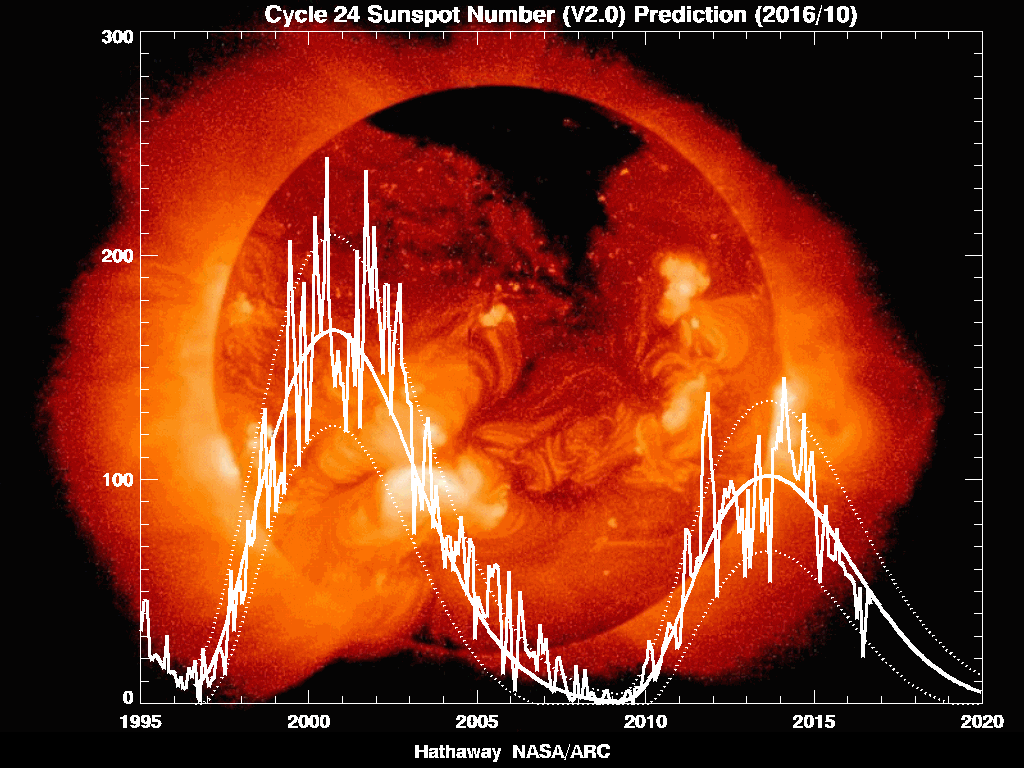
Global warming beats the hell out of global cooling.

http://solarscience.msfc.nasa.gov/SunspotCycle.shtml
"The Maunder Minimum
Early records of sunspots indicate that the Sun went through a period of inactivity in the late 17th century. Very few sunspots were seen on the Sun from about 1645 to 1715 (38 kb JPEG image). Although the observations were not as extensive as in later years, the Sun was in fact well observed during this time and this lack of sunspots is well documented. This period of solar inactivity also corresponds to a climatic period called the "Little Ice Age" when rivers that are normally ice-free froze and snow fields remained year-round at lower altitudes. There is evidence that the Sun has had similar periods of inactivity in the more distant past. The connection between solar activity and terrestrial climate is an area of on-going research."

ssn_predict_l.gif
 
Watermelons. Green outside, red inside. From commies to global warming hoaxers. What it's really all about:

Mises was right.

".....in 1990 by Robert Heilbroner, the multi-millionaire socialist economics professor, author of the best-selling history of economic thought, The Worldly Philosophers. He wrote an obituary: “After Communism.” It was published in The New Yorker(Sept 10, 1990). In it, he wrote these words: “Mises was right.” Right about what? About the impossibility of rational economic calculation in a world without private property and capital markets. He then called for the next phase of socialism, one which will be based on environmentalism, not economic theory. He said that only by mobilizing the masses behind the idea that the government should intervene in order to save the environment, could socialism once again gain a hearing. Otherwise, the movement was dead."

lewrockwell.com
 
Back
Top
