Good luck with — show your proof.
At the same time go do a search and view all the recent headlines about Taiwan not having a case for 200 days. Or simply find the article I posted in ET.
I'm very impressed with how
Taiwan converted
geo-fencing technology for use in a healthcare crisis. Their low numbers are excellent especially when much of the world is increasing very fast and in some places...exponentially on some days of infections / hospitalizations.
Sadly, the United States is way behind the curve on Geo-Fencing technology in a healthcare crisis.
In fact, I didn't know Taiwan are doing so well until I was channel surfing TV and some woman on TV (U.S. news journalist) stated they have some of the best Covid-19 results and that she's very close to the Taiwan people...her family use to live there or she was born there. Thus, it was Taiwan that cause me to look at the other top performers in their Covid-19 response and performance...
Sweden didn't make the list.
Regardless, Taiwan is another Asian country with
excellent response to Epidemics and Pandemics because they had a Pandemic plan and infrastructure designed to manage it. Simply, they did not go around saying its a hoax with a population (culture) that understands the importance of face mask wearing, testing and contact tracking.
Taiwan also had experience on its side. After suffering through the deadly outbreak of severe acute respiratory syndrome (SARS) in 2003, Taiwan worked to build up its capacity to deal with a pandemic, Taiwanese Foreign Minister Joseph Wu said in an interview last month.
"So, when we heard that there were some secret pneumonia cases in China where patients were treated in isolation, we knew it was something similar," he said.
Authorities activated the island's Central Epidemic Command Center, which was set up in the wake of SARS, to coordinate between different ministries. The government also ramped up face mask and protective equipment production to make sure there would be a steady supply of PPE.
Someone must be an
idiot to debate
or criticize the below results.
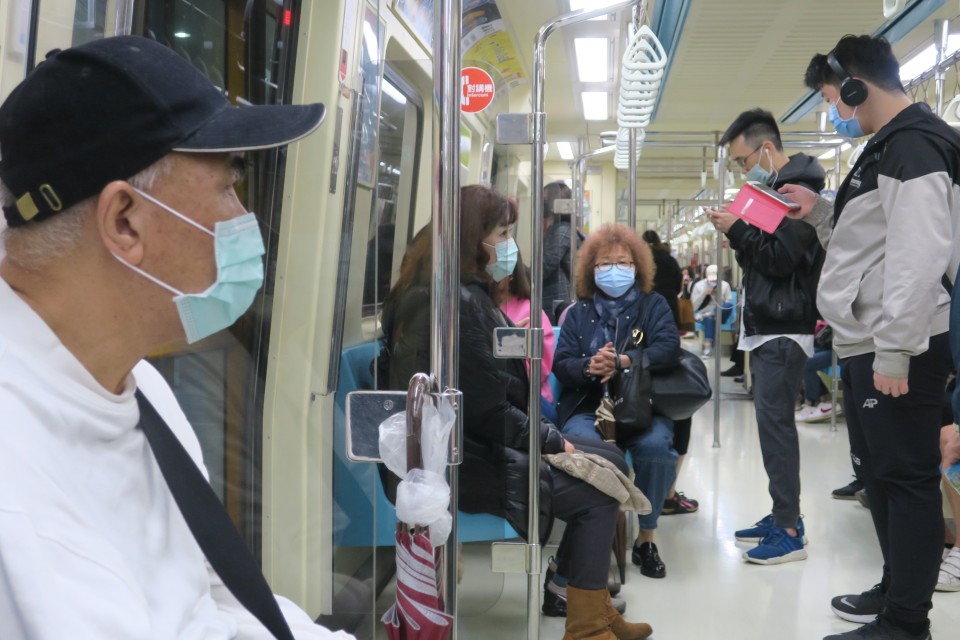
Look at the image below...all those people on public transportation
wearing face masks...going to work, school or whatever. Simply, they were prepared soon after the outbreak in China...Taiwan infrastructure kicked into action as early as
December 31st via checking passengers on flights from China via health checks...
Not some stupid questionnaire that was used by the United States and Canada almost 2 months later and then North America banned flights almost a month later on
January 31st while leaving the backdoor wide open for Europe to travel to U.S. major airports until
March 11th.
Yet, people keep saying the United States / Canada responded quickly. In my opinion just via the dates above about the so called "response"...it was comedy hour and will most likely cost many their jobs in the U.S. Elections.
Simply, if the government doesn't do its job properly in a healthcare crisis...the population will become
revolutionary (social unrest) in reacting to any Lockdowns or strong restrictions.
By the way, Lockdowns worked very well in many countries in Europe and North America.
In contrast, the
Re-Openings failed horribly...poor planning and too many people not willing to continue following the health guidelines.
-------
This is not what was predicted by early risk assessments that identified Taiwan among the most likely to see a rapid spread of the virus due to its proximity to China, where hundreds of thousands of Taiwanese work, and considering the extensive travel across the Taiwan Strait.
To make matters worse, the virus appeared just before the Lunar New Year, when thousands of Taiwanese were heading home from China to spend the holiday with family.
Several reasons have been cited for Taiwan's success in limiting the coronavirus' impact despite obvious disadvantages.
Perhaps foremost among them is preparation.
Following the 2003 epidemic of severe acute respiratory syndrome, which killed 73 in Taiwan, the highest number outside China and Hong Kong, the government passed legislation to facilitate a more effective response to future outbreaks.
Notably, the National Health Command Center was established to coordinate efforts in a variety of rapid onset scenarios like the one that now threatens.
In a recent interview, Taiwan's Vice President Chen Chien-jen, an epidemiologist by training and health minister during the SARS crisis, identified key elements of the program to include transparency, information sharing, staffing agencies with relevant experts, interagency cooperation and coordinating the efforts of government labs with hospitals and other medical facilities across the island.
Infrastructure developed by the NHCC enabled a remarkably quick response to initial reports from Wuhan, with Taiwanese health officials boarding flights from the region as early as
Dec. 31 to check passengers for symptoms.
wrbtrader