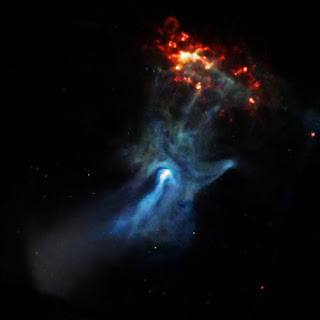
Image Credit: NASA and The Hubble Heritage Team (AURA/STScI)

This colorful image from the Hubble Space Telescope shows the collision of two gases near a dying star. Astronomers have dubbed the tadpole-like objects in the upper right-hand corner "cometary knots" because their glowing heads and gossamer tails resemble comets. Although astronomers have seen gaseous knots through ground-based telescopes, they have never seen so many in a single nebula.
Hubble captured thousands of these knots from a doomed star in the Helix nebula, the closest planetary nebula to Earth at 450 light-years away in the constellation Aquarius. Each gaseous head is at least twice the size of our solar system; each tail stretches 100 billion miles, about 1,000 times the Earth's distance to the Sun.
Firestorm of Star Birth Seen in a Local Galaxy

This monstrous star-birth region contains more than 200 brilliant blue stars within a cloud of glowing gases some 1,300 light-years across, nearly 100 times the size of the Orion Nebula. By contrast, the Orion Nebula contains just four bright central stars. The bright stars in NGC 604 are extremely young by astronomical standards, having formed a mere 3 million years ago.

A small portion of the rough-and-tumble neighborhood of swirling dust and gas near one of the most massive and eruptive stars in our galaxy is seen in this NASA Hubble Space Telescope image. This close-up view shows only a three light-year-wide portion of the entire Carina Nebula, which has a diameter of over 200 light-years. Located 8,000 light-years from Earth, the nebula can be seen in the southern sky with the naked eye.

A NASA Hubble Space Telescope image of a region of the Great Nebula in Orion.
This is one of the nearest regions of very recent star formation (300,000 years ago). The nebula is a giant gas cloud illuminated by the brightest of the young hot stars at the top of the picture. Many of the fainter young stars are surrounded by disks of dust and gas that are slightly more than twice the diameter of the Solar System. The great plume of gas in the lower left in this picture is the result of the ejection of material from a recently formed star.
The brightest portions are "hills" on the surface of the nebula, and the long bright bar is where Earth observers look along a long "wall" on a gaseous surface. The diagonal length of the image is 1.6 light-years. Red light depicts emission in Nitrogen; green is Hydrogen; and blue is Oxygen.
The Orion Nebula star-birth region is 1,500 light-years away, in the direction of the constellation Orion the Hunter.

Remnants from a star that exploded thousands of years ago created a celestial abstract portrait, as captured in this NASA Hubble Space Telescope image of the Pencil Nebula.
The region of the Pencil Nebula captured in this image is about three-fourths of a light-year across. The Vela supernova remnant is 114 light-years (35 parsecs) across. The remnant is about 815 light-years (250 parsecs) away from our solar system.

Eerie, dramatic new pictures from NASA's Hubble Space Telescope show newborn stars emerging from "eggs" â not the barnyard variety â but rather dense, compact pockets of interstellar gas called evaporating gaseous globules (EGGs). Hubble found the "EGGs," appropriately enough, in the Eagle nebula, a nearby star-forming region 6,500 light- years away in the constellation Serpens.

In January 2002, a dull star in an obscure constellation suddenly became 600,000 times more luminous than our Sun, temporarily making it the brightest star in our Milky Way galaxy.
The mysterious star has long since faded back to obscurity, but observations by NASA's Hubble Space Telescope of a phenomenon called a "light echo" have uncovered remarkable new features. These details promise to provide astronomers with a CAT-scan-like probe of the three-dimensional structure of shells of dust surrounding an aging star.

The Coldest Spot In The Universe
Revealed in all it's glory in this Hubble Space Telescope image, the Boomerang Nebula registers in at a bone chilling -458F. That's 1° above absolute zero... the point at which atomic activity ceases. Find out more at CNN.com/SPACE.
This colorful image from the Hubble Space Telescope shows the collision of two gases near a dying star. Astronomers have dubbed the tadpole-like objects in the upper right-hand corner "cometary knots" because their glowing heads and gossamer tails resemble comets. Although astronomers have seen gaseous knots through ground-based telescopes, they have never seen so many in a single nebula.
Hubble captured thousands of these knots from a doomed star in the Helix nebula, the closest planetary nebula to Earth at 450 light-years away in the constellation Aquarius. Each gaseous head is at least twice the size of our solar system; each tail stretches 100 billion miles, about 1,000 times the Earth's distance to the Sun.
Firestorm of Star Birth Seen in a Local Galaxy
This monstrous star-birth region contains more than 200 brilliant blue stars within a cloud of glowing gases some 1,300 light-years across, nearly 100 times the size of the Orion Nebula. By contrast, the Orion Nebula contains just four bright central stars. The bright stars in NGC 604 are extremely young by astronomical standards, having formed a mere 3 million years ago.
A small portion of the rough-and-tumble neighborhood of swirling dust and gas near one of the most massive and eruptive stars in our galaxy is seen in this NASA Hubble Space Telescope image. This close-up view shows only a three light-year-wide portion of the entire Carina Nebula, which has a diameter of over 200 light-years. Located 8,000 light-years from Earth, the nebula can be seen in the southern sky with the naked eye.
A NASA Hubble Space Telescope image of a region of the Great Nebula in Orion.
This is one of the nearest regions of very recent star formation (300,000 years ago). The nebula is a giant gas cloud illuminated by the brightest of the young hot stars at the top of the picture. Many of the fainter young stars are surrounded by disks of dust and gas that are slightly more than twice the diameter of the Solar System. The great plume of gas in the lower left in this picture is the result of the ejection of material from a recently formed star.
The brightest portions are "hills" on the surface of the nebula, and the long bright bar is where Earth observers look along a long "wall" on a gaseous surface. The diagonal length of the image is 1.6 light-years. Red light depicts emission in Nitrogen; green is Hydrogen; and blue is Oxygen.
The Orion Nebula star-birth region is 1,500 light-years away, in the direction of the constellation Orion the Hunter.
Remnants from a star that exploded thousands of years ago created a celestial abstract portrait, as captured in this NASA Hubble Space Telescope image of the Pencil Nebula.
The region of the Pencil Nebula captured in this image is about three-fourths of a light-year across. The Vela supernova remnant is 114 light-years (35 parsecs) across. The remnant is about 815 light-years (250 parsecs) away from our solar system.
Eerie, dramatic new pictures from NASA's Hubble Space Telescope show newborn stars emerging from "eggs" â not the barnyard variety â but rather dense, compact pockets of interstellar gas called evaporating gaseous globules (EGGs). Hubble found the "EGGs," appropriately enough, in the Eagle nebula, a nearby star-forming region 6,500 light- years away in the constellation Serpens.
In January 2002, a dull star in an obscure constellation suddenly became 600,000 times more luminous than our Sun, temporarily making it the brightest star in our Milky Way galaxy.
The mysterious star has long since faded back to obscurity, but observations by NASA's Hubble Space Telescope of a phenomenon called a "light echo" have uncovered remarkable new features. These details promise to provide astronomers with a CAT-scan-like probe of the three-dimensional structure of shells of dust surrounding an aging star.
The Coldest Spot In The Universe
Revealed in all it's glory in this Hubble Space Telescope image, the Boomerang Nebula registers in at a bone chilling -458F. That's 1° above absolute zero... the point at which atomic activity ceases. Find out more at CNN.com/SPACE.