Well I figure if we are going to arbitration then it may as well be over a lot of money-- I'm in a lot of pain today. ) ) )
latest Email to land trust--
Update: I finished the fence along the line you layed out the second time. Unfortunately the adjustment to your former flag has caused me to have to transplant several wisteria-
The first time I just flipped the fence and allowed the plants to still entwine. I hope to god these plants make it. It became a difficult job. That was a really unfortunate extra 4 feet.
I smashed out one side of the Grotto and ruined it. You’ll be happy to know that. The rocks are bigger than I remembered. When I built it I had two strapping Australian brothers helping.
Today my shoulder & back hurts pretty bad.. I’m hesitant to go to the Dr because I do not wish to be prescribed opioids.
In the next few weekends I’ll move as much as I can. I have neurological condition called CMT. I feel this rushed process could endanger my health.
I will contact you again around Thanksgiving. My aim is to create a look of a “ ruin “ now, I’m not sure at the moment how to go about that.
It would be a real shame if you found one of these living under those grotto stones.

Least Shrew
Cryptotis parva
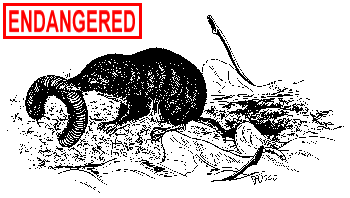
Habitat: Open and dry grassy fields with woodland edges. In Connecticut, least shrews are only found in coastal areas with high beach dunes and adjacent brackish marshes.
Weight: 0.14-0.25 ounces.
Length: 2.7-3.5 inches, including the tail.
Life Expectancy: Less than 2 years of age.
Food: Insects, earthworms, snails, mollusks, amphibians, lizards, small mammals, carrion, and plant material.
Status: State endangered.
Identification: The least shrew is mole-like, with tiny eyes, inconspicuous ears, a long, pointed nose, velvety brown-gray fur, and the shortest tail of all the other shrews found in Connecticut. The fur is lighter in color during the summer months. Both sexes are similar in appearance.
History in Connecticut: The least shrew reaches the northern part of its range in coastal and southwestern Connecticut. In 1840, the species was first reported in Darien by Reverend James H. Linsley, who was better known for publishing bird lists. The species was not found again in Connecticut for 100 years. In 1941, George Goodwin, Assistant Curator of Mammals at the American Museum of Natural History, in New York, found one in Westbrook while walking along the edge of a saltgrass meadow. For almost 50 years since Goodwin's report, the secretive least shrew again remained unseen until one was found in coastal Middlesex County in 1989. Presently, this is the only documented Connecticut location of this species.