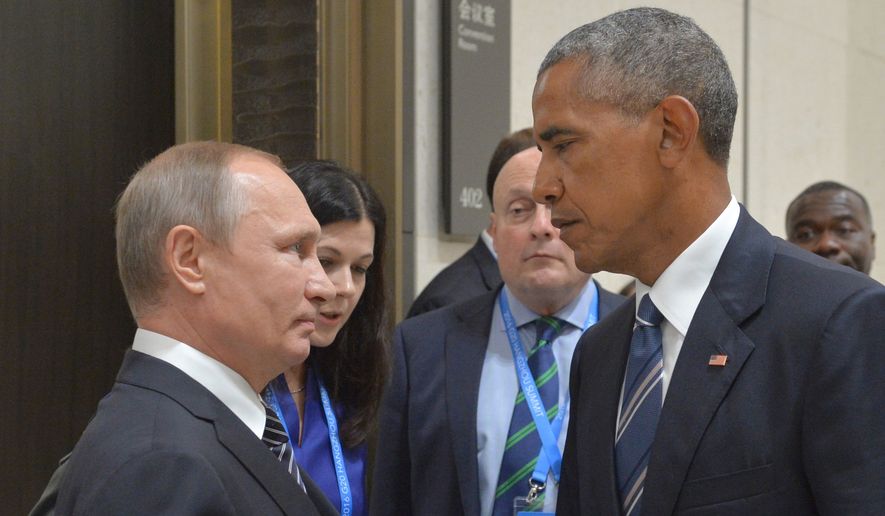
http://www.foxnews.com/politics/201...nts-prove-russia-meddled-in-us-elections.html
Was it a pinky promise?
Last edited:



He sure spotted one in Obama when all this started.
Remember that "red line"?
Vlad gave Donnie quite the wink I'm sure.
Why Donald Trump and Vladimir Putin lie... and why they are so good at it
Post-truth is the first step toward authoritarian rule.
https://www.newstatesman.com/world/...ladimir-putin-lie-and-why-they-are-so-good-it
"Many are shocked by the current political situation in America, and believe it has no precedent. Yet “post-truth” did not arrive anew in 2016, when it was proclaimed the Oxford Dictionaries’ word-of-the-year. In reality, its roots stretch back decades, with both historical and conceptual precursors.
The historical parallels are easiest. Of the totalitarian regimes of the 1930s, the political theorist Hannah Arendt once observed that “the ideal subject of totalitarian rule is not the convinced Nazi or the convinced communist, but people for whom the distinction between fact and fiction … true and false … no longer exist.” In the initial stages of an autocratic regime, it is not uncommon for a would-be ruler to see how many lies he or she can get away with, before preserving political power through propaganda. Even here, though, the point is not to convince but to dominate. Contempt for truth goes hand in hand with political oppression.
As the philosopher Jason Stanley argues in his recent book How Propaganda Works, the goal of propaganda is not to persuade, but to demonstrate that you have authority over truth itself. Epistemological authority has always underpinned political authority. Writing about Bolshevism, the philosopher Roger Scruton, put it this way: “Facts no longer made contact with the theory, which had risen above the facts on clouds of nonsense, rather like a theological system. The point was not to believe the theory, but to repeat it ritualistically and in such a way that both belief and doubt became irrelevant. . . . In this way the concept of truth disappeared from the intellectual landscape, and was replaced by that of power.”
As for the conceptual roots of post-truth, these are easy to see, though perhaps difficult to accept. Most prominent is the notion that forty years of science denial – be this the correlation between smoking and lung cancer, the existence of evolution and climate change, or whether vaccines can be linked to autism – has conditioned people to challenge facts that they simply don’t want to believe. Who needs empirical evidence when you already know what to believe on the basis of ideology? Another root of post-truth, inherent cognitive bias, seems obvious in the abstract, though it can be stubbornly difficult to recognise when we are in its grip. Do viewers believe most of what is seen on MSNBC because they trust that their broadcasts are double-sourced and fact-checked before going on the air, or because they fit with their ideology? And it works that way on the right too – indeed more so – as cognitive scientists have found that those with conservative political beliefs have greater susceptibility to conspiracy theories and fear-based thinking. Finally, what if any blame might be due to post-modernism – that 800 pound gorilla of 1980s literary criticism and cultural studies – that taught a generation of scholars to question whether there was such a thing as objective truth (even in science) and to be suspicious of all factual claims outside the context of their political motives."