You are using an out of date browser. It may not display this or other websites correctly.
You should upgrade or use an alternative browser.
You should upgrade or use an alternative browser.
I need some serious advice and help on day trading FOREX
- Thread starter Melchi
- Start date
Thanks man, you just too the questions right out my mouth..Could you explain what you mean? What was the strategy? And why did it only work with certain brokers? What does "arbed away mean"? Also, do you mind me asking, why are you still participating on trading forums if you didn't make it, or are you still trying to make it?

I am ready to move on right now, as i said, I need a logical reason for that. Not having success for a long time could be a good reason, but if someone could provide some help, there is a chance I could continue putting effort in. Which markets are easier to day trade then? American stocks? Or maybe some others? And why are they easier?
I think it's best that you move on. Retail Forex is the only market where the choice of the broker is extremely important and the possibility of profitability is a lot lower than you think so it's not your fault that you are not making money. The only type of broker that you would have a decent possibility of making money is if it operates in an ECN-type of business model. You are not able to make any money with brokers that operate in what's called the market-maker model in which the broker trades directly against you and does not hedge their net position so they basically have a financial incentive to see you fail. So don't feel bad if you are losing money trading with a market-making broker. Nobody makes money with this type of broker. LOL
Assuming you are able to find a good broker that does operate in an ECN-like business model, retail forex is extremely difficult to chart and gauge for direction. For one thing, it trades 24 hours around the clock and anything can set it off and when it does, the effect can be tremendous. And forex is very heavily influenced by events, economic and/or world than anything else. One huge even hit, all TA, charts, indicators, trading systems all go out of the door. And there is no way you can hedge. The hedging instrument is extremely hard to find and is highly illiquid. So one of those "black swan" events and you are done. Second, it's also very hard to gauge its direction because there is no volume that you can look at. And third, it's highly illiquid for us. They advertise that it's the most liquid market in the world with several trillion dollars of volume and etc. etc. but that liquidity is never available for us. What we trade in retail forex is not the billion-dollar institutional orders, those private client orders that those "liquidity providers" like Deutch Bank handle (notice all of the brokers list exactly the same liquidity brokers) no, those are inaccessible to us. What we trade in is what's simulated for us in an OTC market that's basically created by our broker, what's basically called a CFD. Cash-For-Difference and the trading volume in that market if you can call it a market is very low. And that's why you can't use the "volume" indicator to gauge it because there is none, none in a sense that it's basically created by retail forex brokers themselves on their own.
I have traded retail forex for five years and have never made money. Whatever money that I have made, I have lost even more. At the end, I moved on after the CFTC banned retail forex brokers that operate in market-making business models and forbade foreign brokers to take on US residents, with whatever trading capital I managed to salvage and I find trading in other markets to be lot more profitable. Looking back, I find retail forex is basically no different from a gambling table at a casino designed to suck you in to take your money without the drinks and the hot chicks. I was taken in by the advertisement of the large profit potential and the huge liquidity without knowing the reality behind it. Lesson learned. At least I was lucky that I didn't end up with a broker who absconded with my money; a lot of traders lost their money as soon as they deposited it with the broker.


Don't trade FX. As well as the problems @TheDawn alludes to, retail FX is cripplyingly expensive. Nearly all the dodgy YouTube gurus trade it because the brokers can afford to pay them nice fat referellal fees.
As others have said a simple and relatively slow moving average system on US stocks would be cheap to trade, and a good base for additional complexity.
GAT
As others have said a simple and relatively slow moving average system on US stocks would be cheap to trade, and a good base for additional complexity.
GAT
Don't trade FX. As well as the problems @TheDawn alludes to, retail FX is cripplyingly expensive. Nearly all the dodgy YouTube gurus trade it because the brokers can afford to pay them nice fat referellal fees.
As others have said a simple and relatively slow moving average system on US stocks would be cheap to trade, and a good base for additional complexity.
GAT
I used to get offended when somebody suggested that we retail forex traders should just go to the casino instead of spending our money on forex as we would have more fun that way. Now that I think back, I should've really taken his suggestion. LOL It was so stressful trading forex. Good thing I only did it for five years.
That is a lot of food for thought. Thanks for all the replies. If anyone has anything else to add, please do so. I will continue monitoring this for the next few days and then make a final decision. Luckily, I still have a relatively decent amount of money to focus on a business, and possibly even ways to borrow to expand it.
Statistical Trader, thanks for the offer, I don't have those files any more unfortunately.
Seems to me that even if I was to proceed, there is a whole lot more to learn, and maybe all my knowledge is only 10% of what I need to know.
I chose Forex by chance, I then later learnt about other markets and stayed in Forex because of ability to get high leverage from offshore brokers, so that the money that is not in the broker's account could be working elsewhere (such as a profitable business).
If I quit, I will try to forgive myself for all the wasted time and not be angry at all the advertising.
Statistical Trader, thanks for the offer, I don't have those files any more unfortunately.
Seems to me that even if I was to proceed, there is a whole lot more to learn, and maybe all my knowledge is only 10% of what I need to know.
I chose Forex by chance, I then later learnt about other markets and stayed in Forex because of ability to get high leverage from offshore brokers, so that the money that is not in the broker's account could be working elsewhere (such as a profitable business).
If I quit, I will try to forgive myself for all the wasted time and not be angry at all the advertising.
What chappy and Sekiyo said stood out for me. If i wasn't happy with what i'm discovering, i'd check out trendlines in a high enough time frame, as in swing trading, that allows you to overcome the spreads and fees that day traders face here and there. That way, you could possibly accept a method that yields only a 1.5 profit factor (risk/reward ratio). With that, you would need a way to control drawdowns. To do that you would trade multiple markets, or slightly different time frames that would also produce around 1.5 profit factors, that can produce profit curves that somewhat hedge each other, such when one is in a drawdown, another might be going up. The idea is to control drawdowns by averaging them out in somewhat uncorrelated profit curves (assuming they are all averaging around 1.5 profit factor). Only when overall account drawdown is smoothed out to something fairly predictable, can leverage be considered. I would call what chappy is doing trend following on price action, a good thing. Its not what i propose, but it's the same general idea, so it should work. The more systematic (rules based) you can make it the better. You really have to collect plenty of data to suggest whatever you are trying, is going to work, assuming you can find an honest broker. You would keep collecting that data to compare with the results you get at any particular broker. Great if you can find a bot to implement some method, that would yield you enough data to suggest it might work. Short of that, you really must find a way to collect data manually, and then to evaluate it. I would challenge you to find, develop, or otherwise brainstorm a method that is always in the market, whatever market, either long or short, for however many hours the market is open. That limits you to some kind of trend following system, which is a good thing. I would try stay away from moving averages and try some kind of price action decision that tells you when to cease and desist going one direction, and turn around and go the other. In other words, your stop losses are actually reversals. There would be no "targets", but you would end up with a win% that is lower than 50%, but an average gain per trade that is much higher than the average loss. Just use the charts for one time frame. Achieving even a 1.3 profit factor is a big deal. You can build on that. For example, you could examine what the profit factor would be after you waited for two losses, or three losses. This does not work in a random walk situation like a casino. That is, if you expected profit factor was 1, you cannot expect to elevate that by waiting for losses. But with positive expectancy to begin with, especially 1.5 PF, it works differently, and you can expect higher PF from those trades. You can separate your data stream into long and short streams, and evaluate how to handle each of those with their own statistics. If you are sitting out a lot of trades, then you would want to be trading enough other markets, or time frames, that most of your capital is productively employed, not just sitting around. Once you have positive expectation, then you can use a higher time frame to guide/filter a lower time frame, and boost your profit factor, whenever you trade in harmony with the upper.
So yah, a lot of work. One way to make room for all the work needed is to limit any other kind of work you do to part time, like 25-30 hours a week. You won't get rich, and might only tread water, but it is not how much money you make, it's what you know you can do with it, once your research establishes a clear path forward. I think there is a clear path and you have to find it, and prove it with data. Believe only data. If you've disposed of data from before, this could be the reason for the struggling so far. Your data should tell you about drawdowns, and the average profit per trade to expect. You would then give some of that up on fees and spreads and that would tell you what time frame you would need to practice on.
So yah, a lot of work. One way to make room for all the work needed is to limit any other kind of work you do to part time, like 25-30 hours a week. You won't get rich, and might only tread water, but it is not how much money you make, it's what you know you can do with it, once your research establishes a clear path forward. I think there is a clear path and you have to find it, and prove it with data. Believe only data. If you've disposed of data from before, this could be the reason for the struggling so far. Your data should tell you about drawdowns, and the average profit per trade to expect. You would then give some of that up on fees and spreads and that would tell you what time frame you would need to practice on.
Last edited:
What sort of methodology do you use to swing trade? WHat is the average holding time of your positions? Do you leave positions open for weekend? What is the main problem with day-trading for you, is it transaction costs? Could you explain a bit more?Swing trade forex.
It's win win for everything in your life.
Less work, more returns.
Use something like a systematic trend following system.
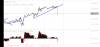
As you can see , I never post on this forum.However your story pulled me in and I felt I should share .You asked for a simple method that required little analysis .This is the way that I have traded for yrs. The key to this method is to use the macd to set the trend line .I don't set the end of the line until the macd is at or over the zero line ..this will avoid early and false entries. If a 1-2-3 appears (Joe Ross ), the chance of a good trade is higher .It will work on all markets,all time frames (15m or longer is my favorite ). The naysayers will say it is TOO simple ....so..just smile and nod ...Good Luck my friend ...