It's hilarious when people say that a certain time frame is just noise. If you can make or lose money by trading that time frame, apparently it isn't just noise.

You are using an out of date browser. It may not display this or other websites correctly.
You should upgrade or use an alternative browser.
You should upgrade or use an alternative browser.
Hypothesis: Technical Analysis only works in the immediate short-term
- Thread starter Investor
- Start date
Fundamental analysis (the kind you've been studying) is useful for determining the valuation of a company. That might be useful if you are buying or selling a company outright.
A company's share price traded as stock on a public exchange is a different matter. It has three components 1) broad market, 2) sector, and 3) company-specific. So the stock price is more than what's just happening with the company.
TA is great for historical analysis. Not very useful to predict future prices. That's why it's called Technical Analysis and not Technical Forecasting. Of course, that doesn't stop many traders from attempting to use it to forecast. And there is a temptation to think that if you just shorten your time frame a little more, your accuracy will improve. Unfortunately, that doesn't work.
All of those elements should impact a private company too. The absolute valuation process is similar in private acquisitions as it is in equity investing. There are adjustments, of course, for synergies (which I tend to think most companies greatly over-value prior to acquisition), but overall the process isn't going to change drastically. It wouldn't make sense that you wouldn't consider either systematic or unsystematic risk just because the company isn't publicly traded.
That aside, I think most people use TA for forecasting purposes. I'm not talking accurate forecasts, but a general idea of where price will go. It's supposed to give you an edge, whether through information about market sentiment or giving you signals, otherwise why use it? It would, at best, not change your mind and, at worst, decrease your odds of success. I will say that there do seem to be more studies that prices in the immediate short-term (especially intra-day) are much more difficult to predict at the significant level than long-term, so perhaps noise is so significant that even TA can't help as previously noted in this thread by comagnum.
Last edited:
No I vehemently disagree. T/A works better on longer timeframes with longer trade holding periods. And that's a fact Jack.
What reasoning or evidence (anecdotal or empirical) leads you to believe this? And if so, do you believe TA gives you an edge over FA? Or do you use these two in combination to confirm one another?

It's hilarious when people say that a certain time frame is just noise. If you can make or lose money by trading that time frame, apparently it isn't just noise.
Oh, if you look at time&sales data from Bloomberg over time you can most assuredly see the advent of automated trade entries and dedicated ECN's - which indeed generates all kinds of short term turbulence. That is real.
With this noise thing...the same can be said for any time frame. You may have a position trader who says that the daily chart is just noise. You may have a long-term value investor who says that anything less than a weekly chart is noise. We can go on and on about what qualifies as noise. What these guys should probably say is that...depending on one's trading style and holding time, certain time frames aren't taken into consideration.Oh, if you look at time&sales data from Bloomberg over time you can most assuredly see the advent of automated trade entries and dedicated ECN's - which indeed generates all kinds of short term turbulence. That is real.
WOW, lack of knowledge big time here. Just cause you don't trade or can't trade using TA intraday doesn't mean it doesn't work, it doesn't work for you, and that is ok. There is so many ways one can trade the markets, even throwing darts at WSJ works in strong Bull market. Using TA on long timeframe, if done correctly, produces more profits than day trading so I agree with some of you there, less overall risk and greater profits per trade, less commissions. I have cut way back on indicators day trading intraday data, but I still use at least 2 of them as it just makes it easier to spot. NOTHING predicts direction and not even price, some of us who have extensively back tested trade percentages of what worked in past. In some degree movement is noise which can snowball into trend, although 90% of my entries are counter-trend, I depend on trend traders to push it in right direction. I went to college early on thinking once I learned fundamentals would aid greatly, it didn't cause by the time you get the info, price has already factored it in. I was lucky, I learned to chart by charting by hand and even after I bought PC, I continued to chart by hand, you learn so much by practicing and doing it over and over.
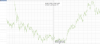
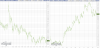
Enclosed is a chart of same instrument, one is a daily and other is intraday, after fifteen minutes, I forgot which is which, so where is the noise?
Enclosed is a chart of same instrument, one is a daily and other is intraday, after fifteen minutes, I forgot which is which, so where is the noise?
Attachments
WOW, lack of knowledge big time here. Just cause you don't trade or can't trade using TA intraday doesn't mean it doesn't work, it doesn't work for you, and that is ok. There is so many ways one can trade the markets, even throwing darts at WSJ works in strong Bull market. Using TA on long timeframe, if done correctly, produces more profits than day trading so I agree with some of you there, less overall risk and greater profits per trade, less commissions. I have cut way back on indicators day trading intraday data, but I still use at least 2 of them as it just makes it easier to spot. NOTHING predicts direction and not even price, some of us who have extensively back tested trade percentages of what worked in past. In some degree movement is noise which can snowball into trend, although 90% of my entries are counter-trend, I depend on trend traders to push it in right direction. I went to college early on thinking once I learned fundamentals would aid greatly, it didn't cause by the time you get the info, price has already factored it in. I was lucky, I learned to chart by charting by hand and even after I bought PC, I continued to chart by hand, you learn so much by practicing and doing it over and over.
Enclosed is a chart of same instrument, one is a daily and other is intraday, after fifteen minutes, I forgot which is which, so where is the noise?
On the topic of pricing already factoring in fundamentals, could one not argue that price also factors in technical analysis? It's paradoxical in a way, but I think it sort of supports the old adage that it is a self-fulfilling prophecy. I tend to think in both cases, it is the lack of consensus that leads to profitable opportunities (e.g: the market priced fundamental information incorrectly or investors are viewing the same price action incorrectly). Of course, I tend to think the process of predicting it correctly even with a minor edge is a ridiculous challenge and is why index investing is so enticing...
Anyway, I really like your mention of charting by hand. Although I do not know if I will go to this extent, I could see myself creating the charts in Excel using my own inputs instead of simply using charting software - I agree completing tasks yourself helps you learn better, both in terms of speed and retention. Thanks for your input regarding noise too, which seems to be a hotter topic than I thought lol.
Last edited:

just to show which is which.
Got it right =P But Markets are Fractal, Yes.
However, it is difficult to practically make sense of any of that data, since you must calculate faster, and the lower volumes lead to many false signals.
Participation and volume are highly important to TA, all of which are proportional to longer timeframes.
If, during the day, volume changes drastically for some reason, it should throw off or invalidate any action that happened before, as many players have either newly entered or changed their own strategies. There could be any number of players waiting on the sidelines during the day before swooping in to cause new action.
But, over the course of weeks or months, you will see a good picture of how generally all the players are moving, which lends more credibility to analysis over longer timeframes. There will be fewer upsets of large movers spoiling certain price action, simply because nobody is big enough to move the accumulated action of several months by themselves. But, a large mover can do that on a small timeframe if they so desired.
Big news events, Fed talks, Oil meetings, Brexits; they are enormous movements on small time frames but on larger time frames are much smaller blips, since, by definition, everything moves slower.
Overall, I think Technical Analysis can hypothetically work in smaller timeframes, but you'd have to account for the surprise players jumping in or out whenever they want. Perhaps non-time-based charting, which is no longer traditional TA, but whatever works.
This is the best answer I've seen thus far as to why using TA for the long-term is a good idea, although it still feels much more like a confirming tool than it feels like a predicting tool. Any thoughts on that, CyJackX? You mention it gives you idea of how all players are moving because movements are smoothed out over longer time-frames, which I agree with. Do you think that gives you enough meaningful information to predict, with any edge, future movements? Or do you feel it is a tool best used for gauging and reacting rather than anticipating? Thanks.