Human-€induced climate change requires urgent action

An interesting read. Much too long to reproduce here.

As the seas rise, a slow-motion disaster gnaws at America’s shores
Part 1: A Reuters analysis finds that flooding is increasing along much of the nation’s coastline, forcing many communities into costly, controversial struggles with a relentless foe.

WALLOPS ISLAND, Virginia – Missions flown from the NASA base here have documented some of the most dramatic evidence of a warming planet over the past 20 years: the melting of polar ice, a force contributing to a global rise in ocean levels.

The Wallops Flight Facility’s relationship with rising seas doesn’t end there. Its billion-dollar space launch complex occupies a barrier island that's drowning under the impact of worsening storms and flooding.

NASA's response? Rather than move out of harm’s way, officials have added more than $100 million in new structures over the past five years and spent $43 million more to fortify the shoreline with sand. Nearly a third of that new sand has since been washed away.

Across a narrow inlet to the north sits the island town of Chincoteague, gateway to a national wildlife refuge blessed with a stunning mile-long recreational beach – a major tourist draw and source of big business for the community. But the sea is robbing the townspeople of their main asset.

The beach has been disappearing at an average rate of 10 to 22 feet (3 to 7 meters) a year. The access road and a 1,000-car parking lot have been rebuilt five times in the past decade because of coastal flooding, at a total cost of $3 million. more . . .


That's a damn good question- What the hell is a multi-trillion dollar company like NASA doing setting up shop in hurricane alley, at what, 50 feet above sea level??

Holy crap I hope they have Obamasurance ;)
 
An interesting read. Much too long to reproduce here.

As the seas rise, a slow-motion disaster gnaws at America’s shores
Part 1: A Reuters analysis finds that flooding is increasing along much of the nation’s coastline, forcing many communities into costly, controversial struggles with a relentless foe.

WALLOPS ISLAND, Virginia – Missions flown from the NASA base here have documented some of the most dramatic evidence of a warming planet over the past 20 years: the melting of polar ice, a force contributing to a global rise in ocean levels.

The Wallops Flight Facility’s relationship with rising seas doesn’t end there. Its billion-dollar space launch complex occupies a barrier island that's drowning under the impact of worsening storms and flooding.

NASA's response? Rather than move out of harm’s way, officials have added more than $100 million in new structures over the past five years and spent $43 million more to fortify the shoreline with sand. Nearly a third of that new sand has since been washed away.

Across a narrow inlet to the north sits the island town of Chincoteague, gateway to a national wildlife refuge blessed with a stunning mile-long recreational beach – a major tourist draw and source of big business for the community. But the sea is robbing the townspeople of their main asset.

The beach has been disappearing at an average rate of 10 to 22 feet (3 to 7 meters) a year. The access road and a 1,000-car parking lot have been rebuilt five times in the past decade because of coastal flooding, at a total cost of $3 million. more . . .
Just watched episode 12 of the new Cosmos. Perhaps the real rising oceans disaster is around the arctic.
 
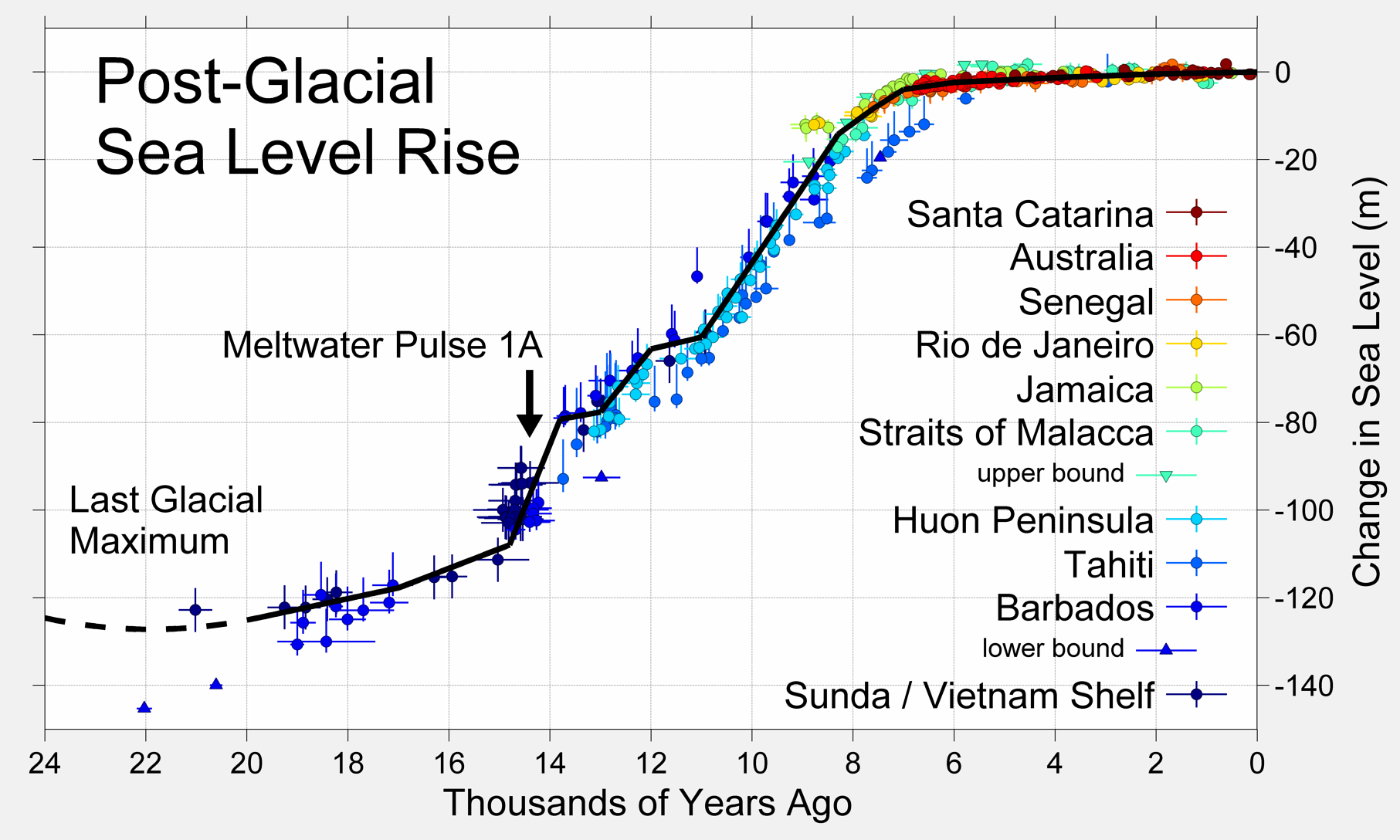
Post-Glacial_Sea_Level.png
 
Let's outline why the report below is completely meaningless and absurd. Here is the reality, China's energy demand will consume 80% more than the US by 2035. And with 50 new coal plants in the pipeline, the chances of reducing their carbon footprint are nil. The best they can hope for is to shift the smog away from their cities. Any Chinese "plan" to "reduce carbon emissions" is merely optics, and a trap to lure western investors into a completely fraudulent "trading" market that is not viable.

http://www.worldreview.info/content/china-powers-ahead-energy-revolution


BEIJING — China plans to introduce its national market for carbon permit trading in 2016, a government official said on Sunday, adding that Beijing is close to completing rules for what will be the world’s biggest emissions trading program.

The nation accounts for nearly 30 percent of global greenhouse gas emissions, and it plans to use the carbon market to slow its rapid growth in climate-changing emissions.

China has pledged to reduce the amount of carbon it emits per unit of its gross domestic product to 40 to 45 percent below its 2005 levels by 2020.

It has already introduced seven regional pilot markets in a bid to gain experience ahead of a nationwide program.

“We will send over the national market regulations to the State Council for approval by the end of the year,” Sun Cuihua, a senior climate official with the National Development and Reform Commission, told a conference in Beijing on Sunday.

The national market will start in 2016, although some provinces would be allowed to start later if they lacked the technical infrastructure to participate from the outset, she said.

The Chinese market, when fully functional, would dwarf the European emissions trading system, which is now the world’s biggest.
 
Compared to the long term warming trend, hiatus periods of fifteen years are common in the surface temperature record. The term is currently used to refer to the period since the exceptionally warm year of 1998. While evidence of continued multi-decadal warming is robust, there is considerable variability on annual to decadal scales, so shorter periods of ten or fifteen years can show weaker or stronger trends.[1] Although the rate of increase in surface temperatures slowed during this period, increasing heat had been trapped in the oceans, at lower depths than previously.[5]


1280px-Warming_since_1880_yearly.jpg


Global mean land-ocean temperature index from January 1880 through January 2014. The colored line is the annual mean and the black line is the five-year running mean. Hiatus periods of fifteen years have occurred several times in this temperature record, but over a longer timescale there has been a robust rising trend.http://en.wikipedia.org/wiki/Global_warming_hiatus#cite_note-AR5_Tech_summary-1


To claim global warming stopped in 1998 overlooks one simple physical reality - the land and atmosphere are just a small fraction of the Earth's climate (albeit the part we inhabit). The entire planet is accumulating heat due to an energy imbalance. Theatmosphere is warming. Oceans are accumulating energy. Land absorbs energy and ice absorbs heat to melt. To get the full picture on global warming, you need to view the Earth's entire heat content.

This analysis is performed in An observationally based energy balance for the Earth since 1950 (Murphy 2009) which adds up heat content from the ocean, atmosphere, land and ice. To calculate the Earth's total heat content, the authors used data of ocean heat content from the upper 700 metres. They included heat content from deeper waters down to 3000 metres depth. They computed atmospheric heat content using the surface temperaturerecord and the heat capacity of the troposphere. Land and ice heat content (the energy required to melt ice) were also included.

Total-Heat-Content.gif
 
Cherry Picking
Most claims that the IPCC models have failed are based on surface temperature changes over the past 15 years (1998–2012). During that period, temperatures have risen about 50 percent more slowly than the multi-model average, but have remained within the range of individual model simulation runs.

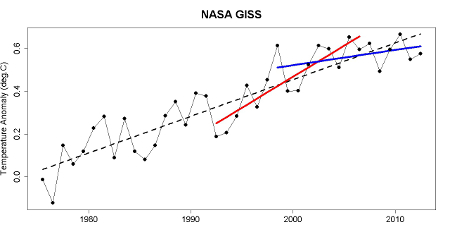
However, 1998 represented an abnormally hot year at the Earth's surface due to one of the strongest El Niño events of the 20th century. Thus it represents a poor choice of a starting date to analyze the surface warming trend (selectively choosing convenient start and/or end points is also known as 'cherry picking '). For example, we can select a different 15-year period, 1992–2006, and find a surface warming trend nearly 50 percentfaster than the multi-model average, as statistician Tamino helpfully illustrates in the figure below.

gisstrend12.jpg
Global surface temperature data 1975–2012 from NASA with a linear trend (black), with trends for 1992–2006 (red) and 1998–2012 (blue).


http://www.theguardian.com/env...projections-accurate
 
here is the reality.... the models failed at the 15 year mark and now we are at 17 years and 11 months.

way beyond the 95% level and past the 97.5% level.


http://wattsupwiththat.com/2014/09/05/matt-ridley-in-the-wsj-whatever-happened-to-global-warming/


When the climate scientist and geologist Bob Carter of James Cook University in Australia wrote an article in 2006 saying that there had been no global warming since 1998 according to the most widely used measure of average global air temperatures, there was an outcry. A year later, when David Whitehouse of the Global Warming Policy Foundation in London made the same point, the environmentalist and journalist Mark Lynas said in the New Statesman that Mr. Whitehouse was “wrong, completely wrong,” and was “deliberately, or otherwise, misleading the public.”


We know now that it was Mr. Lynas who was wrong. Two years before Mr. Whitehouse’s article, climate scientists were already admitting in emails among themselves that there had been no warming since the late 1990s. “The scientific community would come down on me in no uncertain terms if I said the world had cooled from 1998,” wrote Phil Jones of the University of East Anglia in Britain in 2005. He went on: “Okay it has but it is only seven years of data and it isn’t statistically significant.”

If the pause lasted 15 years, they conceded, then it would be so significant that it would invalidate the climate-change models upon which policy was being built. A report from the National Oceanic and Atmospheric Administration (NOAA) written in 2008 made this clear: “The simulations rule out (at the 95% level) zero trends for intervals of 15 yr or more.”

Well, the pause has now lasted for 16, 19 or 26 years—depending on whether you choose the surface temperature record or one of two satellite records of the lower atmosphere. That’s according to a new statisticalcalculation by Ross McKitrick, a professor of economics at the University of Guelph in Canada.
 
Back
Top