
You are using an out of date browser. It may not display this or other websites correctly.
You should upgrade or use an alternative browser.
You should upgrade or use an alternative browser.
Human-induced climate change requires urgent action
- Thread starter futurecurrents
- Start date


GLOBAL WARMING ALERT! South Dakota has earliest snowfall on record

Okay, campers, rise and shine, and don’t forget your booties ‘cause it’s cooooold out there today.
from Argus Leader:
There already are unconfirmed reports of 7 inches of snow in parts of the Black Hills in western South Dakota.
Jon Chamberlain, meteorologist with the National Weather Service in Rapid City, said almost 1 inch of snow had fallen in downtown Rapid City by 8:30 a.m. while 2 inches was measured in higher elevations in town.
The snowfall in Rapid City is the earliest in the city since 1888, the NWS said.
The NWS will be getting more information through the day, but he said they had reports of 7 inches of snow north of Custer.
Heavy wet snow could lead to tree damage and power outages. See the radar and hourly forecast at ArgusLeader.com/weather.
A winter storm warning is in effect until noon Thursday for the northern and central Black Hills including the cities of Lead, Deadwood, Hill City and Mount Rushmore.
The NWS says many areas across far western South Dakota might experience a hard freeze by Friday morning as temperatures are expected to dip into the 20s and even teens in the Black Hills.
read the rest
I know, I know…weather is not climate…unless it fits the narrative.
- See more at:
Okay, campers, rise and shine, and don’t forget your booties ‘cause it’s cooooold out there today.
from Argus Leader:
There already are unconfirmed reports of 7 inches of snow in parts of the Black Hills in western South Dakota.
Jon Chamberlain, meteorologist with the National Weather Service in Rapid City, said almost 1 inch of snow had fallen in downtown Rapid City by 8:30 a.m. while 2 inches was measured in higher elevations in town.
The snowfall in Rapid City is the earliest in the city since 1888, the NWS said.
The NWS will be getting more information through the day, but he said they had reports of 7 inches of snow north of Custer.
Heavy wet snow could lead to tree damage and power outages. See the radar and hourly forecast at ArgusLeader.com/weather.
A winter storm warning is in effect until noon Thursday for the northern and central Black Hills including the cities of Lead, Deadwood, Hill City and Mount Rushmore.
The NWS says many areas across far western South Dakota might experience a hard freeze by Friday morning as temperatures are expected to dip into the 20s and even teens in the Black Hills.
read the rest
I know, I know…weather is not climate…unless it fits the narrative.
- See more at:
And still the right wing douchebags do not understand. These incursions of cold air are due to climate change. Specifically a weakening of the polar vortex. How many times do I have to post the same information before in sinks in.
Here's some news for people on all sides of the climate change debate: Winters still get cold, often unbearably cold, especially if you live in a place like Crane Lake, Minn., which hit 38 below zero this week.
But no matter how low the temperature dropped in your area today, that doesn't mean global warming isn't happening.
So as Americans debate whether a warming planet can still have punishing winters and try to figure out what a "polar vortex" is – with everyone from Rush Limbaugh to the Drudge Report and a few other commentators talking about it – we'd like to add a dose of science to the conversation.
Let's look at the claims skeptics are making one by one:
1) "Polar vortex" is a concept "created to make you think winter is caused by global warming."
Yesterday on his radio program and website, Rush Limbaugh called a "hoax" the claim that global warming was causing the cold weather snap, and that the media had invented the term "polar vortex" to explain it all away.
Actually, the term "polar vortex" is not a new one. It's used by meteorologists to describe a pattern of winds that swirl around the North Pole, as Weather Underground's Dr. Jeff Masters describes it in a blog post today:
"In the winter, the 24-hour darkness over the snow and ice-covered polar regions allows a huge dome of cold air to form. This cold air increases the difference in temperature between the pole and the Equator, and leads to an intensification of the strong upper-level winds of the jet stream. The strong jet stream winds act to isolate the polar regions from intrusions of warmer air, creating a 'polar vortex' of frigid counter-clockwise swirling air over the Arctic."
For a historical perspective, here's an article from the August 1950 issue of the scientific journal Tellus, describing a lab experiment that replicated the effects of the polar vortex.
2) Winters as cold as this one prove that global warming isn't real.
On Monday, U.S. Sen. James Inhofe (R-Okla.) appeared on the floor of the U.S. Senate and said this:
<iframe width="650" height="366" src="//www.youtube.com/embed/B7_t_oTzrcU" frameborder="0" allowfullscreen></iframe>
We include this example not to pick on Inhofe, but to share one of the latest and highest-profile examples of claims about global warming and climate change that have spread around the mainstream national media in recent years.
In the video, Inhofe cites several examples of frigid cold and winter snowstorms from recent years, including one that he says "snowed out" a planned rally on global warming that was to be led by U.S. Rep. Nancy Pelosi (D-Calif.) in March 2009.
No scientist argues that long-term global warming means that we won't still experience winter, even bitterly cold winters like this year's has become. The changes to the climate that scientists who are concerned about global warming point out are exactly that: long-term. Individual weather events don't mean that the trend isn't taking place.
(It's also important to point out that the United States makes up less than 2 percent of the Earth's surface. So even when we see heavy snow events and blasts of Arctic air like this week's, there are many parts of the world experiencing record heat, such as Australia.)
4) The planet hasn't warmed for the past 15 years, so climate change isn't real.
Technically, this isn't really true. Though surface temperatures haven't gone up by as much as climate models predicted they would by now, they've still been rising slightly throughout the decade.
Starting with its first report in 1990, the Intergovernmental Panel on Climate Change projected that the planet would warm by about 0.15 to 0.3°C per decade, if greenhouse gas emissions into the atmosphere continued at their current pace.
That projection held true for years until about 1998, one of the planet's hottest years on record. Since then, despite ever-increasing emissions, global temperatures have risen by only about 0.05°C per decade.
Why this is happening is something climate scientists still are trying to figure out. Many point to the world's oceans, which are absorbing most of the increase in both heat and carbon dioxide, while others note that our most-cited historical temperature observation records leave out large parts of the planet, including the poles.
Still, it's undeniable that a long-term warming trend remains in place, as this temperature trend map from 1960 to 2013 shows:
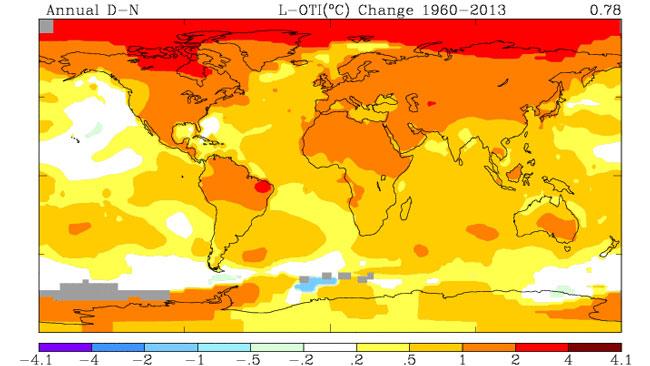
NASA/GISS
Trends in mean surface air temperature from 1960 to 2013. Notice that the Arctic is red, indicating that the trend over this 50-year period is for an increase in air temperature of more than 2°C (3.6°F) across much of the Arctic, a larger increase than in other parts of the globe.
As the map above shows, warming doesn't occur at the same rate worldwide. Some places, like the tropics, have warmed at a much slower pace than the higher latitudes, where warming has been most pronounced.
And the world hasn't stopped experiencing dramatic warming: the past decade has been one of"unprecedented" climate extremes according to the World Meteorological Organization, while 2013 brought the world's hottest November in more than 130 years of record-keeping, and 2012 was thehottest year on record for the U.S.
If global warming is indeed on "pause," we can only hope it doesn't resume.
MORE ON WEATHER.COM: Photos from the Deep Freeze
Here's some news for people on all sides of the climate change debate: Winters still get cold, often unbearably cold, especially if you live in a place like Crane Lake, Minn., which hit 38 below zero this week.
But no matter how low the temperature dropped in your area today, that doesn't mean global warming isn't happening.
So as Americans debate whether a warming planet can still have punishing winters and try to figure out what a "polar vortex" is – with everyone from Rush Limbaugh to the Drudge Report and a few other commentators talking about it – we'd like to add a dose of science to the conversation.
Let's look at the claims skeptics are making one by one:
1) "Polar vortex" is a concept "created to make you think winter is caused by global warming."
Yesterday on his radio program and website, Rush Limbaugh called a "hoax" the claim that global warming was causing the cold weather snap, and that the media had invented the term "polar vortex" to explain it all away.
Actually, the term "polar vortex" is not a new one. It's used by meteorologists to describe a pattern of winds that swirl around the North Pole, as Weather Underground's Dr. Jeff Masters describes it in a blog post today:
"In the winter, the 24-hour darkness over the snow and ice-covered polar regions allows a huge dome of cold air to form. This cold air increases the difference in temperature between the pole and the Equator, and leads to an intensification of the strong upper-level winds of the jet stream. The strong jet stream winds act to isolate the polar regions from intrusions of warmer air, creating a 'polar vortex' of frigid counter-clockwise swirling air over the Arctic."
For a historical perspective, here's an article from the August 1950 issue of the scientific journal Tellus, describing a lab experiment that replicated the effects of the polar vortex.
2) Winters as cold as this one prove that global warming isn't real.
On Monday, U.S. Sen. James Inhofe (R-Okla.) appeared on the floor of the U.S. Senate and said this:
<iframe width="650" height="366" src="//www.youtube.com/embed/B7_t_oTzrcU" frameborder="0" allowfullscreen></iframe>
We include this example not to pick on Inhofe, but to share one of the latest and highest-profile examples of claims about global warming and climate change that have spread around the mainstream national media in recent years.
In the video, Inhofe cites several examples of frigid cold and winter snowstorms from recent years, including one that he says "snowed out" a planned rally on global warming that was to be led by U.S. Rep. Nancy Pelosi (D-Calif.) in March 2009.
No scientist argues that long-term global warming means that we won't still experience winter, even bitterly cold winters like this year's has become. The changes to the climate that scientists who are concerned about global warming point out are exactly that: long-term. Individual weather events don't mean that the trend isn't taking place.
(It's also important to point out that the United States makes up less than 2 percent of the Earth's surface. So even when we see heavy snow events and blasts of Arctic air like this week's, there are many parts of the world experiencing record heat, such as Australia.)
4) The planet hasn't warmed for the past 15 years, so climate change isn't real.
Technically, this isn't really true. Though surface temperatures haven't gone up by as much as climate models predicted they would by now, they've still been rising slightly throughout the decade.
Starting with its first report in 1990, the Intergovernmental Panel on Climate Change projected that the planet would warm by about 0.15 to 0.3°C per decade, if greenhouse gas emissions into the atmosphere continued at their current pace.
That projection held true for years until about 1998, one of the planet's hottest years on record. Since then, despite ever-increasing emissions, global temperatures have risen by only about 0.05°C per decade.
Why this is happening is something climate scientists still are trying to figure out. Many point to the world's oceans, which are absorbing most of the increase in both heat and carbon dioxide, while others note that our most-cited historical temperature observation records leave out large parts of the planet, including the poles.
Still, it's undeniable that a long-term warming trend remains in place, as this temperature trend map from 1960 to 2013 shows:
NASA/GISS
Trends in mean surface air temperature from 1960 to 2013. Notice that the Arctic is red, indicating that the trend over this 50-year period is for an increase in air temperature of more than 2°C (3.6°F) across much of the Arctic, a larger increase than in other parts of the globe.
As the map above shows, warming doesn't occur at the same rate worldwide. Some places, like the tropics, have warmed at a much slower pace than the higher latitudes, where warming has been most pronounced.
And the world hasn't stopped experiencing dramatic warming: the past decade has been one of"unprecedented" climate extremes according to the World Meteorological Organization, while 2013 brought the world's hottest November in more than 130 years of record-keeping, and 2012 was thehottest year on record for the U.S.
If global warming is indeed on "pause," we can only hope it doesn't resume.
MORE ON WEATHER.COM: Photos from the Deep Freeze
Last edited:
Record Cool in July: 10 Cities On Track For A Cool Summer As Cold Blast Approaches
http://www.weather.com/news/weather-forecast/cool-summer-pattern-july-20140709
http://www.weather.com/news/weather-forecast/cool-summer-pattern-july-20140709
Norway basks under warmest spring
June 9, 2014
Norwegians enjoyed spectacular weather over the pinse holiday, the country’s last long weekend of the year. It capped off a spring which saw average temperatures 2.3 degrees above normal, making it Norway’s warmest spring on record.
http://www.newsinenglish.no/2014/06/09/norway-basks-through-warmest-spring/
June 9, 2014
Norwegians enjoyed spectacular weather over the pinse holiday, the country’s last long weekend of the year. It capped off a spring which saw average temperatures 2.3 degrees above normal, making it Norway’s warmest spring on record.
http://www.newsinenglish.no/2014/06/09/norway-basks-through-warmest-spring/

In Denmark, July 2014 tied with 1994 as the second warmest July in the country's 141-year period of record, behind only July 2006, at 3.9°C (7.0°F) higher than the 1961–1990 average.
Amazing the number of people who claim to be intelligent and yet still can't understand that warming can create cooler temperatures. One can even draw pictures and they still don't get it.
Tsing knows the difference between weather and climate, he's just being a 'tard and fucking with you.Amazing the number of people who claim to be intelligent and yet still can't understand that warming can create cooler temperatures. One can even draw pictures and they still don't get it.