
You are using an out of date browser. It may not display this or other websites correctly.
You should upgrade or use an alternative browser.
You should upgrade or use an alternative browser.
Human-induced climate change requires urgent action
- Thread starter futurecurrents
- Start date

Evaluating a 1981 temperature projection - GHG theory - from Hansen et al.
Global warming was not yet an issue at the KNMI where the focus was much more on climate variability, which explains why the article of Hansen et al. was unnoticed at that time by the second author. It turns out to be a very interesting read.
They got 10 pages in Science, which is a lot, but in it they cover radiation balance, 1D and 3D modelling, climate sensitivity, the main feedbacks (water vapour, lapse rate, clouds, ice- and vegetation albedo); solar and volcanic forcing; the uncertainties of aerosol forcings; and ocean heat uptake. Obviously climate science was a mature field even then: the concepts and conclusions have not changed all that much. Hansen et al clearly indicate what was well known (all of which still stands today) and what was uncertain.
Next they attribute global mean temperature trend 1880-1980 to CO2, volcanic and solar forcing. Most interestingly, Fig.6 (below) gives a projection for the global mean temperature up to 2100. At a time when the northern hemisphere was cooling and the global mean temperature still below the values of the early 1940s, they confidently predicted a rise in temperature due to increasing CO2 emissions. They assume that no action will be taken before the global warming signal will be significant in the late 1990s, so the different energy-use scenarios only start diverging after that.
The first 31 years of this projection are thus relatively well-defined and can now be compared to the observations. We used the GISS Land-Ocean Index that uses SST over the oceans (the original one interpolated from island stations) and overlaid the graph from the KNMI Climate Explorer on the lower left-hand corner of their Fig.6.
Given the many uncertainties at the time, notably the role of aerosols, the agreement is very good indeed. They only underestimated the observed trend by about 30%, similar or better in magnitude than the CMIP5 models over the same period (although these tend to overestimate the trend, still mainly due to problems related to aerosols).
To conclude, a projection from 1981 for rising temperatures in a major science journal, at a time that the temperature rise was not yet obvious in the observations, has been found to agree well with the observations since then, underestimating the observed trend by about 30%, and easily beating naive predictions of no-change or a linear continuation of trends. It is also a nice example of a statement based on theory that could be falsified and up to now has withstood the test. The “global warming hypothesis” has been developed according to the principles of sound science.
- See more at: http://www.realclimate.org/index.ph...1-temperature-projection/#sthash.mPJWKWGz.dpu
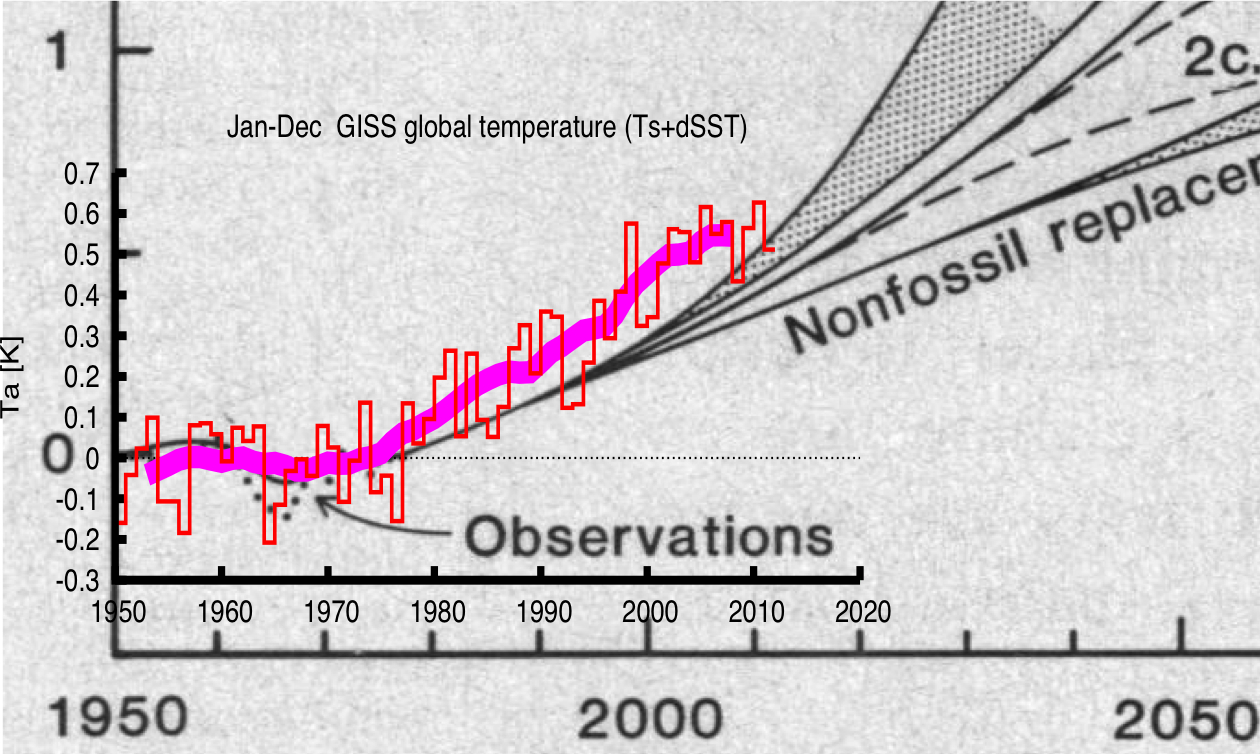
Seen in retrospect now, it's a little unfair to say this, Fig. 6 relating to Hansen, et al., 1981, seems comical. The 1981 paper may have been reviewed internally by the editors, as sometimes happens at Science, rather than having been truly peer reviewed, as that would explain how something as bizarre as this could slip by. Apparently no one noticed that after 90 years of increasing fossil fuel consumption and two world wars the net temperature had barely budged, only to be projected, based on their models, to suddenly begin to zoom up! I love this sort of thing! When later revisited, their projections seemed to agree with a modest increase in temperature observed by then. Unfortunately the rise also approximated the magnitude of cooling noted for the prior period of profligate fossil fuel consumption. They apparently got so excited by their "findings" that no one bothered to ask the obvious questions: "Does the heating noticed so far fall outside normal variation, and were they perhaps basing their unbridled pride in their own brilliance on just a little too short a period."
 Sadly for them their model has now gone very badly wrong and the temperature is refusing to cooperate further. God bless science, god bless Science and god bless scientists!
These sorts of mistakes are not unusual, and when there is either youth or inexperience, or both, they are quite common. Fortunately, for myself, they become less frequent as one ages.
Seen in retrospect now, it's a little unfair to say this, Fig. 6 relating to Hansen, et al., 1981, seems comical. The 1981 paper may have been reviewed internally by the editors, as sometimes happens at Science, rather than having been truly peer reviewed, as that would explain how something as bizarre as this could slip by. Apparently no one noticed that after 90 years of increasing fossil fuel consumption and two world wars the net temperature had barely budged, only to be projected, based on their models, to suddenly begin to zoom up! I love this sort of thing! When later revisited, their projections seemed to agree with a modest increase in temperature observed by then. Unfortunately the rise also approximated the magnitude of cooling noted for the prior period of profligate fossil fuel consumption. They apparently got so excited by their "findings" that no one bothered to ask the obvious questions: "Does the heating noticed so far fall outside normal variation, and were they perhaps basing their unbridled pride in their own brilliance on just a little too short a period."
These sorts of mistakes are not unusual, and when there is either youth or inexperience, or both, they are quite common. Fortunately, for myself, they become less frequent as one ages.
You must have missed the part where Hansen was right 33 years ago and modeled the temp rise quite well and the only way the model made sense was because of the ghg effect of CO2. You must have missed that part. I always find that amusing with you professional deniers. That you somehow totally miss the science. Maybe you are so old your sight is going. Or maybe you work for a think tank.
I notice pie has not responded here. He just tosses bullshit out and then moves on.
His statements are italicized. Mine are standard script.
************************************************************************
"Just because CO2 is a greenhouse gas by definition, and its concentration has been rising, and that's true, it isn't, necessarily, the cause of an observed increase in the Earth's surface temperature. "
Of course it is you bullshit artist. CO2 is the earth's most important long term greenhouse gas. Without it the earth would be 30 - 50 degrees colder. We have raised it's levels by 40%. That HAS to cause warming and it has and is. The level of CO2 is what controls the long term temperature of the earth.http://www.giss.nasa.gov/research/briefs/lacis_01/
"All scientists who have had any training in photochemistry or photophysics know that the effectiveness of a greenhouse gas will depend on its concentration profile, the absorbtivity at the wavelengths emitted from the Earth's surface, and the intensity of emission as a function of wavelength"
Yes, beneath all your layers of impressive sounding and superfluous horseshit you say something right. The effectiveness depends on concentration. We have increased by 40%. So the CO2 in the atmosphere has become more a more effective trapper of long wavelength radiation. Heat.
"To assume that a dilute gas being defined as a greenhouse gas is a sufficient condition for it to cause significant warming, in something as complex as our Earths atmosphere, is, frankly, ridiculous."
No it's not. It's a bedrock principle of climate science. CO2 is a greenhouse gas, you said it yourself. It's the very definition of "greenhouse gas", a dilute gas that that warms the atmosphere. Again, you are off the reservation and full of shit.
"Finally, let me say that your calling internationally recognized experts such as Professor Salby, who is one of the foremost experts in atmospheric physics, a fool and a fraud does your credibility no favor."
I really don't care what you say since you yourself has zero credibility after all the festering piles of impressive sounding, but ultimately absurdly wrong bullshit that you have piled on this topic. You have some set of balls. Are you Salby? Why else would you defend a man like this...
"The National Science Foundation investigation report issued on 20 February 2009 found that Salby had overcharged his grants and violated financial conflict of interest policies, displaying"a pattern of deception, a lack of integrity, and a persistent and intentional disregard of NSF and University rules and policies" and a "consistent willingness to violate rules and regulations, whether federal or local, for his personal benefit." It debarred Salby from receiving federal assistance and benefits until 13 August 2012.[2]
After leaving Colorado, Salby joined the faculty of Macquarie University in Australia, where he was appointed Professor of Climate Risk in 2008. In May 2011, Salby's research showing thatozone levels over Antarctica had begun to recover since the Montreal Protocol banned the use of ozone-depleting substances, was published in Geophysical Research Letters.[7][8] Salby's employment at Macquarie was terminated in 2013. Macquarie University stated that he was dismissed for refusing to fulfill his teaching responsibilities and for inappropriate use of university resources including a corporate credit card.[3][9]"
So he's a liar and a thief.
In addition, his scientific statements and positions are a joke, completely ignoring that there are large annual fluctuations in carbon dioxide, as it is exchanged back-and-forth between the atmosphere, oceans, soils, and forests. This flux in and out of the biosphere and oceans is many times larger than man's annual contributions The resulting CO2 level changes thus are not expected to match human emissions. However, Salby wants us to believe that therefore man's CO2 emissions are not showing up in the atmosphere since they are not well correlated on short term time frames. However, over the course of many years the annual flux in and out of the biosphere and oceans evens out. Some years more is absorbed and others less. On decades long time scales the rising CO2 levels are very well correlated to man's emissions.
So then from this narrow mistaken view of it he then makes the absurd leap that therefore man's emissions are not causing the rise in CO2 and it is instead due to temperature changes. However the temp record does not fit with his theory so he basically just says the ice record is wrong and is not showing atmospheric CO2 levels at the time the ice was laid down. But indeed that is exactly what the ice record is. It is the trapped air of the time the ice was laid down.
On top of all this is the simple fact that man is dumping about 8 billion tons of CO2 into the air every year. That quantity does not just disappear. Indeed the CO2 rise matches the increasing emissions as seen in this chart.
.png)
Far from being a foremost atmospheric expert, Salby is a liar, a thief, a fraud and a fool. He has zero respect among climate scientists dealing with AGW. His earlier work with the ozone layer being an exception. He used this early respect to earn him higher prostitution fees from the fossil fuel interests as an AGW denialist.
That you would defend such a person speaks volumes about you. You are just like him.
His statements are italicized. Mine are standard script.
************************************************************************
"Just because CO2 is a greenhouse gas by definition, and its concentration has been rising, and that's true, it isn't, necessarily, the cause of an observed increase in the Earth's surface temperature. "
Of course it is you bullshit artist. CO2 is the earth's most important long term greenhouse gas. Without it the earth would be 30 - 50 degrees colder. We have raised it's levels by 40%. That HAS to cause warming and it has and is. The level of CO2 is what controls the long term temperature of the earth.http://www.giss.nasa.gov/research/briefs/lacis_01/
"All scientists who have had any training in photochemistry or photophysics know that the effectiveness of a greenhouse gas will depend on its concentration profile, the absorbtivity at the wavelengths emitted from the Earth's surface, and the intensity of emission as a function of wavelength"
Yes, beneath all your layers of impressive sounding and superfluous horseshit you say something right. The effectiveness depends on concentration. We have increased by 40%. So the CO2 in the atmosphere has become more a more effective trapper of long wavelength radiation. Heat.
"To assume that a dilute gas being defined as a greenhouse gas is a sufficient condition for it to cause significant warming, in something as complex as our Earths atmosphere, is, frankly, ridiculous."
No it's not. It's a bedrock principle of climate science. CO2 is a greenhouse gas, you said it yourself. It's the very definition of "greenhouse gas", a dilute gas that that warms the atmosphere. Again, you are off the reservation and full of shit.
"Finally, let me say that your calling internationally recognized experts such as Professor Salby, who is one of the foremost experts in atmospheric physics, a fool and a fraud does your credibility no favor."
I really don't care what you say since you yourself has zero credibility after all the festering piles of impressive sounding, but ultimately absurdly wrong bullshit that you have piled on this topic. You have some set of balls. Are you Salby? Why else would you defend a man like this...
"The National Science Foundation investigation report issued on 20 February 2009 found that Salby had overcharged his grants and violated financial conflict of interest policies, displaying"a pattern of deception, a lack of integrity, and a persistent and intentional disregard of NSF and University rules and policies" and a "consistent willingness to violate rules and regulations, whether federal or local, for his personal benefit." It debarred Salby from receiving federal assistance and benefits until 13 August 2012.[2]
After leaving Colorado, Salby joined the faculty of Macquarie University in Australia, where he was appointed Professor of Climate Risk in 2008. In May 2011, Salby's research showing thatozone levels over Antarctica had begun to recover since the Montreal Protocol banned the use of ozone-depleting substances, was published in Geophysical Research Letters.[7][8] Salby's employment at Macquarie was terminated in 2013. Macquarie University stated that he was dismissed for refusing to fulfill his teaching responsibilities and for inappropriate use of university resources including a corporate credit card.[3][9]"
So he's a liar and a thief.
In addition, his scientific statements and positions are a joke, completely ignoring that there are large annual fluctuations in carbon dioxide, as it is exchanged back-and-forth between the atmosphere, oceans, soils, and forests. This flux in and out of the biosphere and oceans is many times larger than man's annual contributions The resulting CO2 level changes thus are not expected to match human emissions. However, Salby wants us to believe that therefore man's CO2 emissions are not showing up in the atmosphere since they are not well correlated on short term time frames. However, over the course of many years the annual flux in and out of the biosphere and oceans evens out. Some years more is absorbed and others less. On decades long time scales the rising CO2 levels are very well correlated to man's emissions.
So then from this narrow mistaken view of it he then makes the absurd leap that therefore man's emissions are not causing the rise in CO2 and it is instead due to temperature changes. However the temp record does not fit with his theory so he basically just says the ice record is wrong and is not showing atmospheric CO2 levels at the time the ice was laid down. But indeed that is exactly what the ice record is. It is the trapped air of the time the ice was laid down.
On top of all this is the simple fact that man is dumping about 8 billion tons of CO2 into the air every year. That quantity does not just disappear. Indeed the CO2 rise matches the increasing emissions as seen in this chart.
Far from being a foremost atmospheric expert, Salby is a liar, a thief, a fraud and a fool. He has zero respect among climate scientists dealing with AGW. His earlier work with the ozone layer being an exception. He used this early respect to earn him higher prostitution fees from the fossil fuel interests as an AGW denialist.
That you would defend such a person speaks volumes about you. You are just like him.
Last edited:

Yup, missed it.You must have missed the part where Hansen was right 33 years ago and modeled the temp rise quite well and the only way the model made sense was because of the ghg effect of CO2. You must have missed that part. I always find that amusing with you professional deniers. That you somehow totally miss the science. Maybe you are so old your sight is going. Or maybe you work for a think tank.
- Warming of the climate system is unequivocal, as evidenced by increases in global average air and ocean temperatures, the widespread melting of snow and ice, and rising global average sea level.[5]
- Most of the global warming since the mid-20th century is very likely due to human activities.[6]
- Benefits and costs of climate change for [human] society will vary widely by location and scale.[7] Some of the effects intemperate and polar regions will be positive and others elsewhere will be negative.[7] Overall, net effects are more likely to be strongly negative with larger or more rapid warming.[7]
- The range of published evidence indicates that the net damage costs of climate change are likely to be significant and to increase over time.[8]
- The resilience of many ecosystems is likely to be exceeded this century by an unprecedented combination of climate change, associated disturbances (e.g.flooding, drought, wildfire, insects, ocean acidification) and other global change drivers (e.g. land-use change, pollution, fragmentation of natural systems, over-exploitation of resources).[9]

An enhanced greenhouse effect from CO2 has been confirmed by multiple lines of empirical evidence. Satellite measurements of infrared spectra over the past 40 years observe less energy escaping to space at the wavelengths associated with CO2. Surface measurements find more downward infrared radiation warming the planet's surface. This provides a direct, empirical causal link between CO2 and global warming
As a greenhouse gas, this increase in atmospheric CO2 increases the amount of downward longwave radiation from the atmosphere, including towards the Earth's surface.
Surface measurements of downward longwave radiation
The increase in atmospheric CO2 and other greenhouse gases has increased the amount of infrared radiation absorbed and re-emitted by these molecules in the atmosphere. The Earth receives energy from the Sun in the form of visible light and ultraviolet radiation, which is then re-radiated away from the surface as thermal radiation in infrared wavelengths. Some of this thermal radiation is then absorbed by greenhouse gases in theatmosphere and re-emitted in all directions, some back downwards, increasing the amount of energy bombarding the Earth's surface. This increase in downward infrared radiationhas been observed through spectroscopy, which measures changes in the electromagnetic spectrum.

Figure 2: Spectrum of the greenhouse radiation measured at the surface. Greenhouse effect from water vapor is filtered out, showing the contributions of other greenhouse gases (Evans 2006).
Satellite measurements of outgoing longwave radiation
The increased greenhouse effect is also confirmed by NASA's IRIS satellite and the Japanese Space Agency's IMG satellite observing less longwave leaving the Earth'satmosphere.

Figure 3: Change in spectrum from 1970 to 1996 due to trace gases. 'Brightness temperature' indicates equivalent blackbody temperature (Harries 2001).
The increased energy reaching the Earth's surface from the increased greenhouse effectcauses it to warm. So how do we quantify the amount of warming that it causes?
As a greenhouse gas, this increase in atmospheric CO2 increases the amount of downward longwave radiation from the atmosphere, including towards the Earth's surface.
Surface measurements of downward longwave radiation
The increase in atmospheric CO2 and other greenhouse gases has increased the amount of infrared radiation absorbed and re-emitted by these molecules in the atmosphere. The Earth receives energy from the Sun in the form of visible light and ultraviolet radiation, which is then re-radiated away from the surface as thermal radiation in infrared wavelengths. Some of this thermal radiation is then absorbed by greenhouse gases in theatmosphere and re-emitted in all directions, some back downwards, increasing the amount of energy bombarding the Earth's surface. This increase in downward infrared radiationhas been observed through spectroscopy, which measures changes in the electromagnetic spectrum.

Figure 2: Spectrum of the greenhouse radiation measured at the surface. Greenhouse effect from water vapor is filtered out, showing the contributions of other greenhouse gases (Evans 2006).
Satellite measurements of outgoing longwave radiation
The increased greenhouse effect is also confirmed by NASA's IRIS satellite and the Japanese Space Agency's IMG satellite observing less longwave leaving the Earth'satmosphere.
Figure 3: Change in spectrum from 1970 to 1996 due to trace gases. 'Brightness temperature' indicates equivalent blackbody temperature (Harries 2001).
The increased energy reaching the Earth's surface from the increased greenhouse effectcauses it to warm. So how do we quantify the amount of warming that it causes?
Radiative Transfer Models
Radiative transfer models use fundamental physical equations and observations to translate this increased downward radiation into a radiative forcing, which effectively tells us how much increased energy is reaching the Earth's surface. Studies have shown that these radiative transfer models match up with the observed increase in energy reaching the Earth's surface with very good accuracy (Puckrin 2004). Scientists can then derive a formula for calculating the radiative forcing based on the change in the amount of eachgreenhouse gas in the atmosphere (Myhre 1998). Each greenhouse gas has a differentradiative forcing formula, but the most important is that of CO2:
dF = 5.35 ln(C/Co)
Where 'dF' is the radiative forcing in Watts per square meter, 'C' is the concentration of atmospheric CO2, and 'Co' is the reference CO2concentration. Normally the value of Co is chosen at the pre-industrial concentration of 280 ppmv.
Now that we know how to calculate the radiative forcing associated with an increase inCO2, how do we determine the associated temperature change?
Climate sensitivity
As the name suggests, climate sensitivity is an estimate of how sensitive the climate is to an increase in a radiative forcing. The climate sensitivity value tells us how much the planet will warm or cool in response to a given radiative forcing change. As you might guess, the temperature change is proportional to the change in the amount of energy reaching the Earth's surface (the radiative forcing), and the climate sensitivity is the coefficient of proportionality:
dT = λ*dF
Where 'dT' is the change in the Earth's average surface temperature, 'λ' is the climate sensitivity, usually with units in Kelvin or degrees Celsius per Watts per square meter (°C/[W/m2]), and 'dF' is the radiative forcing.
So now to calculate the change in temperature, we just need to know the climate sensitivity. Studies have given a possible range of values of 2-4.5°C warming for a doubling of CO2 (IPCC 2007). Using these values it's a simple task to put the climate sensitivity into the units we need, using the formulas above:
λ = dT/dF = dT/(5.35 * ln[2])= [2 to 4.5°C]/3.7 = 0.54 to 1.2°C/(W/m2)
Using this range of possible climate sensitivity values, we can plug λ into the formulas above and calculate the expected temperature change. The atmospheric CO2concentration as of 2010 is about 390 ppmv. This gives us the value for 'C', and for 'Co' we'll use the pre-industrial value of 280 ppmv.
dT = λ*dF = λ * 5.35 * ln(390/280) = 1.8 * λ
Plugging in our possible climate sensitivity values, this gives us an expected surface temperature change of about 1–2.2°C of global warming, with a most likely value of 1.4°C. However, this tells us the equilibrium temperature. In reality it takes a long time to heat up the oceans due to their thermal inertia. For this reason there is currently a planetary energy imbalance, and the surface has only warmed about 0.8°C. In other words, even if we were to immediately stop adding CO2 to the atmosphere, the planet would warm another ~0.6°C until it reached this new equilibrium state (confirmed by Hansen 2005). This is referred to as the 'warming in the pipeline'.
Of course this is just the temperature change we expect to observe from the CO2 radiative forcing. Humans cause numerous other radiative forcings, both positive (e.g. othergreenhouse gases) and negative (e.g. sulfate aerosols which block sunlight). Fortunately, the negative and positive forcings are roughly equal and cancel each other out, and the natural forcings over the past half century have also been approximately zero (Meehl 2004), so the radiative forcing from CO2 alone gives us a good estimate as to how much we expect to see the Earth's surface temperature change.
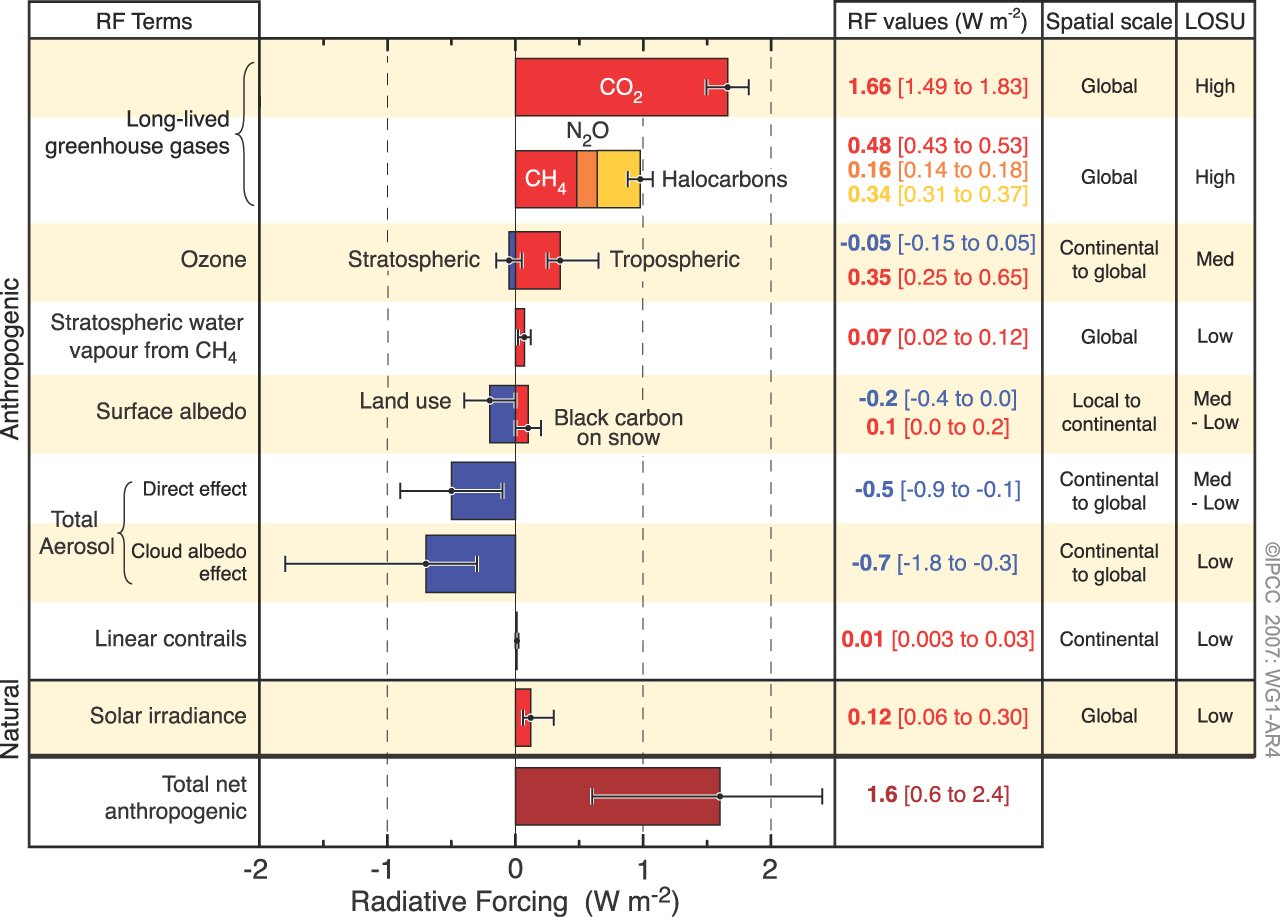
Figure 4: Global average radiative forcing in 2005 (best estimates and 5 to 95%uncertainty ranges) with respect to 1750 (IPCC AR4).
We can also calculate the most conservative possible temperature change in response to the CO2 increase. Some climate scientists who are touted as 'skeptics' have suggested the actual climate sensitivity could be closer to 1°C for a doubling of CO2, or 0.27°C/(W/m2). Although numerous studies have ruled out climate sensitivity values this low, it's worth calculating how much of a temperature change this unrealistically low value would generate. Using the same formulas as above,
dT = 1.8 * λ = 1.8 * 0.27 = 0.5°C.
Therefore, even under this ultra-conservative unrealistic low climate sensitivity scenario, the increase in atmospheric CO2 over the past 150 years would account for over half of the observed 0.8°C increase in surface temperature.
Radiative transfer models use fundamental physical equations and observations to translate this increased downward radiation into a radiative forcing, which effectively tells us how much increased energy is reaching the Earth's surface. Studies have shown that these radiative transfer models match up with the observed increase in energy reaching the Earth's surface with very good accuracy (Puckrin 2004). Scientists can then derive a formula for calculating the radiative forcing based on the change in the amount of eachgreenhouse gas in the atmosphere (Myhre 1998). Each greenhouse gas has a differentradiative forcing formula, but the most important is that of CO2:
dF = 5.35 ln(C/Co)
Where 'dF' is the radiative forcing in Watts per square meter, 'C' is the concentration of atmospheric CO2, and 'Co' is the reference CO2concentration. Normally the value of Co is chosen at the pre-industrial concentration of 280 ppmv.
Now that we know how to calculate the radiative forcing associated with an increase inCO2, how do we determine the associated temperature change?
Climate sensitivity
As the name suggests, climate sensitivity is an estimate of how sensitive the climate is to an increase in a radiative forcing. The climate sensitivity value tells us how much the planet will warm or cool in response to a given radiative forcing change. As you might guess, the temperature change is proportional to the change in the amount of energy reaching the Earth's surface (the radiative forcing), and the climate sensitivity is the coefficient of proportionality:
dT = λ*dF
Where 'dT' is the change in the Earth's average surface temperature, 'λ' is the climate sensitivity, usually with units in Kelvin or degrees Celsius per Watts per square meter (°C/[W/m2]), and 'dF' is the radiative forcing.
So now to calculate the change in temperature, we just need to know the climate sensitivity. Studies have given a possible range of values of 2-4.5°C warming for a doubling of CO2 (IPCC 2007). Using these values it's a simple task to put the climate sensitivity into the units we need, using the formulas above:
λ = dT/dF = dT/(5.35 * ln[2])= [2 to 4.5°C]/3.7 = 0.54 to 1.2°C/(W/m2)
Using this range of possible climate sensitivity values, we can plug λ into the formulas above and calculate the expected temperature change. The atmospheric CO2concentration as of 2010 is about 390 ppmv. This gives us the value for 'C', and for 'Co' we'll use the pre-industrial value of 280 ppmv.
dT = λ*dF = λ * 5.35 * ln(390/280) = 1.8 * λ
Plugging in our possible climate sensitivity values, this gives us an expected surface temperature change of about 1–2.2°C of global warming, with a most likely value of 1.4°C. However, this tells us the equilibrium temperature. In reality it takes a long time to heat up the oceans due to their thermal inertia. For this reason there is currently a planetary energy imbalance, and the surface has only warmed about 0.8°C. In other words, even if we were to immediately stop adding CO2 to the atmosphere, the planet would warm another ~0.6°C until it reached this new equilibrium state (confirmed by Hansen 2005). This is referred to as the 'warming in the pipeline'.
Of course this is just the temperature change we expect to observe from the CO2 radiative forcing. Humans cause numerous other radiative forcings, both positive (e.g. othergreenhouse gases) and negative (e.g. sulfate aerosols which block sunlight). Fortunately, the negative and positive forcings are roughly equal and cancel each other out, and the natural forcings over the past half century have also been approximately zero (Meehl 2004), so the radiative forcing from CO2 alone gives us a good estimate as to how much we expect to see the Earth's surface temperature change.
Figure 4: Global average radiative forcing in 2005 (best estimates and 5 to 95%uncertainty ranges) with respect to 1750 (IPCC AR4).
We can also calculate the most conservative possible temperature change in response to the CO2 increase. Some climate scientists who are touted as 'skeptics' have suggested the actual climate sensitivity could be closer to 1°C for a doubling of CO2, or 0.27°C/(W/m2). Although numerous studies have ruled out climate sensitivity values this low, it's worth calculating how much of a temperature change this unrealistically low value would generate. Using the same formulas as above,
dT = 1.8 * λ = 1.8 * 0.27 = 0.5°C.
Therefore, even under this ultra-conservative unrealistic low climate sensitivity scenario, the increase in atmospheric CO2 over the past 150 years would account for over half of the observed 0.8°C increase in surface temperature.