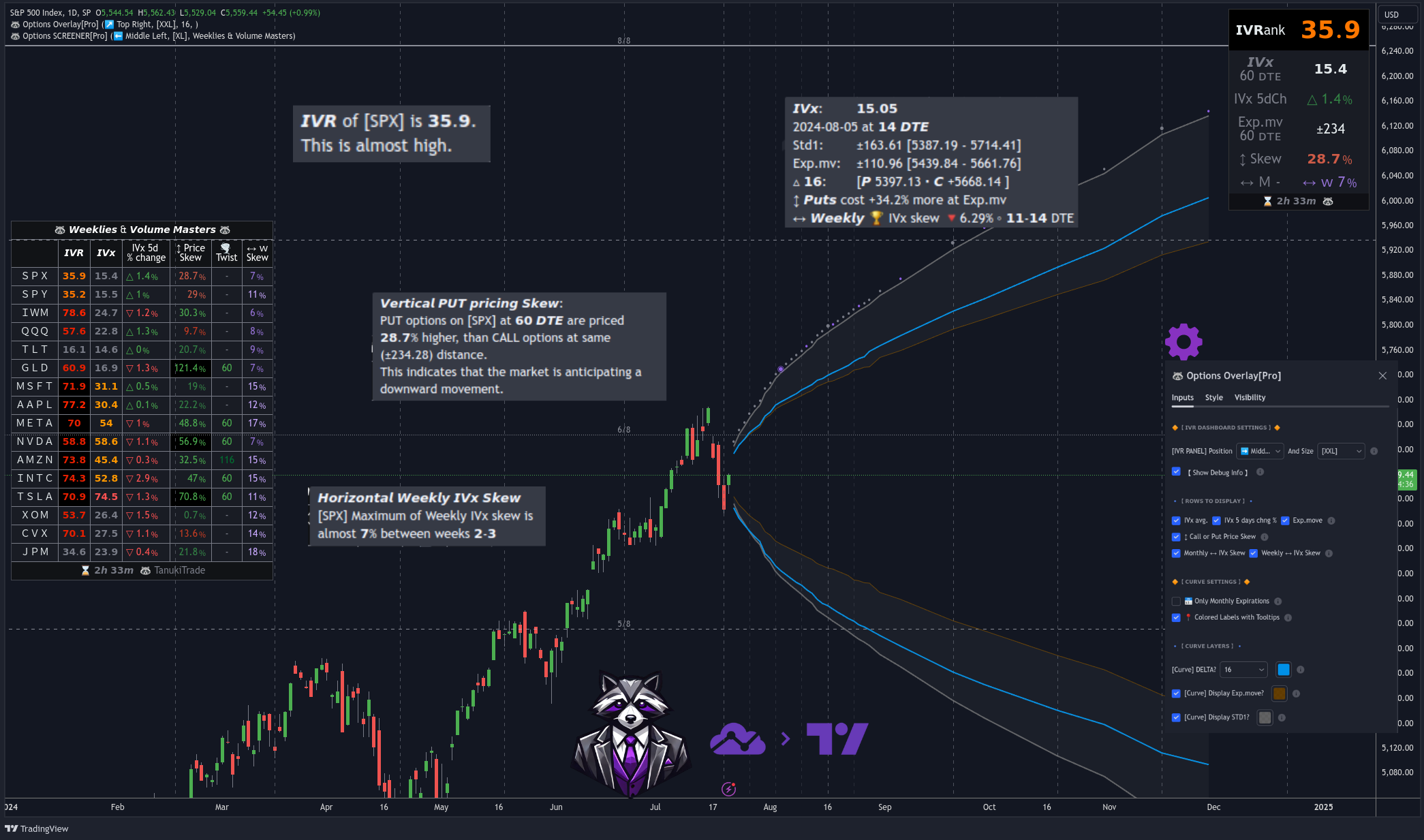
How to Use ‘Expected Move’ to Improve Your Options Trading Strategy

Which ‘Expected Move’ Can Help Your Option Strategies? Standard, Binary, and Implied Moves: When to Use Each?

One of the most crucial yet often misunderstood concepts in options trading is the “Expected Move.” Despite its widespread use by top educators, I’ve noticed confusion among traders due to unclear distinctions between different types of Expected Move calculations. This post aims to demystify the key types of Expected Move used in options trading, explaining their applications, advantages, and limitations.

My goal is to help the options community better understand market dynamics and use strategies more effectively.

Gregory Peter Szilagyi,
Founder of TanukiTrade Options

If you want to get a better understanding of Option Implied Probability Distributions, it is worth digging through some of the following

Natenberg:

upload_2024-9-6_12-55-50.png


Morgan Stanley:

upload_2024-9-6_12-56-58.png


Mean Absolute Deviation v Standard Deviation:


Option Implied Probabilities:

https://reasonabledeviations.com/2020/10/01/option-implied-pdfs/
https://reasonabledeviations.com/2020/10/10/option-implied-pdfs-2/

Straddles, Volatility and Win Rates:

https://moontowermeta.com/straddles-volatility-and-win-rates/
https://moontowermeta.com/a-visual-appreciation-for-black-scholes-delta/
 
If you want to get a better understanding of Option Implied Probability Distributions, it is worth digging through some of the following

Thank you for your insights and critical feedback! I appreciate that you took the time to share your detailed thoughts on the different Expected Move calculation methods, and these professional discussions truly help us all to better understand the topic.

  1. Normal vs. Lognormal Distribution
    You are absolutely right that the Standard Expected Move (STD1) calculation assumes a normal distribution, which is symmetric and does not account for the lower boundary of stock prices (prices cannot be negative). It’s important to clarify this difference, and indeed, it would be more accurate to consider lognormal distributions when discussing probability distributions in the options markets. The STD1 calculation is more of a simplified tool to estimate the general boundaries of market volatility rather than a precise forecast.

  2. Binary Expected Move (BEM)
    The BEM aims to provide a straightforward method for predicting expected moves in event-driven market scenarios. Your point that the BEM probability might be lower than the standard 68% range is valid, and it would be worth emphasizing this more clearly in the article. This method originates from TastyTrade and offers an approximation that focuses more on weighing market reactions rather than mapping a strict probability distribution.

  3. Offering Multiple Methods
    The various Expected Move calculations are included in the article to give traders a range of tools because there isn’t a single “best” method that applies to every market scenario. The goal was to present different perspectives that traders can use based on their individual preferences and market conditions.
It’s important to highlight that before the TanukiTrade Options Overlay indicator, there was no tool on TradingView that considered options pricing data in such a visually accessible form. According to feedback from active options traders, the indicator performs well because it finally allows them to see the same data visualized on their charts as they do on their broker platforms, but without the need to monitor two windows simultaneously. This visualization significantly enhances decision-making and improves the trading experience.

hero_mobile.png


The main goal of my project was exactly this: to create a high level options tool for that provides practical assistance for retail traders, not to develop a quant-level tool that would require further refinement of probability distributions. Of course, many probability distributions, such as lognormal or MED, could be integrated, but our target audience—retail traders using the options overlay indicator—do not necessarily need more than this in practice. This is why the indicator has been successful.

Thank you for your comments, and I look forward to continuing the dialogue with the community to further enhance this tool according to traders’ needs.

Best regards,
Gregory Peter Szilagyi
TanukiTrade.com

 
Thank you for your insights and critical feedback! I appreciate that you took the time to share your detailed thoughts on the different Expected Move calculation methods, and these professional discussions truly help us all to better understand the topic.

  1. Normal vs. Lognormal Distribution
    You are absolutely right that the Standard Expected Move (STD1) calculation assumes a normal distribution, which is symmetric and does not account for the lower boundary of stock prices (prices cannot be negative). It’s important to clarify this difference, and indeed, it would be more accurate to consider lognormal distributions when discussing probability distributions in the options markets. The STD1 calculation is more of a simplified tool to estimate the general boundaries of market volatility rather than a precise forecast.

  2. Binary Expected Move (BEM)
    The BEM aims to provide a straightforward method for predicting expected moves in event-driven market scenarios. Your point that the BEM probability might be lower than the standard 68% range is valid, and it would be worth emphasizing this more clearly in the article. This method originates from TastyTrade and offers an approximation that focuses more on weighing market reactions rather than mapping a strict probability distribution.

  3. Offering Multiple Methods
    The various Expected Move calculations are included in the article to give traders a range of tools because there isn’t a single “best” method that applies to every market scenario. The goal was to present different perspectives that traders can use based on their individual preferences and market conditions.
It’s important to highlight that before the TanukiTrade Options Overlay indicator, there was no tool on TradingView that considered options pricing data in such a visually accessible form. According to feedback from active options traders, the indicator performs well because it finally allows them to see the same data visualized on their charts as they do on their broker platforms, but without the need to monitor two windows simultaneously. This visualization significantly enhances decision-making and improves the trading experience.

hero_mobile.png


The main goal of my project was exactly this: to create a high level options tool for that provides practical assistance for retail traders, not to develop a quant-level tool that would require further refinement of probability distributions. Of course, many probability distributions, such as lognormal or MED, could be integrated, but our target audience—retail traders using the options overlay indicator—do not necessarily need more than this in practice. This is why the indicator has been successful.

Thank you for your comments, and I look forward to continuing the dialogue with the community to further enhance this tool according to traders’ needs.

Best regards,
Gregory Peter Szilagyi
TanukiTrade.com

Except none of your methods are mathematically coherent or consistent with any realised/implied volatility, particularly as you seem to extrapolate the Expected Move analysis over a 6 month+ foward window ... which just increases the error factor

Why not use an Expeced Range that is "implied" from the Option Prices themselves ?
 
The BEM (Binary expected move range) is implied exactly from the options price.
First of all, I wanted to show you what you see on tastytrade.

i-Z2h-CYmz-Photoroom.jpg

TanukiTrade Options Overlay [PRO] for TradingView and the compliance in metrics with TastyTrade platform

By saying that you think that all the formulas or approaches I cited are flawed, you are saying that all the approaches and metrics on the tastytrade platform are flawed, as I consider them to be the guiding ones. I will go further: this is what the vast majority of retail options traders consider to be the guiding principles for practical purposes in their day to day trading.
 
The BEM (Binary expected move range) is implied exactly from the options price.
First of all, I wanted to show you what you see on tastytrade.

i-Z2h-CYmz-Photoroom.jpg

TanukiTrade Options Overlay [PRO] for TradingView and the compliance in metrics with TastyTrade platform

By saying that you think that all the formulas or approaches I cited are flawed, you are saying that all the approaches and metrics on the tastytrade platform are flawed, as I consider them to be the guiding ones. I will go further: this is what the vast majority of retail options traders consider to be the guiding principles for practical purposes in their day to day trading.

You seem to have drunk the TastyTrade Kool-Aid ... and yes ... the TastyTrade calculations of Expected Move are Mathematical Diarreah ...

Happy to be proved wrong if you can answer these 2 questions:

1. Why, for a Stock with same Spot/Vol, but different strike widths (say 99-100-101 v 90-100-110), then the TastyTrade method of aggregating Staddle+OTM Straddles result in a different value of Expeceted Move ?

2. Explain why, using your own screenshot, does the TastyTrade 1 Standard Deviation Expected Move (~16% probability) line up with the 32 Delta (~32% probability) Strike ?

upload_2024-9-15_9-3-2.png
 
Back
Top