
You are using an out of date browser. It may not display this or other websites correctly.
You should upgrade or use an alternative browser.
You should upgrade or use an alternative browser.
How to simulate selling straddles?
- Thread starter luckyputanski
- Start date
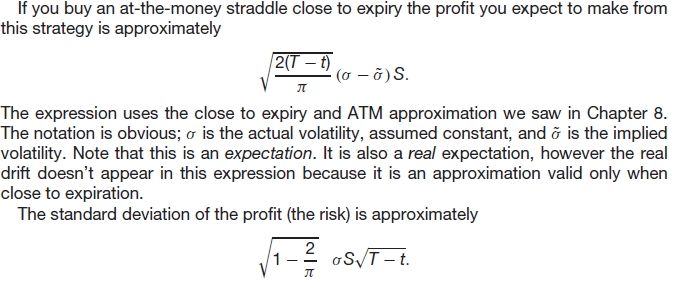
Yep, it's not a coincidence that the "magical factor" the OP is observing is 1.3ish  .
.
.Quote from comintel:
As noted by Martinghoul and others, this is incorrect.
Consider a market which exhibits a steady climb over a period of time.
Since returns are almost constant, realized and implied volatility (the standard deviation of returns) will be almost zero.
That's why I'm using non-centered vol as it supposed to work around this.
You need to think about, amico. You'll see the light, I'm sure. You need to think about the difference between variance and volatility, given your context.Quote from luckyputanski:
No, I sell straddle and wait until expiration. I don't think delta hedging is the reason, as then buying straddles with too high IV and keeping them until expiry would be profitable.
Quote from luckyputanski:
That's why I'm using non-centered vol as it supposed to work around this.
It works around it by assuming the mean is zero (ie. that there is no trend). But if the mean is not actually zero, i.e. if there is a trend, then use of non-centered vol (i.e "ditching the mean") is not valid, as far as I know.
I think if you simulate a strong trend and its effect on options premiums, you will see that one side can even go into the money and show enormous losses without volatility ever increasing, if there is a trend.
Quote from comintel:
It works around it by assuming the mean is zero (ie. that there is no trend). But if the mean is not actually zero, i.e. if there is a trend, then use of non-centered vol (i.e "ditching the mean") is not valid, as far as I know.
That's a good point. But then, if price goes up by 1% every single day, Black-Scholes would price ATM as worthless, which is ludicrous.
Quote from luckyputanski:
That's a good point. But then, if price goes up by 1% every single day, Black-Scholes would price ATM as worthless, which is ludicrous.
Not necessarily because floor-traders / market makers do delta-hedge their positions constantly at almost zero cost to them, so to them the value of a short option (after hedging) may float nicely down to zero and they have made money in that case.
I think that selling a straddle without dynamic hedging it later is a bet that
(1) volatility will not rise
AND
(2) that the underlying will not trend much either.
If either half of this bet is wrong, you lose.
Quote from comintel:
Not necessarily because floor-traders / market makers do delta-hedge their positions constantly at almost zero cost to them, so to them the value of a short option (after hedging) may float nicely down to zero and they have made money in that case.
I think that selling a straddle without dynamic hedging it later is a bet that
(1) volatility will not rise
AND
(2) that the underlying will not trend much either.
If either half of this bet is wrong, you lose.
I think I get the point. However, even when I implemented rolling to ATM every day (once a day), selling straddles still losses money in my simulation. I must be either doing something wrong, or hedging once a day is too rarely.
Quote from luckyputanski:
I think I get the point. However, even when I implemented rolling to ATM every day (once a day), selling straddles still losses money in my simulation. I must be either doing something wrong, or hedging once a day is too rarely.
Where is the money lost? On the put side or the call side? Is it lost on big moves?
Woodard covers simulations similar to yours in
http://www.creativeedge.com/book/personal-finance/9780132756099
You can read it free with a trial subscription.
He has some filters to make it profitable.