
You are using an out of date browser. It may not display this or other websites correctly.
You should upgrade or use an alternative browser.
You should upgrade or use an alternative browser.
How to know if an option leg is expensive?
- Thread starter gowthamn
- Start date

The Black Scholes Option Pricing Model:
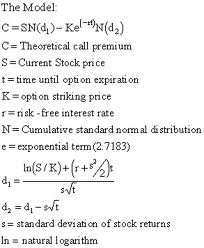
The Model or Formula calculates an theoretical value of an option based on 6 variables. These variables are:
The Model or Formula calculates an theoretical value of an option based on 6 variables. These variables are:
- Whether the option is a call or a put
- The current underlying stock price
- The time left until the option's expiration date
- The strike price of the option
- The risk-free interest rate
- The volatility of the stock
Yes, I know that. The only unknown is Volatility.The Black Scholes Option Pricing Model:
The Model or Formula calculates an theoretical value of an option based on 6 variables. These variables are:
- Whether the option is a call or a put
- The current underlying stock price
- The time left until the option's expiration date
- The strike price of the option
- The risk-free interest rate
- The volatility of the stock
Yes, I know that. The only unknown is Volatility.
That's going vary according to "what's happening now"... with the market in general and with a particular issue and current fundamentals. I don't know how you can "put a number" on that.
IMO: Terminology a bit to vague to provide helpful response. "expensive" relative to what? Consider what you are desiring to accomplish, then focus on more precise objective. Since you mention historic IV, you may be considering whether a specific term/strike is expected to decrease in value due to your expectation that volatility is elevated more than normal. It may aid to consider more of how you expect to exploit a perceived edge, and gain a bit more focus on your evaluation. (how much time will you be in the trade, and what other conditions will impact your decision). Perhaps consider if the specific strike price is in balance with the neighboring strikes (perhaps concavity in the IV surface near your interest point) that may influence you strike choice. Observation of the IV surface near the point in time you expect to exit the trade (assuming you do enough of these to desire statistical bias on your side). [errata: not really statistical bias... More like where the market expects it to go based on current info]How does one know if the price of an options leg is expensive or not? Is looking at the IV of that strike relative to its historic IV the only way to do it?

Look at the IV skew of the option leg relative to the other legs of the spread. If you're trading a call spread where you're buying a 10% IV call and selling a 12% IV call, the skew is in your favor. You'll be paying less extrinsic premium on the 10% IV long strike and you're selling more extrinsic premium on the 12% IV strike. If you have a specific trade in mind, post a screenshot so we can evaluate it.

A more intuitive way is to ask yourself what you believe forward volatility will look like. Vol is only cheap or expensive when you have a view of it going forward. If volatility is 30 and it's never reached that level, but I believe it's going to 40 by historical measure it may be wildly expensive when in reality my forecast means I view it as cheap.
BTW if it's the only strike/expiration that is really out of line there is potentially a really good opportunity to create a ratio or a fly at very favorable prices and I'd be asking myself why the MM trade engines didn't just arb it out.
BTW if it's the only strike/expiration that is really out of line there is potentially a really good opportunity to create a ratio or a fly at very favorable prices and I'd be asking myself why the MM trade engines didn't just arb it out.
Last edited: