

How the IRS Helps the Rich Get Richer
The top 1 percent gets the most from federal tax breaks, a new report shows, fueling election-year outrage over income inequality.
September 29, 2016 — 4:00 AM CDTUpdated on September 29, 2016 — 11:25 AM CDT
Source: Fuse via Getty Images
This U.S. presidential campaign, and particularly that of Democratic Senator Bernie Sanders of Vermont, moved the issue of income inequality front and center. Now there are some new numbers in that department, and they won’t make many people happy. At best, maybe just 1 out of 100.
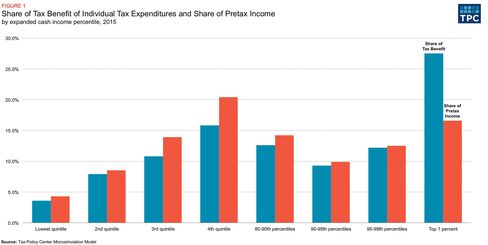
The top 1 percent of Americans as measured by income rake in 17 percent of all U.S. income on an annual basis—before taxes, of course. And that caveat is important, according to a new analysis by the Tax Policy Center (TPC),1 because that select group of citizens gets 27 percent of the tax breaks doled out by the federal government.
https://www.youtube.com/user/Bloomberg
The TPC’s calculations show an estimated $1.17 trillion in federal revenue last year going to individual tax expenditures (a fancy way of saying taxes we didn’t have to pay because of deductions, like for giving old clothes to the Salvation Army—or, in this case, collections to the Metropolitan Museum of Art). While the wealthy see an outsize benefit compared with their share, the lowest-income households get just about 4 percent of federal tax breaks, close to their portion of all pretax income. That same trend holds for taxpayers in middle- and upper-middle-income households.
Source: Tax Policy Center Microsimulation Model
Those 1.1 million folks in the 1 percent, as measured by the TPC, have annual income that averages a little less than $700,000. The top one-tenth of that group, some 110,000 households, average about $3.6 million, according to Howard Gleckman, a senior fellow at the TPC.2..
http://www.bloomberg.com/news/articles/2016-09-29/how-the-irs-helps-the-rich-get-richer
The top 1 percent gets the most from federal tax breaks, a new report shows, fueling election-year outrage over income inequality.
September 29, 2016 — 4:00 AM CDTUpdated on September 29, 2016 — 11:25 AM CDT
Source: Fuse via Getty Images
This U.S. presidential campaign, and particularly that of Democratic Senator Bernie Sanders of Vermont, moved the issue of income inequality front and center. Now there are some new numbers in that department, and they won’t make many people happy. At best, maybe just 1 out of 100.
The top 1 percent of Americans as measured by income rake in 17 percent of all U.S. income on an annual basis—before taxes, of course. And that caveat is important, according to a new analysis by the Tax Policy Center (TPC),1 because that select group of citizens gets 27 percent of the tax breaks doled out by the federal government.
https://www.youtube.com/user/Bloomberg
The TPC’s calculations show an estimated $1.17 trillion in federal revenue last year going to individual tax expenditures (a fancy way of saying taxes we didn’t have to pay because of deductions, like for giving old clothes to the Salvation Army—or, in this case, collections to the Metropolitan Museum of Art). While the wealthy see an outsize benefit compared with their share, the lowest-income households get just about 4 percent of federal tax breaks, close to their portion of all pretax income. That same trend holds for taxpayers in middle- and upper-middle-income households.
Source: Tax Policy Center Microsimulation Model
Those 1.1 million folks in the 1 percent, as measured by the TPC, have annual income that averages a little less than $700,000. The top one-tenth of that group, some 110,000 households, average about $3.6 million, according to Howard Gleckman, a senior fellow at the TPC.2..
http://www.bloomberg.com/news/articles/2016-09-29/how-the-irs-helps-the-rich-get-richer
