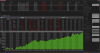
If I make 100 trades a day, and each trade I am risking $30 to make $90 (forget pips for this example), the gross loss of the losing trades is $1500 and the gross profit is $4500. It doesn't matter how many times you flip that coin, you will always make money at the end of the day under those circumstances. Account size is irreverent here as these trades are not relative to account size, but rather a fixed trade size that doesn't change.
If you assume a binomial distribution perhaps. But that's not how trading works.
You'll find in a monte carlo simulation your gains can be substantially less. This code assumes a uniform distribution, which is also not correct, but far more accurate than your binomial assumption.
Your contrived example also has a flaw in assuming that account size doesn't matter. In fact, it matters a lot. Moreover risking $30 to make $90 is entirely unrealistic. I've never seen such a lopsided profit/loss and I've watched every single tastytrade video where they pretend reality is like that.
Code:
import random
def flip():
    flips = 100
    sum = 0
    current_worst = 0
    worst = 0

    for _ in range(flips):
         flip = random.randint(0, 1)
         if (flip == 0):
              sum = sum + 90
              if current_worst > worst:
                worst = current_worst
              current_worst = 0

         else:
              sum = sum - 30
              current_worst = current_worst + 1


    return (worst, sum)

if __name__ == '__main__':
  realizations = []
  drawdowns = []

  i = 10000
  while i > 0:
    results = flip()
    realizations.append(results[1])
    drawdowns.append(results[0])
    i = i - 1

  print(min(realizations))
  print(max(drawdowns))
In my runs I saw a maximum drawdown period of 17. That means in at least one realization there were 17 straight periods of drawdown. It absolutely matters what your account size is and this scales with leverage. Assuming a 25x leverage a 17 period drawdown will ruin you. Feel free to play with it. I set it to 100 trades which was quite generous for this assumption and ran 10,000 simulations.