How is it possible to print money like hell and cause no inflation

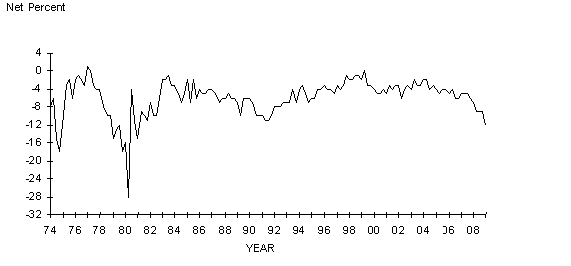
This is a chart from NFIB, Availability of Loans Compared to Three Months Ago (Regular Borrowers Only), Net Percent (“Easier” Minus “Harder”):
nfib.GIF
 
Quote from buylo:

Simple and excellent explanation. Everyone is saying "free money, free money" but banks are not lending. Their standards are as strict as ever so the availability of $$ is just not there for the economy. I have numerous friends with small businesses and they are surely not seeing the money that is being pumped to the banks.

They are probably buying risk assets on the cheap with the money themselves.

If not them, who else is pushing stockmarkets back to pre 08 hights.
 
Quote from Martinghoul:

This is a chart from NFIB, Availability of Loans Compared to Three Months Ago (Regular Borrowers Only), Net Percent (“Easier” Minus “Harder”):
nfib.GIF

Broadening top formation?:eek: :eek:
 
Quote from Martinghoul:

This is a chart from NFIB, Availability of Loans Compared to Three Months Ago (Regular Borrowers Only), Net Percent (“Easier” Minus “Harder”):
nfib.GIF

Martin,
Is this updated?It seems to differ from the Fed Senior Survey which is just about to start showing net easing
Perhaps the difference is that the Fed Survey has a bigger large businesses component and this one is more consumer, small business related?
 
Quote from Daal:

Martin,
Is this updated?It seems to differ from the Fed Senior Survey which is just about to start showing net easing
Perhaps the difference is that the Fed Survey has a bigger large businesses component and this one is more consumer, small business related?
Exactly, Daal. This is a chart of NFIB data, which is specifically based on polls of small US business borrowers. The Fed SLO survey is a poll of the banks that lend to businesses and households. I'd guess that it's the household bit that makes the SLO survey so different from the NFIB one, due to the various mtge relief malarkey.

I haven't looked at the SLO survey recently, but, in general, the disparity between the fortunes of large companies with access to capital mkts and small businesses that rely on the banking system is one of the most striking things in this recession. The way I look at that is normally by comparing the NFIB readings vs the PMIs.
 
Quote from antitrust:

try to keep in mind that inflation is only when all prices rise together. more money being produced then total goods and services. pointing out that one particularity industry is inflating is not inflation. it could be do to increased taxes or land prices or other. It's a common mistake especially on ET

I'm sorry, WHAT? :confused:

Let me try it this way. The money supply has been inflated by astronomic proportion but very little of it has actually hit the mass population. Most of it is in reserves and a lot of it has been used in the stock market. I think an even bigger portion is getting repackaged into debt to federal, state & local.

However, certain basic needs categories will rarely be unaffected by increases in money supply. Water & Food are the primary ones, and while retail food prices did experience a slight price drop in the midst of the crisis, they have risen right back to pre-crisis levels and then some. Same goes for water, although that is regulated.
I can also point to electricity, which has been continuing its rise in spite of dropping natural gas prices.
 
1. "Printing money" is a flux; money level is a stock variable. T

These two variables are obviously related but prices are affected directly by the current level of money and credit (stock) not by the velocity that it is growing or shrinking (flux) - even though it can affect inflation expectation and thus inflation itself to a lesser extent.

2. Since Keynes we formally know that money has a utility called "value reserve".

It means that people (or institutions) may not spend on goods and services the money they have on hands if they are not confident about the future. They play it safe and store it.

3. No economic variable has value alone.

They are worth something only in relation with other variable.

For example, in a country where the GDP is growing in a fastest pace than the money supply, the economy could suffer from DEflation even though its central bank was printing money "out of thin air".
 
Quote from misterno:

Yet, this is right now happening

Can someone explain how this is possible?

When loans are made by banks new money enters the system.

When loans are repaid by borrowers, money is "destroyed" and the money supply contracts.

Despite the Fed giving trillions to the banking institutions, they (the commercial banks) are HARDLY making new loans.

Maybe some of the traders/investors here on the Site could offer more info. Personally, I don't borrow money for anything so I'm unsure if banks are lending.

I've heard from friends that RE lending is still very tight (unavailable); not sure if people are getting financing for larger purchases (cars, electronics, etc.)

Hope this answers your question, OP.

Remember it all depends on whether commercial banks are creating new Loans to the public, as this is the only way the money supply expands.
 
Quote from Daal:

Martin,
Is this updated?It seems to differ from the Fed Senior Survey which is just about to start showing net easing
Perhaps the difference is that the Fed Survey has a bigger large businesses component and this one is more consumer, small business related?


They are all faked anyway. :D
 
Back
Top