How Bitcoin's vast energy use could burst its bubble - BBC

The biggest bogeyman out there re energy use is the inflationary policies of the global governments. Those policies automatically equal much higher uses of energy across the board.

This is why picking on Bitcoin's energy usage is not something many people in power should touch because doing so opens up the conversation to investigate how energy is being used across the board. How then can the Fed virtue signal about saving the planet when they'll have to face serious questions about how their policies (always growth, must have growth at any cost) are basically doing just the opposite.

Talk all you want, but realise there are very real consequences to that talk.
 
Flared gas that is uneconomic to move to market is being converted into electricity for bitcoin mining. That must be an environmental benefit.
 
Flared gas that is uneconomic to move to market is being converted into electricity for bitcoin mining. That must be an environmental benefit.

Stop it ZB, you're messing with the emotional narative that Bitcoin boils the world.

The Bitcoin bears need something/anything to help them.

The best one I've heard so far is Bitcoin is being used by Right wing domestic terrorists (most of them white of course!) so 'something must be done'.

I haven't heard (yet) that Bitcoin is racist but you know it's coming.
 
https://www.bbc.com/news/science-environment-56215787

We've all heard the stories of Bitcoin millionaires.

Elon Musk is the latest.

His electric car company Tesla made a paper profit of more than $900m (£646m) after buying $1.5bn (£1bn) -worth of the cryptocurrency in early February.

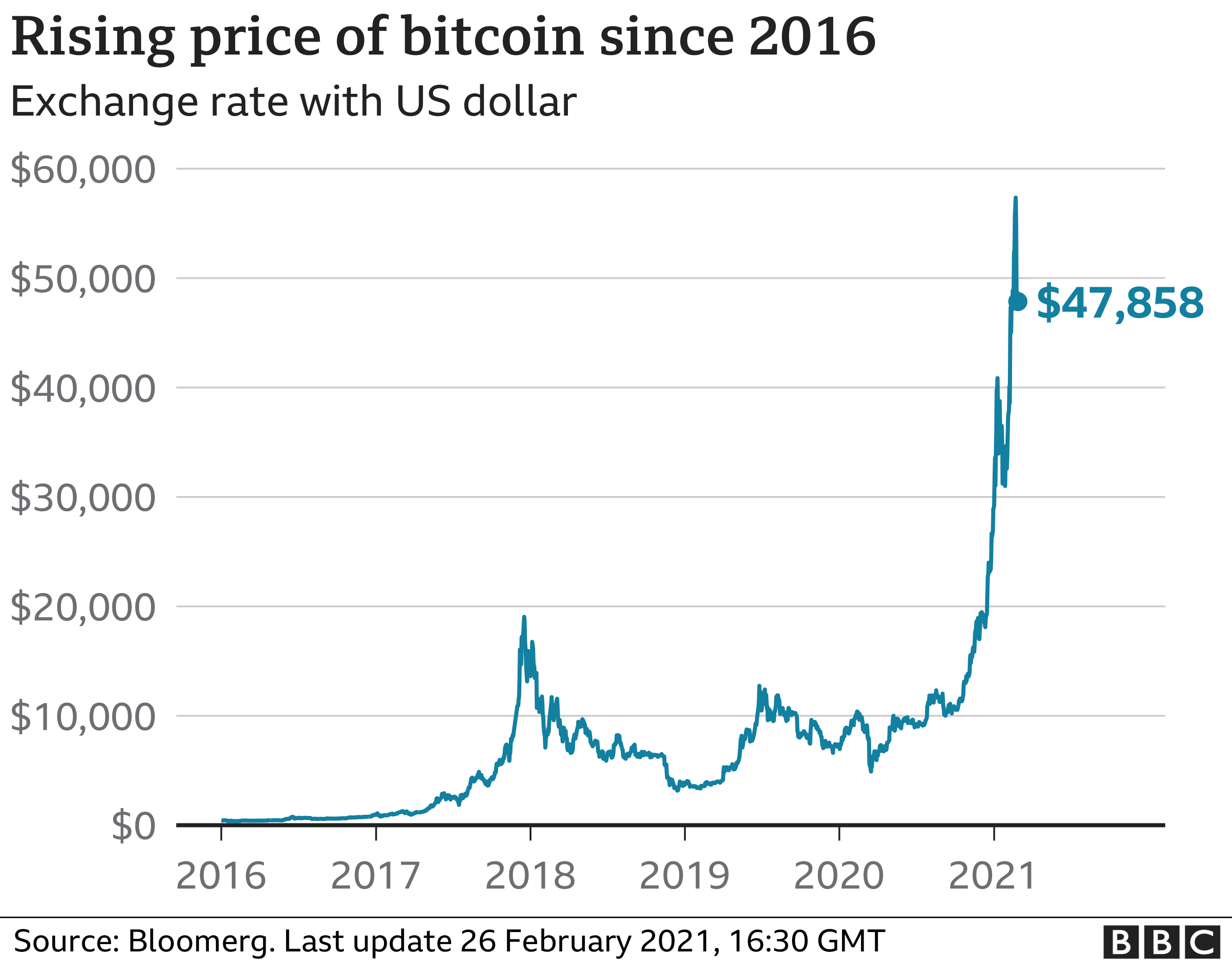
Its high profile support helped pushed the price of a single Bitcoin to more than $58,000.

But it isn't just the digital asset's price that has hit an all-time high. So has its energy footprint.

And that's caused blowback for Mr Musk, as the scale of the currency's environmental impact becomes clearer.

It also helped prompt a series of high profile critics to slate the digital currency this week, including US Treasury Secretary Janet Yellen.

President Biden's top economic adviser described Bitcoin as "an extremely inefficient way to conduct transactions," saying "the amount of energy consumed in processing those transactions is staggering".

It's unclear exactly how much energy Bitcoin uses. Cryptocurrencies are - by design - hard to track. But the consensus is that Bitcoin mining is a very energy-intensive business.

_117317836_optimised-bitcoin-nc.png

The University of Cambridge Centre for Alternative Finance (CCAF) studies the burgeoning business of cryptocurrencies.

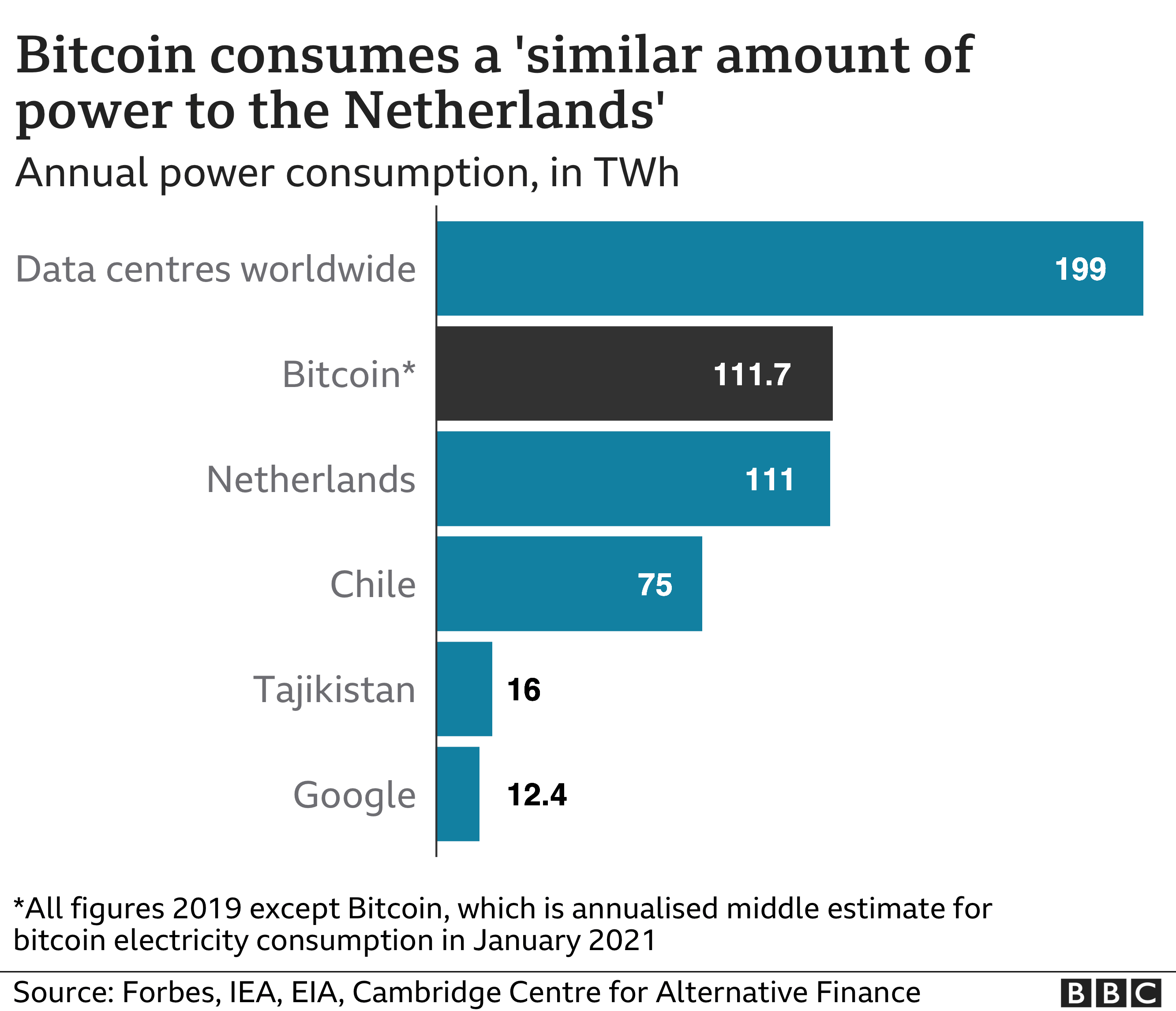
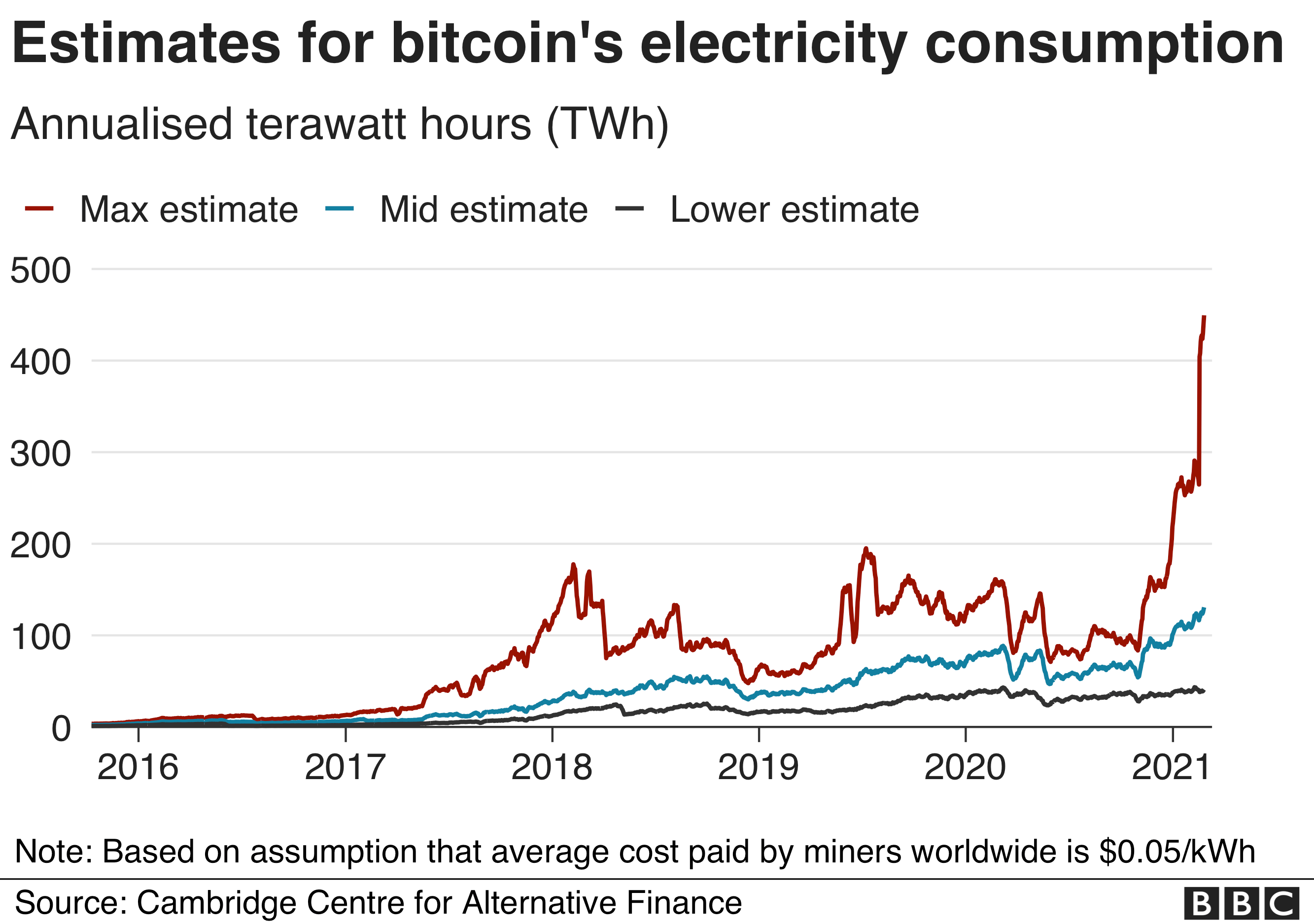
It calculates that Bitcoin's total energy consumption is somewhere between 40 and 445 annualised terawatt hours (TWh), with a central estimate of about 130 terawatt hours.

The UK's electricity consumption is a little over 300 TWh a year, while Argentina uses around the same amount of power as the CCAF's best guess for Bitcoin.

And the electricity the Bitcoin miners use overwhelmingly comes from polluting sources.

The CCAF team surveys the people who manage the Bitcoin network around the world on their energy use and found that about two-thirds of it is from fossil fuels.

Huge computing power - and therefore energy use - is built into the way the blockchain technology that underpins the cryptocurrency has been designed.

It relies on a vast decentralised network of computers.

These are the so-called Bitcoin "miners" who enable new Bitcoins to be created, but also independently verify and record every transaction made in the currency.

In fact, the Bitcoins are the reward miners get for maintaining this record accurately.

It works like a lottery that runs every 10 minutes, explains Gina Pieters, an economics professor at the University of Chicago and a research fellow with the CCAF team.

Data processing centres around the world race to compile and submit this record of transactions in a way that is acceptable to the system.

They also have to guess a random number.

The first to submit the record and the correct number wins the prize - this becomes the next block in the blockchain.

_117317835_optimised-bitcoinelec2-nc.png

At the moment, they are rewarded with six-and-a-quarter Bitcoins, valued at about $50,000 each.

As soon as one lottery is over, a new number is generated, and the whole process starts again.

The higher the price, says Prof Pieters, the more miners want to get into the game.

"They want to get that revenue," she tells me, "and that's what's going to encourage them to introduce more and more powerful machines in order to guess this random number, and therefore you will see an increase in energy consumption," she says.

And there is another factor that drives Bitcoin's increasing energy consumption.

The software ensures it always takes 10 minutes for the puzzle to be solved, so if the number of miners is increasing, the puzzle gets harder and the more computing power needs to be thrown at it.

Bitcoin is therefore actually designed to encourage increased computing effort.

The idea is that the more computers that compete to maintain the blockchain, the safer it becomes, because anyone who might want to try and undermine the currency must control and operate at least as much computing power as the rest of the miners put together.

What this means is that, as Bitcoin gets more valuable, the computing effort expended on creating and maintaining it - and therefore the energy consumed - inevitably increases.

We can track how much effort miners are making to create the currency.

They are currently reckoned to be making 160 quintillion calculations every second - that's 160,000,000,000,000,000,000, in case you were wondering.

And this vast computational effort is the cryptocurrency's Achilles heel, says Alex de Vries, the founder of the Digiconomist website and an expert on Bitcoin.

All the millions of trillions of calculations it takes to keep the system running aren't really doing any useful work.

"They're computations that serve no other purpose," says de Vries, "they're just immediately discarded again. Right now we're using a whole lot of energy to produce those calculations, but also the majority of that is sourced from fossil energy."

The vast effort it requires also makes Bitcoin inherently difficult to scale, he argues.

"If Bitcoin were to be adopted as a global reserve currency," he speculates, "the Bitcoin price will probably be in the millions, and those miners will have more money than the entire [US] Federal budget to spend on electricity."

"We'd have to double our global energy production," he says with a laugh. "For Bitcoin."

He says it also limits the number of transactions the system can process to about five per second.

This doesn't make for a useful currency, he argues.

_117317834_optimised-bitcoin_26022021-nc.png

And that view is echoed by many eminent figures in finance and economics.

The two essential features of a successful currency are that it is an effective form of exchange and a stable store of value, says Ken Rogoff, a professor of economics at Harvard University in Cambridge, Massachusetts, and a former chief economist at the International Monetary Fund (IMF).

He says Bitcoin is neither.

"The fact is, it's not really used much in the legal economy now. Yes, one rich person sells it to another, but that's not a final use. And without that it really doesn't have a long-term future."

What he is saying is that Bitcoin exists almost exclusively as a vehicle for speculation.

So, I want to know: is the bubble about to burst?

"That's my guess," says Prof Rogoff and pauses.

"But I really couldn't tell you when."

Good job man, looks like you spent a lot of time posting that here. I'm sure the price of Bitcoin will start plummeting now that you posted this. Maybe you'll have a chance to buy at 48k instead of 49. Very proud of you, you are so smart...
 
Flared gas that is uneconomic to move to market is being converted into electricity for bitcoin mining. That must be an environmental benefit.
Anything Bit"coin" is always going to be a waste of resources no matter what. There's no purpose, no end use for a made-up digital token that nobody needs. Even if the energy is near-free, speciality hardware used for mining is not. Typically ASICs made just for Bit"coin".

All the BTC bulls are talking their book all the time, for their own personal gain. (I have no involvement in cryptos.) The pyramid scheme -- that Bit"coin" is -- needs a constant influx of new fools to merely stay afloat.

We've just established why. At normal costs of $0.10/kWh even 5% of BTC's current market cap is spent on power each year. That's excluding the speciality hardware. BTC would die of its own weight were it not for the influx of conned new fools buying an intrinsically worthless digital token.
 
Anything Bit"coin" is always going to be a waste of resources no matter what. There's no purpose, no end use for a made-up digital token that nobody needs. Even if the energy is near-free, speciality hardware used for mining is not. Typically ASICs made just for Bit"coin".

All the BTC bulls are talking their book all the time, for their own personal gain. (I have no involvement in cryptos.) The pyramid scheme -- that Bit"coin" is -- needs a constant influx of new fools to merely stay afloat.

We've just established why. At normal costs of $0.10/kWh even 5% of BTC's current market cap is spent on power each year. That's excluding the speciality hardware. BTC would die of its own weight were it not for the influx of conned new fools buying an intrinsically worthless digital token.

How much energy is used in gold mining? How much energy is used by banks running the fractional reserve? Money is energy.
 
Americans should learn from Galileo and his battle with heliocentrism, ie the world doesn't revolve around America.

As a European citizen I agree for 100%.

Now we should try to find somebody o learn you math. Then you can see yourself that what you posted doesn't add up.
 
Anything Bit"coin" is always going to be a waste of resources no matter what. There's no purpose, no end use for a made-up digital token that nobody needs. Even if the energy is near-free, speciality hardware used for mining is not. Typically ASICs made just for Bit"coin".

All the BTC bulls are talking their book all the time, for their own personal gain. (I have no involvement in cryptos.) The pyramid scheme -- that Bit"coin" is -- needs a constant influx of new fools to merely stay afloat.

We've just established why. At normal costs of $0.10/kWh even 5% of BTC's current market cap is spent on power each year. That's excluding the speciality hardware. BTC would die of its own weight were it not for the influx of conned new fools buying an intrinsically worthless digital token.

Why not buck the trend buddy?

Put on a short position rather than talk because you're talking with some conviction. Something in your view is worthless yet the market is valuing it around $50k. Lot's of money to be made there.

In this game you get paid when you put positions on, not when you talk which is why few listen to the bears and thank god we haven't over the last 10 years.

So give the bulls some credit, at least they're backing their talk with action. The other big difference with the bulls versus the bears is the bulls have a point where they'll be wrong, a good one being if/when it trades sub $1k for 365 days solid. Until that happens the game is very much on.

So where's that point for the bears? Good trading and investment is as much about understanding where and when you'll be wrong as much as where and when you'll be right. In fact, as we all know, being first wrong can often be excellent news as it can lead you to being big-time right overall.

So as the virtual/digital economy grows and grows over the coming decade, and Bitcoin is (probably) seen as the native currency/value to drive it ever stronger, will you still be telling us how it's all worthless and everything will 'soon' collapse. Or maybe you'll be like Pek, still screaming about Tether!
 
Put on a short position rather than talk because you're talking with some conviction. Something in your view is worthless yet the market is valuing it around $50k. Lot's of money to be made there.

  • You only make money when you sell all your bitcoins (when the money is in the bank). I know people who were millionaires in stocks, but they forgot to sell at that moment and finally they were millionaire off again.
  • In general people who are against crypto's are so because they see it as a scam. So why go short in a scam? Better trade real stocks or futures.
  • I would never use a trading system to play in a casino, because it will not work. Crypto's are like a casino.
  • I know several people who are already a few years in crypto's. I beat all of them trading futures. Why trade crypto's then, if I have for me better options with MUCH less risk and more profits? Even if crypto's would not be a scam I would not trade them as I have better options and money is in the bank every day after the close, no overnight risk.
 
I've never heard anyone complain about the use of tumble dryers and their excess energy use.

Global energy use for tumble dryers is around 3-5 times higher than Bitcoin and there's a great and free alternative - hang you washing outside.

I've also never heard anyone complain about the use of 'standby' for electronics. That energy use just in the US is 2x Bitcoin's.

So if people want to whinge about energy use, go after bigger things than Bitcoin otherwise all your talk is fake.

I don't buy this analysis. Dryers run 5-6kw for an hr once a week. A single bitcoin miner is at least 1kw/hr/24/7
Flared gas that is uneconomic to move to market is being converted into electricity for bitcoin mining. That must be an environmental benefit.
I explored this idea and pitched it to a few people. No takers though. See a few comps have taken the mantle finally.
 
Back
Top