
You are using an out of date browser. It may not display this or other websites correctly.
You should upgrade or use an alternative browser.
You should upgrade or use an alternative browser.
Home ownership in US lowest in 20 years
- Thread starter Tsing Tao
- Start date

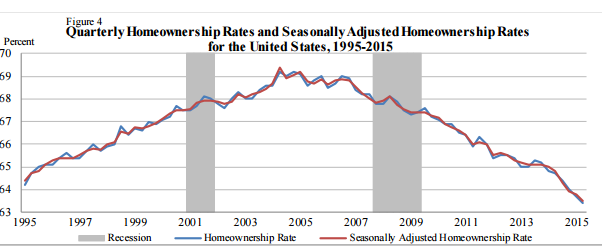

The latest decline began in 2004. Before that, the Reagan years.
I get that you want to counter every possible economic stat that might potentially indicate this is Obama's fault (it's not) but you can't spin either chart (yours or mine) in a good way. Sorry. The headline was correct - lowest in 20 years.
Not sure why you're on that track, I was countering your feddunit angle. Fed policy has varied greatly over those decades.I get that you want to counter every possible economic stat that might potentially indicate this is Obama's fault (it's not) but you can't spin either chart (yours or mine) in a good way. Sorry.
If the recent decline is at least in part attributable to millenials not wanting to be tied down, then the trend is at least in part a good thing (for them).
Not sure why you're on that track, I was countering your feddunit angle. Fed policy has varied greatly over those decades.
If the recent decline is at least in part attributable to millenials not wanting to be tied down, then the trend is at least in part a good thing (for them).
Where in here did I say this was because of the Fed?
Ah, the QE angle. No, I was saying how we need more QE to solve it (sarcasm) which is what some Fed governors are suggesting.
The root cause is obviously wealth inequality - which has been exacerbated by QE.

By keeping their foot mashed on the accelerator pedal the Fed has effectively lost regulatory control of the economy. They themselves pushed it out of the band-of-control. The slightest lift of the pedal (miniscule increase in the prime) now will crash the entire edifice.
Mathematically speaking the response of the US economy to manipulation of interest rates has gone from a critically-damped system to an under-damped system. It is now highly unstable, unresponsive to easing and hyper-responsive to tightening. Welcome to the world of oscillators Obama lol.
Mathematically speaking the response of the US economy to manipulation of interest rates has gone from a critically-damped system to an under-damped system. It is now highly unstable, unresponsive to easing and hyper-responsive to tightening. Welcome to the world of oscillators Obama lol.
Unless there is a supply shock to drive inflation there is no reason for the Fed to raise interest rates, that is, until demand-driven inflation makes an appearance. But when the latter has appeared, wages are rising and the system can withstand the tightening.By keeping their foot mashed on the accelerator pedal the Fed has effectively lost regulatory control of the economy. They themselves pushed it out of the band-of-control. The slightest lift of the pedal (miniscule increase in the prime) now will crash the entire edifice.
Mathematically speaking the response of the US economy to manipulation of interest rates has gone from a critically-damped system to an under-damped system. It is now highly unstable, unresponsive to easing and hyper-responsive to tightening. Welcome to the world of oscillators Obama lol.
Of course all this would be less harrowing (supply shocks do occur) if the nation's currency weren't mainly sitting on one side of the sales counter--income inequality.
The problem could go away, too, if capital finds some new place to go (domestically), on the order of a technological development like the internet.
Unless there is a supply shock to drive inflation there is no reason for the Fed to raise interest rates, that is, until demand-driven inflation makes an appearance. But when the latter has appeared, wages are rising and the system can withstand the tightening.
So you disagree with the number of Fed governors - including Yellen - that have stated that incredibly accomodative policy has helped lead/led to financial market distortion?
No, and I'll concede that point if you'll concede that trickle-down as we knew it is broken.So you disagree with the number of Fed governors - including Yellen - that have stated that incredibly accomodative policy has helped lead/led to financial market distortion?
(I left out an important point re supply shock inflation: we all know what can happen when that occurs, while effective demand is low, and the Fed tightens.)