

Baron
ET Founder
When strength athletes cut out most of the carbohydrates out of their diet, but remain high in their calories, their fat mass decreases and their muscle mass remains constant. According to sports scientists at the University of Malaga in Spain, this means that a high-caloric but low-carbohydrate diet can help strength athletes to lose body fat while retaining muscle mass. But it also means that a low-carbohydrate diet is not effective when strength athletes want to build muscle mass.
Study
The researchers had 24 healthy men, who had been training with weights for at least 2 years, train for 8 weeks in an identical manner. The researchers gave the men a schedule that was designed to stimulate hypertrophy. The researchers divided the men into 3 groups, and gave each group a different diet.
The men in the control group continued to eat as they used to be. [CG]
Another group of men received a protein-rich - 2 grams of protein per kilogram of body weight per day - but low-carbohydrate diet - the men ate a maximum of 42 grams of carbohydrates per day. [KD] The caloric intake was high. Every day the men ate more than 3000 kilocalories.
A third group of men received a more or less 'normal' protein-rich diet. [NKD] These men also ate more than 3000 kilocalories per day.
Results
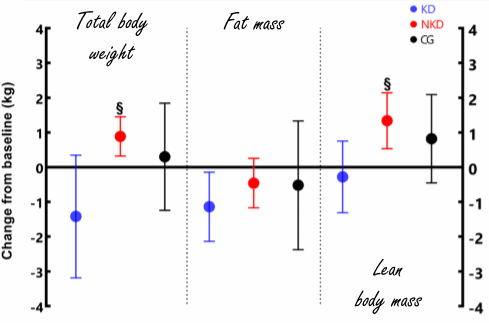
The low-carbohydrate diet reduced the fat mass of the subjects, including the fat mass in the abdominal cavity. Especially the latter type of fat can be dangerous to health. The fat-free mass remained constant.

Conclusion
"According to our results, we concluded that subjects who underwent resistance training during a ketogenic diet experienced a greater reduction in fat mass and visceral adipose tissue, when compared to the non-ketogenic diet group", write the researchers. "The greater reduction in visceral adipose tissue may have some clinical relevance due to its inverse association to cardio-metabolic risk."
"Further studies are necessary to evaluate the advantages of this combination (resistance training and ketogenic diet) in subjects with excess of body fat mass, with particular attention to the reported significant reduction in visceral adipose tissue, which might be highly beneficial to this population given that lean body mass is maintained."
"Indeed, this research showed no significant changes nor effect size on lean body mass, despite hyperenergetic condition and high protein intake (2.0 g/kg/d) in resistance-trained men of the ketogenic diet group. Thus, we conclude that low-carbohydrate dietary approaches would not be an optimal strategy for building muscle mass in trained men under the training conditions of this study (mechanical tension-focused resistance training protocol during 8 weeks)."
Source:
J Int Soc Sports Nutr. 2018 Jul 9;15(1):31.
Study
The researchers had 24 healthy men, who had been training with weights for at least 2 years, train for 8 weeks in an identical manner. The researchers gave the men a schedule that was designed to stimulate hypertrophy. The researchers divided the men into 3 groups, and gave each group a different diet.
The men in the control group continued to eat as they used to be. [CG]
Another group of men received a protein-rich - 2 grams of protein per kilogram of body weight per day - but low-carbohydrate diet - the men ate a maximum of 42 grams of carbohydrates per day. [KD] The caloric intake was high. Every day the men ate more than 3000 kilocalories.
A third group of men received a more or less 'normal' protein-rich diet. [NKD] These men also ate more than 3000 kilocalories per day.
Results
The low-carbohydrate diet reduced the fat mass of the subjects, including the fat mass in the abdominal cavity. Especially the latter type of fat can be dangerous to health. The fat-free mass remained constant.
Conclusion
"According to our results, we concluded that subjects who underwent resistance training during a ketogenic diet experienced a greater reduction in fat mass and visceral adipose tissue, when compared to the non-ketogenic diet group", write the researchers. "The greater reduction in visceral adipose tissue may have some clinical relevance due to its inverse association to cardio-metabolic risk."
"Further studies are necessary to evaluate the advantages of this combination (resistance training and ketogenic diet) in subjects with excess of body fat mass, with particular attention to the reported significant reduction in visceral adipose tissue, which might be highly beneficial to this population given that lean body mass is maintained."
"Indeed, this research showed no significant changes nor effect size on lean body mass, despite hyperenergetic condition and high protein intake (2.0 g/kg/d) in resistance-trained men of the ketogenic diet group. Thus, we conclude that low-carbohydrate dietary approaches would not be an optimal strategy for building muscle mass in trained men under the training conditions of this study (mechanical tension-focused resistance training protocol during 8 weeks)."
Source:
J Int Soc Sports Nutr. 2018 Jul 9;15(1):31.


 .
.