Radiosondes measure temperature at the earths surface as well as at increasing altitudes. They simultaneously measure pressure and humidity. the fundamental problem is that the Hansen Hypothesis in inconsistent with some of the data records. Perhaps you are not aware that conventional surface temperature data is not obtained at constant altitude pressure and humidity.

You are using an out of date browser. It may not display this or other websites correctly.
You should upgrade or use an alternative browser.
You should upgrade or use an alternative browser.
Here's a running list of all the ways climate change has altered Earth in 2019
- Thread starter futurecurrents
- Start date

Radiosondes measure temperature at the earths surface as well as at increasing altitudes. They simultaneously measure pressure and humidity. the fundamental problem is that the Hansen Hypothesis in inconsistent with some of the data records. Perhaps you are not aware that conventional surface temperature data is not obtained at constant altitude pressure and humidity.
So please tell us, since you pretend to know more than the actual climate scientists, what is wrong with the data from the world's top sources as presented below?

And you keep bringing up "Hansen's Hypothesis" in an effort to ad hom and diminish it. It's actually called the greenhouse effect.
And as I showed you multiple times now, Hansen was spot on, was not, and is not wrong .
And radiosonds are not used for surface temps, so again you are wrong, for some deliberate reason.

Don't worry. There will be a new government report that is coming out in the future that will clear all of this up.Guess what? U.S. carbon emissions popped back up in a big way" data-reactid="20" style="font-size: 1.4em; margin: 0.5em 0px 1em; -webkit-font-smoothing: antialiased; text-rendering: optimizelegibility; line-height: 1.4em;">1. Guess what? U.S. carbon emissions popped back up in a big way

Carbon dioxide emissions from air travel rose in 2018.
Image: SHUTTERSTOCK / FRANK_PETERS
"It’s trending in the wrong direction — it’s not encouraging," said Robert McGrath, the director of the University of Colorado Boulder's Renewable and Sustainable Energy Institute who had no role in the report but reviewed it.
Antarctica’s once sleepy ice sheets have awoken. That's bad." data-reactid="35" style="font-size: 1.4em; margin: 0.5em 0px 1em; -webkit-font-smoothing: antialiased; text-rendering: optimizelegibility; line-height: 1.4em;">2. Antarctica’s once sleepy ice sheets have awoken. That's bad.

Antarctic icebergs.
Image: GETTY IMAGES/FOTOSEARCH RF
Antarctica — home to the greatest ice sheets on Earth — isn't just melting significantly faster than it was decades ago. Great masses of ice that scientists once presumed were largely immune to melting are losing ample ice into the sea.
"People are beginning to recognize that East Antarctica might be waking up," said Josh Willis, an oceanographer at NASA's Jet Propulsion Laboratory that visits and measures Earth's melting glaciers.
"There’s growing evidence that eastern Antarctica is not just going to stay frozen and well-behaved in the next 50 to 100 years," he explained.
60% of the planet's wild coffee species face extinction. What that means for your morning caffeine kick." data-reactid="51" style="font-size: 1.4em; margin: 0.5em 0px 1em; -webkit-font-smoothing: antialiased; text-rendering: optimizelegibility; line-height: 1.4em;">3. 60% of the planet's wild coffee species face extinction. What that means for your morning caffeine kick.

Coffee beans
Image: SHUTTERSTOCK / AFRICA STUDIO
"As farmers are increasingly exposed to new climate conditions and changing pest pressures, the genetic diversity of wild crop relatives may be essential to breeding new coffee varieties that can withstand these pressures," Nathan Mueller, an assistant professor of earth system science at the University of California, Irvine who researches global food security, said over email.
Extreme weather — not politicians — convinces Americans that climate change is real" data-reactid="68" style="font-size: 1.4em; margin: 0.5em 0px 1em; -webkit-font-smoothing: antialiased; text-rendering: optimizelegibility; line-height: 1.4em; color: rgb(0, 0, 0); font-family: Georgia, "Times New Roman", serif; background-color: rgb(255, 255, 255);">4. Extreme weather — not politicians — convinces Americans that climate change is real

Reds, oranges, and yellows show 2017 global temperatures warmer than the average.
Image: nasa
The polar vortex will return, this time with the coldest temps of the year" data-reactid="83" style="font-size: 1.4em; margin: 0.5em 0px 1em; -webkit-font-smoothing: antialiased; text-rendering: optimizelegibility; line-height: 1.4em; color: rgb(0, 0, 0); font-family: Georgia, "Times New Roman", serif; background-color: rgb(255, 255, 255);">5. The polar vortex will return, this time with the coldest temps of the year

Temperature forecast for early February 2019.
Image: UNIVERSITY OF MAINE/CLIMATE REANALYZER
The polar vortex has become a popular phenomenon for good reason: This weakening of the polar vortex and the subsequent spillover of frigid air has become more common over the last two decades.
"We are seeing these events occurring more frequently as of late," said Jeff Weber, a meteorologist with the University Corporation for Atmospheric Research.
It's damn cold, but heat records in the U.S. still dominate" data-reactid="99" style="font-size: 1.4em; margin: 0.5em 0px 1em; -webkit-font-smoothing: antialiased; text-rendering: optimizelegibility; line-height: 1.4em; color: rgb(0, 0, 0); font-family: Georgia, "Times New Roman", serif; background-color: rgb(255, 255, 255);">6. It's damn cold, but heat records in the U.S. still dominate

Arctic air flowing south into the U.S. on January 31, 2019.
Image: CLIMATE REANALYZER/UNIVERSITY OF MAINE
While certain portions of the winter sure felt frigid, overall, the number of daily cold records set in the U.S. has been consistently dwarfed by the number of warm or high temperature records. The score isn't even close. High records over the last decade are outpacing low records by a rate of two to one.
In the past 10 years there have been 21,461 record daily highs and 11,466 lows.
"The trend is in exactly the direction we would expect as a result of a warming planet," said Michael Mann, a climate scientist at Penn State University.
Don’t forget about the colossal Himalayan glaciers. They’re rapidly vanishing, too." data-reactid="115" style="font-size: 1.4em; margin: 0.5em 0px 1em; -webkit-font-smoothing: antialiased; text-rendering: optimizelegibility; line-height: 1.4em; color: rgb(0, 0, 0); font-family: Georgia, "Times New Roman", serif; background-color: rgb(255, 255, 255);">7. Don’t forget about the colossal Himalayan glaciers. They’re rapidly vanishing, too.

A weather station in the Hindu Kush Himalaya region.
Image: JITENDRA BAJRACHARYA/ICIMOD
"Glacier-wise, it's not a great story," Joseph Shea, one of the report's lead authors and an assistant professor of environmental geomatics at the University of Northern British Columbia, said in an interview.
House lawmakers finally let climate scientists set the record straight" data-reactid="131" style="font-size: 1.4em; margin: 0.5em 0px 1em; -webkit-font-smoothing: antialiased; text-rendering: optimizelegibility; line-height: 1.4em; color: rgb(0, 0, 0); font-family: Georgia, "Times New Roman", serif; background-color: rgb(255, 255, 255);">8. House lawmakers finally let climate scientists set the record straight

The U.S. Capitol Building in Washington D.C.
Image: SHUTTERSTOCK / NICOLAS AGUIAR
Trump fails to block NASA's carbon sleuth from going to space" data-reactid="147" style="font-size: 1.4em; margin: 0.5em 0px 1em; -webkit-font-smoothing: antialiased; text-rendering: optimizelegibility; line-height: 1.4em; color: rgb(0, 0, 0); font-family: Georgia, "Times New Roman", serif; background-color: rgb(255, 255, 255);">9. Trump fails to block NASA's carbon sleuth from going to space

Half the Earth illuminated by the sun.
Image: esa
Again, the refrigerator-sized space machine persisted.
"Carbon dioxide is the most important gas humans are emitting into the atmosphere," said Annmarie Eldering, the project scientist for OCO-3 at NASA's Jet Propulsion Laboratory. "Understanding how it will play out in the future is critical."
Earth's coldest years on record all happened over 90 years ago" data-reactid="164" style="font-size: 1.4em; margin: 0.5em 0px 1em; -webkit-font-smoothing: antialiased; text-rendering: optimizelegibility; line-height: 1.4em; color: rgb(0, 0, 0); font-family: Georgia, "Times New Roman", serif; background-color: rgb(255, 255, 255);">10. Earth's coldest years on record all happened over 90 years ago

In 2017 Earth's temperatures were significantly warmer than compared to the average.
Image: NASA
Here's a statistic: On Earth, 18 of the last 19 years have been the warmest in recorded history.
The coldest year on record occurred in 1904.
Earth is greener than it was 20 years ago, but not why you think" data-reactid="180" style="font-size: 1.4em; margin: 0.5em 0px 1em; -webkit-font-smoothing: antialiased; text-rendering: optimizelegibility; line-height: 1.4em; color: rgb(0, 0, 0); font-family: Georgia, "Times New Roman", serif; background-color: rgb(255, 255, 255);">11. Earth is greener than it was 20 years ago, but not why you think

Green areas show increases in areas covered by green leaves.
Image: nasa
Two NASA satellites have watched Earth grow greener over the last 20 years — in large part because China is hellbent on planting millions of trees.
China kickstarted its tree-planting mobilizations in the 1990s to combat erosion, climate change, and air pollution. This dedicated planting — sometimes done by soldiers — equated to over 40 percent of China's greening, so far.
The Green New Deal: Historians weigh in on the immense scale required to pull it off" data-reactid="196" style="font-size: 1.4em; margin: 0.5em 0px 1em; -webkit-font-smoothing: antialiased; text-rendering: optimizelegibility; line-height: 1.4em; color: rgb(0, 0, 0); font-family: Georgia, "Times New Roman", serif; background-color: rgb(255, 255, 255);">12. The Green New Deal: Historians weigh in on the immense scale required to pull it off

A New Deal project: the Chickamauga Dam.
Image: SHUTTERSTOCK / EVERETT HISTORICAL
The scope of a Green New Deal — if such a program ever truly comes to match the scale of the original New Deal — wouldn’t just put millions of Americans to work, but could very well transform the mood, culture, and spirit of the United States in the 21st century.
“Those men at the end of their lives would take their families back to show them what they had done — because they were quite proud of it,” said Gray Brechin, a historical geographer and New Deal scholar.
Trump's climate expert is wrong: The world's plants don't need more CO2" data-reactid="212" style="font-size: 1.4em; margin: 0.5em 0px 1em; -webkit-font-smoothing: antialiased; text-rendering: optimizelegibility; line-height: 1.4em; color: rgb(0, 0, 0); font-family: Georgia, "Times New Roman", serif; background-color: rgb(255, 255, 255);">13. Trump's climate expert is wrong: The world's plants don't need more CO2

Higher CO2 concentrations swirling around Earth (shown by yellows and reds).
Image: nasa
The Washington Post[/a]. Happer maintains that the planet's atmosphere needs significantly more CO2, the potent greenhouse gas that U.S. government scientists — and a bevy of independent scientists — have repeatedly underscoredis stoking accelerating climate change.
Earth and plant scientists disagree.
"The idea that increased CO2 is universally beneficial [to plants] is very misguided," said Jill Anderson, an evolutionary ecologist specializing in plant populations at the University of Georgia.
A powerful atmospheric river pummeled California, and the pictures look unreal" data-reactid="229" style="font-size: 1.4em; margin: 0.5em 0px 1em; -webkit-font-smoothing: antialiased; text-rendering: optimizelegibility; line-height: 1.4em; color: rgb(0, 0, 0); font-family: Georgia, "Times New Roman", serif; background-color: rgb(255, 255, 255);">14. A powerful atmospheric river pummeled California, and the pictures look unreal

Rich Willson paddles through the miniature golf course after the flooding in in Guerneville, California.
Image: KARL MONDON/MEDIANEWS GROUP/THE MERCURY NEWS VIA GETTY IMAGES
"We're likely to see rain in increasingly intense bursts," said Daniel Swain, a climate scientist at the National Center for Atmospheric Research.
The Bering Strait should be covered in ice, but it's nearly all gone" data-reactid="245" style="font-size: 1.4em; margin: 0.5em 0px 1em; -webkit-font-smoothing: antialiased; text-rendering: optimizelegibility; line-height: 1.4em; color: rgb(0, 0, 0); font-family: Georgia, "Times New Roman", serif; background-color: rgb(255, 255, 255);">15. The Bering Strait should be covered in ice, but it's nearly all gone

Satellite imagery of the mostly ice-free Bering Strait on Feb. 28. 2019.
Image: SENTINEL HUB EO BROWSER/SENTINEL 3
During winter, the Bering Strait has historically been blanketed in ice. But this year, the ice has nearly vanished [by late February].
"The usually ice-covered Bering Strait is almost completely open water," said Zack Labe, a climate scientist and Ph.D. candidate at the University of California at Irvine.
"There should be ice here until May," added Lars Kaleschke, a climate scientist at the Alfred Wegener Institute for Polar and Marine Research.
Geoengineering might not be as ludicrous if we gave Earth the right dose" data-reactid="261" style="font-size: 1.4em; margin: 0.5em 0px 1em; -webkit-font-smoothing: antialiased; text-rendering: optimizelegibility; line-height: 1.4em; color: rgb(0, 0, 0); font-family: Georgia, "Times New Roman", serif; background-color: rgb(255, 255, 255);">16. Geoengineering might not be as ludicrous if we gave Earth the right dose

Sunlight reflecting off the Earth.
Image: nasa
Solar geoengineering is widely viewed as risky business.
Nature Climate Change, acknowledges these problems but finds a potential fix: only deploying enough reflective specks in the atmosphere to reduce about half of Earth's warming, rather than relying on geoengineering to completely return Earth to the cooler, milder climate of the 19th century. In other words, giving Earth a geoengineering dose that would reverse a significant portion of the warming, but not enough to stoke the problematic side effects.
"Solar engineering might not be a good choice in an emergency," said David Keith, a solar engineering researcher at Harvard University and study coauthor. "If it makes any sense at all, it makes sense to gradually ramp it up."
The ocean keeps gulping up a colossal amount of CO2 from the air, but will it last?" data-reactid="278" style="font-size: 1.4em; margin: 0.5em 0px 1em; -webkit-font-smoothing: antialiased; text-rendering: optimizelegibility; line-height: 1.4em; color: rgb(0, 0, 0); font-family: Georgia, "Times New Roman", serif; background-color: rgb(255, 255, 255);">17. The ocean keeps gulping up a colossal amount of CO2 from the air, but will it last?

The ocean.
Image: Getty Images/WIN-Initiative RM
But a weighty question still looms: How much longer can we rely on the ocean to so effectively store away carbon dioxide, and stave off considerably more global warming?
"At some point the ability of the ocean to absorb carbon will start to diminish," said Jeremy Mathis, a National Oceanic and Atmospheric Administration (NOAA) climate scientist who coauthored the study. "It means atmospheric CO2 levels could go up faster than they already are."
"That's a big deal," Mathis emphasized.
https://news.yahoo.com/apos-running-list-ways-climate-120000618.html
‘It’s Probably Over for Us’: Record Flooding Pummels Midwest When Farmers Can Least Afford It
https://www.nytimes.com/2019/03/18/...tion=click&module=Top Stories&pgtype=Homepage
This is starting to become more common and will get worse as the climate warms and the atmosphere contains more moisture.
https://www.nytimes.com/2019/03/18/...tion=click&module=Top Stories&pgtype=Homepage
This is starting to become more common and will get worse as the climate warms and the atmosphere contains more moisture.
‘It’s Probably Over for Us’: Record Flooding Pummels Midwest When Farmers Can Least Afford It
https://www.nytimes.com/2019/03/18/us/nebraska-floods.html?action=click&module=Top Stories&pgtype=Homepage
This is starting to become more common and will get worse as the climate warms and the atmosphere contains more moisture.
One of the annoying things about both sides of this debate is the apparent ignorance of seasonal considerations such as snow melt. The other annoying thing is the hysteria associated with most common weather events such as “dryer than normal” or “colder than normal” every time a front passes through. Short term climate variations with their “extreme” conditions are statistically normal, should be expected, and are in fact, statistically inevitable over a longer time horizon even when there is no underlying climate trend.
Another point is nothing meaningful relative to our current carbon emissions is going to be done until there are tangible, easily measurable benefits to adopting other energy sources.
In other words, most of our debating is just hot air.
I only question Hansen's Hypothesis. There is no question about what the greenhouse effect is.It's actually called the greenhouse effect.
I only question Hansen's Hypothesis. There is no question about what the greenhouse effect is.
So perhaps you could provide a chart of what his predictions were and what they are now. All that you have said is some vague stuff about feedbacks that aren't there that he predicted and are occurring. What Hansen hypothesized is essentially what all of climate science has been saying and has in fact occurred. He was right.
I suggest that if you want to be taken seriously that you show your work. Where are the charts?
Here you may want to look at this. Ha, yeah sure.
I posted this earlier and you ignored it. Maybe you missed it. LOL yeah sure.
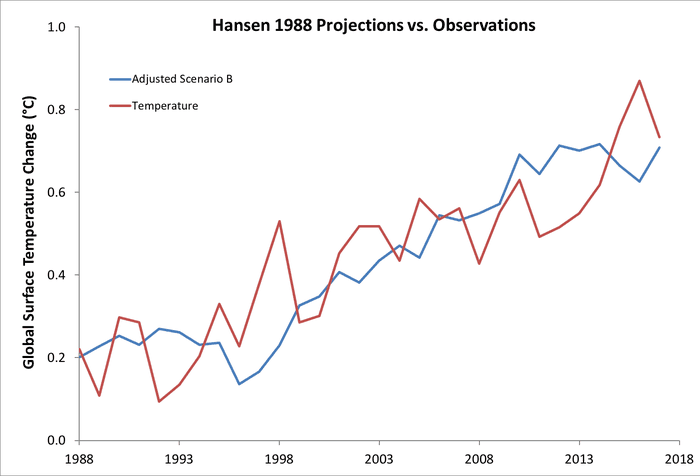
30 years later, deniers are still lying about Hansen’s amazing global warming prediction. https://www.theguardian.com/environ...out-hansens-amazing-global-warming-prediction
Maybe you missed the above post pie? lol
I just want to make sure that you see it this time so you don't keep repeating the same tired BS about Hansen, as if you never saw this.
I just want to make sure that you see it this time so you don't keep repeating the same tired BS about Hansen, as if you never saw this.
And we are near a solar minimum? The things are looking, I’ll gladly take AOC’s “12 years”!
Rapid results in on climate change and the European heat wave
Heat wave was several degrees Celsius hotter than an equivalent event in 1900.
SCOTT K. JOHNSON - 7/2/2019, 2:45 PM
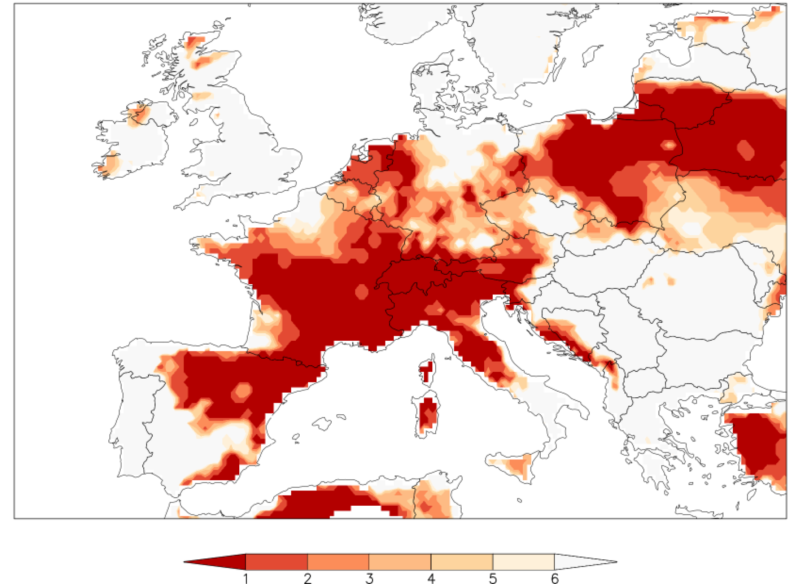
Enlarge / How the warmest three-day averages from June rank—the darkest red area set new records.
van Oldenborgh et al.
75WITH 41 POSTERS PARTICIPATING, INCLUDING STORY AUTHOR
Much of Europe—and particularly France—has been sweating through an incredible heat wave in recent days, with temperature records falling left and right. Despite it being only June (albeit the hottest June on record in Europe), a station in Gallargues-le-Montueux actually broke France's all-time high by more than 1.5°C, reaching a sweltering 45.9°C (114.6 °F).
A team of climate scientists with an established method of rapidly analyzing extreme weather events like this has already taken a look at this heat wave. (The study has yet to be peer-reviewed but follows a protocol which has.) The team's results give a good idea of the role of climate change in this heat wave.
FURTHER READING
Climate change or “just the weather?” Here’s how to answer that
The first question is how to define this weather event. The scientists decided to go with a human-health-relevant definition of the three-day mean temperature rather than a single daily high. They focused on June temperatures for the whole of France, as well as performing a local-scale analysis for just the city of Toulouse—where much of the team coincidentally happened to be attending a conference on weather extremes at the time.
The analyses look at both changes in past weather data and a host of climate-model simulations. In this case, the data shows a very large increase in heat waves since the start of the 20th century. Based on the most recent data, this heat wave looks like it is approximately a 30-year event (meaning it has a probability of about 1 in 30 of occurring in a given year).
Around 1900, however, this would have been a much rarer event. The difference means it's now roughly 100 times more likely to happen in our current, warmer climate. Put another way, the current 30-year heat wave event is a whopping 4°C or so hotter than what would have been a 30-year heat wave at the start of last century. These numbers came out pretty much the same for Toulouse and for France as a whole.
The climate-model simulations proved a little murkier. To start with, the models' results were compared to data to see how accurately they simulate this particular weather pattern in this particular place. In this case, the model simulations produced fewer and weaker heat waves than have actually occurred, so the models have to be taken with a grain of salt.
Nevertheless, they do all simulate increases in heat waves in France due to human-caused warming (that relationship is relatively straightforward). But the increase in probability was mainly in the 5- to 100-times-greater range. As for the increase in the temperature of a 30-year heat wave, it was closer to 1-2°C than the 4°C change seen in the actual data.
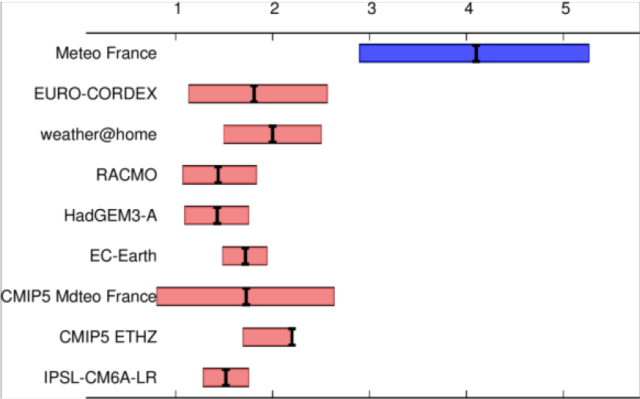
Enlarge / How much warmer this heat wave was, in degrees C, compared to a 30-year heat wave in the early 1900s. Observed weather data shown in blue, and a collection of model simulation results is in red.
van Oldenborgh et al
Taken together, the researchers conclude that climate change made the recent heat wave at least five times more likely, though that's the lower limit of their results. This isn't really a surprise, especially given that past analyses by this team have found similar answers for other heat waves around Europe.
Fortunately, the researchers also note that past heat waves have led to improvements in preparedness. The extreme heat was forecast days in advance, and France put its emergency plans into motion—very likely saving lives.
Rapid results in on climate change and the European heat wave
Heat wave was several degrees Celsius hotter than an equivalent event in 1900.
SCOTT K. JOHNSON - 7/2/2019, 2:45 PM
Enlarge / How the warmest three-day averages from June rank—the darkest red area set new records.
van Oldenborgh et al.
75WITH 41 POSTERS PARTICIPATING, INCLUDING STORY AUTHOR
Much of Europe—and particularly France—has been sweating through an incredible heat wave in recent days, with temperature records falling left and right. Despite it being only June (albeit the hottest June on record in Europe), a station in Gallargues-le-Montueux actually broke France's all-time high by more than 1.5°C, reaching a sweltering 45.9°C (114.6 °F).
A team of climate scientists with an established method of rapidly analyzing extreme weather events like this has already taken a look at this heat wave. (The study has yet to be peer-reviewed but follows a protocol which has.) The team's results give a good idea of the role of climate change in this heat wave.
FURTHER READING
Climate change or “just the weather?” Here’s how to answer that
The first question is how to define this weather event. The scientists decided to go with a human-health-relevant definition of the three-day mean temperature rather than a single daily high. They focused on June temperatures for the whole of France, as well as performing a local-scale analysis for just the city of Toulouse—where much of the team coincidentally happened to be attending a conference on weather extremes at the time.
The analyses look at both changes in past weather data and a host of climate-model simulations. In this case, the data shows a very large increase in heat waves since the start of the 20th century. Based on the most recent data, this heat wave looks like it is approximately a 30-year event (meaning it has a probability of about 1 in 30 of occurring in a given year).
Around 1900, however, this would have been a much rarer event. The difference means it's now roughly 100 times more likely to happen in our current, warmer climate. Put another way, the current 30-year heat wave event is a whopping 4°C or so hotter than what would have been a 30-year heat wave at the start of last century. These numbers came out pretty much the same for Toulouse and for France as a whole.
The climate-model simulations proved a little murkier. To start with, the models' results were compared to data to see how accurately they simulate this particular weather pattern in this particular place. In this case, the model simulations produced fewer and weaker heat waves than have actually occurred, so the models have to be taken with a grain of salt.
Nevertheless, they do all simulate increases in heat waves in France due to human-caused warming (that relationship is relatively straightforward). But the increase in probability was mainly in the 5- to 100-times-greater range. As for the increase in the temperature of a 30-year heat wave, it was closer to 1-2°C than the 4°C change seen in the actual data.
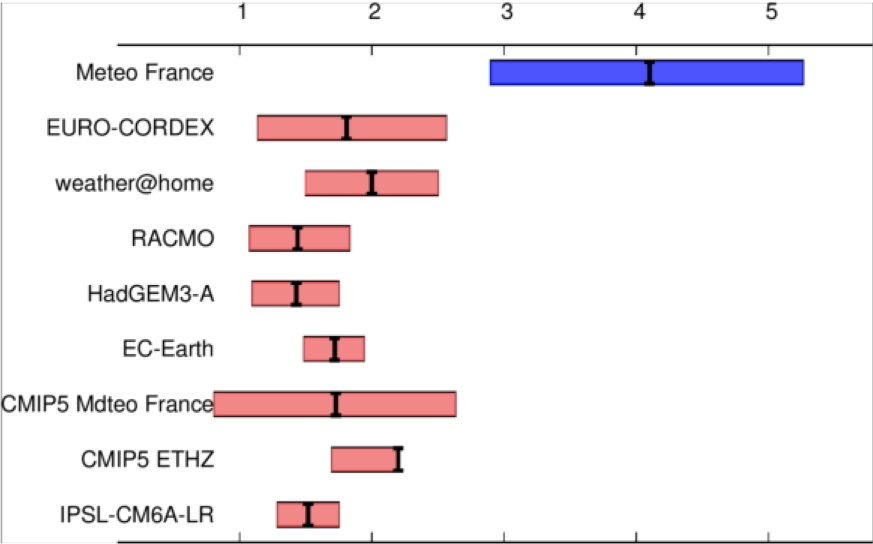
Enlarge / How much warmer this heat wave was, in degrees C, compared to a 30-year heat wave in the early 1900s. Observed weather data shown in blue, and a collection of model simulation results is in red.
van Oldenborgh et al
Taken together, the researchers conclude that climate change made the recent heat wave at least five times more likely, though that's the lower limit of their results. This isn't really a surprise, especially given that past analyses by this team have found similar answers for other heat waves around Europe.
Fortunately, the researchers also note that past heat waves have led to improvements in preparedness. The extreme heat was forecast days in advance, and France put its emergency plans into motion—very likely saving lives.