
You are using an out of date browser. It may not display this or other websites correctly.
You should upgrade or use an alternative browser.
You should upgrade or use an alternative browser.
Heat goes on: Earth headed for warmest year on record
- Thread starter futurecurrents
- Start date
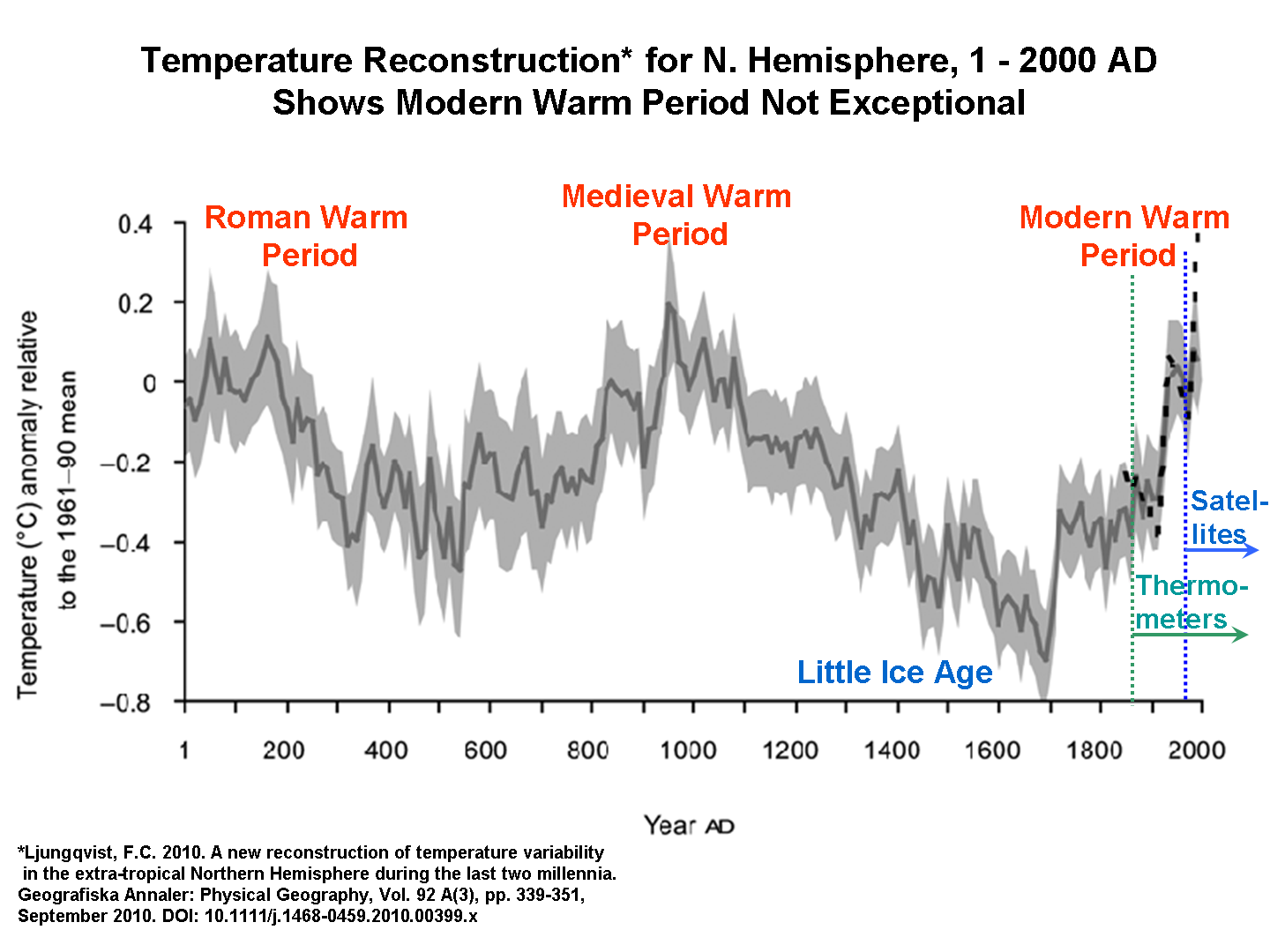

Jerm, this is what a real chart looks like, as opposed to that stupid shit you have posted. Notice the multiple independent data sets. See the blade of the hockey stick on the right? That's from man's release of greenhouse gasses.

Last edited:
NOAA caught revising temps to cause no warming trend to become a warming trend. They did this particular revision sometime between 2013 and 2015.
http://www.powerlineblog.com/archives/2015/05/noaa-caught-rewriting-us-temperature-history-again.php
The whole thing is not a difference of scientific opinion. It is one big scam.
http://www.powerlineblog.com/archives/2015/05/noaa-caught-rewriting-us-temperature-history-again.php
The whole thing is not a difference of scientific opinion. It is one big scam.
NOAA caught revising temps to cause no warming trend to become a warming trend. They did this particular revision sometime between 2013 and 2015.
http://www.powerlineblog.com/archives/2015/05/noaa-caught-rewriting-us-temperature-history-again.php
The whole thing is not a difference of scientific opinion. It is one big scam.
"Their cooling of the past to keep the global warming meme alive reminds me of the old Soviet joke – the future is known, it is the past that keeps changing."
NOAA caught revising temps to cause no warming trend to become a warming trend. They did this particular revision sometime between 2013 and 2015.
http://www.powerlineblog.com/archives/2015/05/noaa-caught-rewriting-us-temperature-history-again.php
The whole thing is not a difference of scientific opinion. It is one big scam.
And if they were NOT adjusted they would not be as accurate.
Having worked with many of the scientists in question, I can say with certainty that there is no grand conspiracy to artificially warm the earth; rather, scientists are doing their best to interpret large datasets with numerous biases such as station moves, instrument changes, time of observation changes, urban heat island biases, and other so-called inhomogenities that have occurred over the last 150 years. Their methods may not be perfect, and are certainly not immune from critical analysis, but that critical analysis should start out from a position of assuming good faith and with an understanding of what exactly has been done.
http://judithcurry.com/2014/07/07/understanding-adjustments-to-temperature-data/
And if they were NOT adjusted they would not be as accurate.
Having worked with many of the scientists in question, I can say with certainty that there is no grand conspiracy to artificially warm the earth; rather, scientists are doing their best to interpret large datasets with numerous biases such as station moves, instrument changes, time of observation changes, urban heat island biases, and other so-called inhomogenities that have occurred over the last 150 years. Their methods may not be perfect, and are certainly not immune from critical analysis, but that critical analysis should start out from a position of assuming good faith and with an understanding of what exactly has been done.
http://judithcurry.com/2014/07/07/understanding-adjustments-to-temperature-data/
You know this would be true if the temperatures were adjusted to show the trend to be both up and down, but the temperatures are only being adjusted to show an up trend.
Why Adjust Temperatures?
There are a number of folks who question the need for adjustments at all. Why not just use raw temperatures, they ask, since those are pure and unadulterated? The problem is that (with the exception of the newly created Climate Reference Network), there is really no such thing as a pure and unadulterated temperature record. Temperature stations in the U.S. are mainly operated by volunteer observers (the Cooperative Observer Network, or co-op stations for short). Many of these stations were set up in the late 1800s and early 1900s as part of a national network of weather stations, focused on measuring day-to-day changes in the weather rather than decadal-scale changes in the climate.
Nearly every single station in the network in the network has been moved at least once over the last century, with many having 3 or more distinct moves. Most of the stations have changed from using liquid in glass thermometers (LiG) inStevenson screens to electronic Minimum Maximum Temperature Systems(MMTS) or Automated Surface Observing Systems (ASOS). Observation times have shifted from afternoon to morning at most stations since 1960, as part of an effort by the National Weather Service to improve precipitation measurements.
All of these changes introduce (non-random) systemic biases into the network. For example, MMTS sensors tend to read maximum daily temperatures about 0.5 C colder than LiG thermometers at the same location. There is a very obvious cooling bias in the record associated with the conversion of most co-op stations from LiG to MMTS in the 1980s, and even folks deeply skeptical of the temperature network like Anthony Watts and his coauthors add an explicit correction for this in their paper.
Time of observation changes from afternoon to morning also can add a cooling bias of up to 0.5 C, affecting maximum and minimum temperatures similarly. The reasons why this occurs, how it is tested, and how we know that documented time of observations are correct (or not) will be discussed in detail in the subsequent post. There are also significant positive minimum temperature biases from urban heat islands that add a trend bias up to 0.2 C nationwide to raw readings.
Because the biases are large and systemic, ignoring them is not a viable option. If some corrections to the data are necessary, there is a need for systems to make these corrections in a way that does not introduce more bias than they remove.
http://judithcurry.com/2014/07/07/understanding-adjustments-to-temperature-data/
There are a number of folks who question the need for adjustments at all. Why not just use raw temperatures, they ask, since those are pure and unadulterated? The problem is that (with the exception of the newly created Climate Reference Network), there is really no such thing as a pure and unadulterated temperature record. Temperature stations in the U.S. are mainly operated by volunteer observers (the Cooperative Observer Network, or co-op stations for short). Many of these stations were set up in the late 1800s and early 1900s as part of a national network of weather stations, focused on measuring day-to-day changes in the weather rather than decadal-scale changes in the climate.
Nearly every single station in the network in the network has been moved at least once over the last century, with many having 3 or more distinct moves. Most of the stations have changed from using liquid in glass thermometers (LiG) inStevenson screens to electronic Minimum Maximum Temperature Systems(MMTS) or Automated Surface Observing Systems (ASOS). Observation times have shifted from afternoon to morning at most stations since 1960, as part of an effort by the National Weather Service to improve precipitation measurements.
All of these changes introduce (non-random) systemic biases into the network. For example, MMTS sensors tend to read maximum daily temperatures about 0.5 C colder than LiG thermometers at the same location. There is a very obvious cooling bias in the record associated with the conversion of most co-op stations from LiG to MMTS in the 1980s, and even folks deeply skeptical of the temperature network like Anthony Watts and his coauthors add an explicit correction for this in their paper.
Time of observation changes from afternoon to morning also can add a cooling bias of up to 0.5 C, affecting maximum and minimum temperatures similarly. The reasons why this occurs, how it is tested, and how we know that documented time of observations are correct (or not) will be discussed in detail in the subsequent post. There are also significant positive minimum temperature biases from urban heat islands that add a trend bias up to 0.2 C nationwide to raw readings.
Because the biases are large and systemic, ignoring them is not a viable option. If some corrections to the data are necessary, there is a need for systems to make these corrections in a way that does not introduce more bias than they remove.
http://judithcurry.com/2014/07/07/understanding-adjustments-to-temperature-data/
Why Adjust Temperatures?
There are a number of folks who question the need for adjustments at all. Why not just use raw temperatures, they ask, since those are pure and unadulterated? The problem is that (with the exception of the newly created Climate Reference Network), there is really no such thing as a pure and unadulterated temperature record. Temperature stations in the U.S. are mainly operated by volunteer observers (the Cooperative Observer Network, or co-op stations for short). Many of these stations were set up in the late 1800s and early 1900s as part of a national network of weather stations, focused on measuring day-to-day changes in the weather rather than decadal-scale changes in the climate.
Nearly every single station in the network in the network has been moved at least once over the last century, with many having 3 or more distinct moves. Most of the stations have changed from using liquid in glass thermometers (LiG) inStevenson screens to electronic Minimum Maximum Temperature Systems(MMTS) or Automated Surface Observing Systems (ASOS). Observation times have shifted from afternoon to morning at most stations since 1960, as part of an effort by the National Weather Service to improve precipitation measurements.
All of these changes introduce (non-random) systemic biases into the network. For example, MMTS sensors tend to read maximum daily temperatures about 0.5 C colder than LiG thermometers at the same location. There is a very obvious cooling bias in the record associated with the conversion of most co-op stations from LiG to MMTS in the 1980s, and even folks deeply skeptical of the temperature network like Anthony Watts and his coauthors add an explicit correction for this in their paper.
Time of observation changes from afternoon to morning also can add a cooling bias of up to 0.5 C, affecting maximum and minimum temperatures similarly. The reasons why this occurs, how it is tested, and how we know that documented time of observations are correct (or not) will be discussed in detail in the subsequent post. There are also significant positive minimum temperature biases from urban heat islands that add a trend bias up to 0.2 C nationwide to raw readings.
Because the biases are large and systemic, ignoring them is not a viable option. If some corrections to the data are necessary, there is a need for systems to make these corrections in a way that does not introduce more bias than they remove.
http://judithcurry.com/2014/07/07/understanding-adjustments-to-temperature-data/
TLDR, global warming is a hoax.
; )
It seems google is scrubbing articles on temp adjustments as fast as the con artists are adjusting the temps. Most of the stuff that comes up is just recent articles about those 'idiot deniers'.
Go back to an article written in '10 and see what it had to say and compare it to the fraudboy stuff being shown to us on google now.
http://www.americanthinker.com/articles/2010/01/climategate_cru_was_but_the_ti.html
Pay careful attention to how the noaa has dropped the number of weather station readings by 75% and how the omitted stations just happen to be in colder locals.
Also, the article shows how the 'homogenation' process took five temp readings in a certain location that were essentially all the same and turned it into a warming trend after homogenation. Some trick that is!
Go back to an article written in '10 and see what it had to say and compare it to the fraudboy stuff being shown to us on google now.
http://www.americanthinker.com/articles/2010/01/climategate_cru_was_but_the_ti.html
Pay careful attention to how the noaa has dropped the number of weather station readings by 75% and how the omitted stations just happen to be in colder locals.
Also, the article shows how the 'homogenation' process took five temp readings in a certain location that were essentially all the same and turned it into a warming trend after homogenation. Some trick that is!