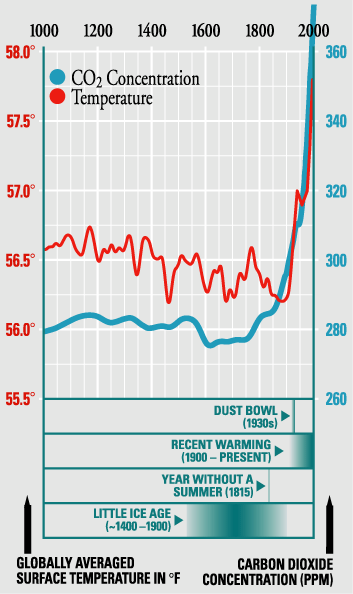
Heat goes on: Earth headed for warmest year on record

..... warmest October ever....global temperature year-to-date is 1.22 degrees above the 20th-century average......2014 is on target to beat 2010 and 1998, the previous warmest years since records began in 1880......representative of the entire globe.......marked the 38th consecutive October — and the 356th month in a row overall — with a global temperature that was above average.......


First I'm not a Denialist. I'm a Skeptic. And once again we have yet another cut and paste from fc that makes for a good example of just one of the many reasons why. Anytime one questions a particular year or a decade of temps, say 1934 vs. 1998, or temps for the last decade or two vs. the Medieval warm period, one is told that one should only look at the period since the Industrial Revolution which began around 1760. (254 years is a very short period compared to the age of the earth or just the time of man, but we'll let that one go) Now the Chicken Little Conformacrats want us to accept that recent temps are the warmest years "since records began in 1880", and that regional temps are invalid since ones data must be "representative of the entire globe" (actually the industrial revolution didn't really kick in till WWII, but Chicken Little's time frame keeps getting shorter all the time, so we'll let that go also.) The main point is, if we take the statements at face value, .."since records began in 1880"....... "represent the entire globe"..... "above the 20th-century average", One must ask the question... How do you know? How do you really know that average global temperatures are 1.22 degrees above the 20th-century average. (I'm certain weather satellites weren't around in 1880, the first one considered a success launched 1960, Weather balloons also didn't start wide use and only in the developed world till the 1960s.) I find it imposable to accept that thousands or even hundreds of climate scientists stationed around the globe to record and report local temps had the calibrated instruments to quantify global temps to such a degree in the 1880s (or the 1930s or the '50s, or maybe even today with such exactness as touted by the Chicken Little's.) Ahhh...but the Ice Cores they say.... "Ice cores contain an abundance of information aboutclimate.... bubbles of atmospheric gas.....a variety information greater than in any other natural recorder such astree ringsorsediment layers.... This enables the reconstruction of local temperature records and the history of atmospheric composition." (taken directly from a Chicken Little AGW site,...but opps there's that word "Local" again. and when it come atmospheric gas.... the cores show CO2 higher at times then today without wormer temps) So the question remains, How do you know? Should the Chicken Little's shorten their time frame even more or just "cherry pick" (something us skeptics are accused of all the time)the years to compare.


RAH


(p.s. I'm expecting one or a combination of responses to this from the Conforacrats here on ET:

1. A statement that all the information confirming AGW has already be provided which only brings us back to where we started here.


2. That any and all views that may be contrary to Chicken Little's vision of the way things work are nothing more than right wing propaganda funded by the fossil fuel industry and Chicken Little's observations are gospel & therefore can not be questioned without be called a name...like "Denialist".


3. That I'm nothing more than a #!*% and a $%#@^&* not to mention you're a *&##$%. )
 
that eventuality is probably the reality right now... we are waiting for more clarity because the papers I have read have said they do not have enough readings across all the oceans.


http://scrippsscholars.ucsd.edu/aan...w-water-oceans-source-or-sink-atmospheric-co2

CO2?

Citation:
Andersson, AJ, Mackenzie FT. 2004. Shallow-water oceans: a source or sink of atmospheric CO2? Frontiers in Ecology and the Environment. 2:348-353.
Export

Abstract:
The shallow-water ocean environment is of great importance in the context of global change and is heavily impacted by human activity. This study evaluates the effects of human activity on the CO2 exchange between the atmosphere and the surface water of shallow-water oceans. The evaluation is based on changes in net ecosystem metabolism, net ecosystem calcification, and atmospheric CO2 concentrations, as seen in a process-driven biogeochemical box model. Numerical simulations show that this air-sea interface has probably served as a net source of CO2 to the atmosphere for much of the past 300 years, but has recently switched, or will switch soon, to a net sink of CO2, because of rising atmospheric CO2 and increasing inorganic nutrient


So eventually the oceans will release more CO2 than they absorb. When they're warmer still.
 
Last edited:
It was a joke, dude. You really need to chill out on this topic. I can literally feel you seething every time someone posts. I should have posted "It was the hottest year on Uranus". Maybe then you'd have gotten it?

Oh it was a joke even though it is common denier talking point and I'm just supposed to laugh. Got ya.

You see, if I don't counter it with facts some idiot denier like jerm will just repeat it because it suits his lies. Actually he probably will anyway.
 
its actually the 5th warmest on land.
now we are mixing and matching records to find the heat.

we are having an el nino... so of course the ocean is warm its been warming since the last ice age and for the last over 100 years.


http://www.ncdc.noaa.gov/sotc/global/2014/10


Global Highlights
  • The combined average temperature over global land and ocean surfaces for October 2014 was the highest on record for October, at 0.74°C (1.33°F) above the 20th century average of 14.0°C (57.1°F).
  • The global land surface temperature was 1.05°C (1.89°F) above the 20th century average of 9.3°C (48.7°F)—the fifth highest for October on record.
  • For the ocean, the October global sea surface temperature was 0.62°C (1.12°F) above the 20thcentury average of 15.9°C (60.6°F) and the highest for October on record.
  • The combined global land and ocean average surface temperature for the January–October period (year-to-date) was 0.68°C (1.22°F) above the 20th century average of 14.1°C (57.4°F). The first ten months of 2014 were the warmest such period on record.


You're lying. The earth is the hottest it has ever been. No question.
 
this whole thing is getting really old. The only question, the only debate should be, "How much does man made co2 contribute to global warming?"


Well what do the experts say?....

The Geological Society of America
"The Geological Society of America (GSA) concurs with assessments by the National Academies of Science (2005), the National Research Council (2006), and the Intergovernmental Panel on Climate Change (IPCC, 2007) that global climate has warmed and that human activities (mainly greenhouse‐gas emissions) account for most of the warming since the middle 1900s." (2006; revised 2010)9
 
really? you have science showing they are net absorbing co2?
I think you need to read up on how the bern hypothesis is failing as new studies come out.

for instance... this is the first one I clicked on and it shows how unsure they really are.

http://www.newscientist.com/article...ase-co2-faster-than-thought.html#.VG-tofnF_3Q


As the world's oceans warm, their massive stores of dissolved carbon dioxide may be quick to bubble back out into the atmosphere and amplify the greenhouse effect, according to a new study.

The oceans capture around 30 per cent of human carbon dioxide emissions and hide it in their depths. This slows the march of global warming somewhat. But climate records from the end of the last ice age show that as temperatures climb, the trend reverses and the oceans emit CO2, which exacerbates warming.

Previous studies have suggested that it takes between 400 and 1300 years for this to happen. But now the most precise analysis to date has whittled that figure down.

Quick response
"We now think the delay is more like 200 years, possibly even less," says Tas van Ommen from the Australian Antarctic Division, in Hobart, who led the study.

The new results come from Siple and Byrd ice cores in western Antarctica. Van Ommen and colleagues dated CO2 bubbles trapped in the ice, and then compared their measurements with records of atmospheric temperatures from the same time period.

As expected, when temperature increased, carbon dioxide followed, but at both Siple and Byrd the time lag was around 200 years – much shorter than previous studies found.


inReadcloseicon.png


Rising temperatures make carbon dioxide leak from the oceans for two main reasons. First, melting sea ice increases the rate that the ocean mixes, which dredges up CO2-rich deep ocean waters. Second, "when you warm the ocean up, just like warming up a Coke bottle, it drives the gas out," says van Ommen.

Previous estimates used cores from regions with low snowfall, van Ommen says, leading to a very gradual trapping of the carbon dioxide in the ice. This increased uncertainty in timing. Also, many previous studies used only one ice core site.

Worse warming?
And while more precise than the others, the team's study also comes with significant uncertainty: plus or minus 200 years, meaning there could actually be no lag time between rising temperatures and gases being released from the atmosphere.

"They've nailed it," says Paul Fraser, a greenhouse gas researcher at Australia's Commonwealth Scientific and Industrial Research Organisation (CSIRO). He adds that despite the uncertainty, "this is a really good data set that they've got."

Van Ommen says climate modelling will be needed before we can speculate how the results relate to current warming.

The work was presented at the Greenhouse 2011 conference in Cairns earlier this month.


That was in the past you liar. When 9 billion tons of CO2 per year were not being released into the air from man's activities. The oceans are certainly currently absorbing CO2 and becoming more acidic. There is no doubt about this among the experts.
 
1. yes there a plenty who say things like knocking down rain forests and creating crops would have a greater impact than man made co2.

2. NASA tells us it can be a negative feedback also.
As you have more co2... the earth gets greener... eating more co2.
Converting that sunlight into more sugar.

3. The bottom line is that it is complex system with complex feedback systems... and the agw models are just failing guesses at what is happening.

We really do not know.


No liar, YOU do not know. And what YOU don't know doesn't matter. It's quite obvious what is going on and that it will get worse.

loyak....CO2 is a greenhouse gas


historical03.gif
 
First I'm not a Denialist. I'm a Skeptic. And once again we have yet another cut and paste from fc that makes for a good example of just one of the many reasons why. Anytime one questions a particular year or a decade of temps, say 1934 vs. 1998, or temps for the last decade or two vs. the Medieval warm period, one is told that one should only look at the period since the Industrial Revolution which began around 1760. (254 years is a very short period compared to the age of the earth or just the time of man, but we'll let that one go) Now the Chicken Little Conformacrats want us to accept that recent temps are the warmest years "since records began in 1880", and that regional temps are invalid since ones data must be "representative of the entire globe" (actually the industrial revolution didn't really kick in till WWII, but Chicken Little's time frame keeps getting shorter all the time, so we'll let that go also.) The main point is, if we take the statements at face value, .."since records began in 1880"....... "represent the entire globe"..... "above the 20th-century average", One must ask the question... How do you know? How do you really know that average global temperatures are 1.22 degrees above the 20th-century average. (I'm certain weather satellites weren't around in 1880, the first one considered a success launched 1960, Weather balloons also didn't start wide use and only in the developed world till the 1960s.) I find it imposable to accept that thousands or even hundreds of climate scientists stationed around the globe to record and report local temps had the calibrated instruments to quantify global temps to such a degree in the 1880s (or the 1930s or the '50s, or maybe even today with such exactness as touted by the Chicken Little's.) Ahhh...but the Ice Cores they say.... "Ice cores contain an abundance of information aboutclimate.... bubbles of atmospheric gas.....a variety information greater than in any other natural recorder such astree ringsorsediment layers.... This enables the reconstruction of local temperature records and the history of atmospheric composition." (taken directly from a Chicken Little AGW site,...but opps there's that word "Local" again. and when it come atmospheric gas.... the cores show CO2 higher at times then today without wormer temps) So the question remains, How do you know? Should the Chicken Little's shorten their time frame even more or just "cherry pick" (something us skeptics are accused of all the time)the years to compare.


RAH


(p.s. I'm expecting one or a combination of responses to this from the Conforacrats here on ET:

1. A statement that all the information confirming AGW has already be provided which only brings us back to where we started here.


2. That any and all views that may be contrary to Chicken Little's vision of the way things work are nothing more than right wing propaganda funded by the fossil fuel industry and Chicken Little's observations are gospel & therefore can not be questioned without be called a name...like "Denialist".


3. That I'm nothing more than a #!*% and a $%#@^&* not to mention you're a *&##$%. )


So your question is how do they know what the temperatures were? It's pretty complicated. You can start here.

http://en.wikipedia.org/wiki/Temperature_record
 
that eventuality is probably the reality right now... we are waiting for more clarity because the papers I have read have said they do not have enough readings across all the oceans.


http://scrippsscholars.ucsd.edu/aan...w-water-oceans-source-or-sink-atmospheric-co2

CO2?

Citation:
Andersson, AJ, Mackenzie FT. 2004. Shallow-water oceans: a source or sink of atmospheric CO2? Frontiers in Ecology and the Environment. 2:348-353.
Export

Abstract:
The shallow-water ocean environment is of great importance in the context of global change and is heavily impacted by human activity. This study evaluates the effects of human activity on the CO2 exchange between the atmosphere and the surface water of shallow-water oceans. The evaluation is based on changes in net ecosystem metabolism, net ecosystem calcification, and atmospheric CO2 concentrations, as seen in a process-driven biogeochemical box model. Numerical simulations show that this air-sea interface has probably served as a net source of CO2 to the atmosphere for much of the past 300 years, but has recently switched, or will switch soon, to a net sink of CO2, because of rising atmospheric CO2 and increasing inorganic nutrient


No it's not the reality now liar. The reality now is that 30 - 40% of the CO2 man releases is being absorbed into the ocean.

http://en.wikipedia.org/wiki/Ocean_acidification
 
Back
Top