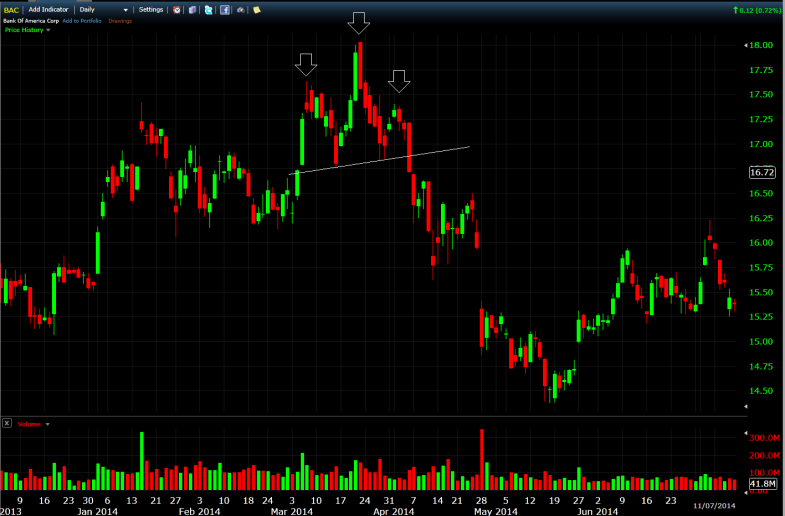
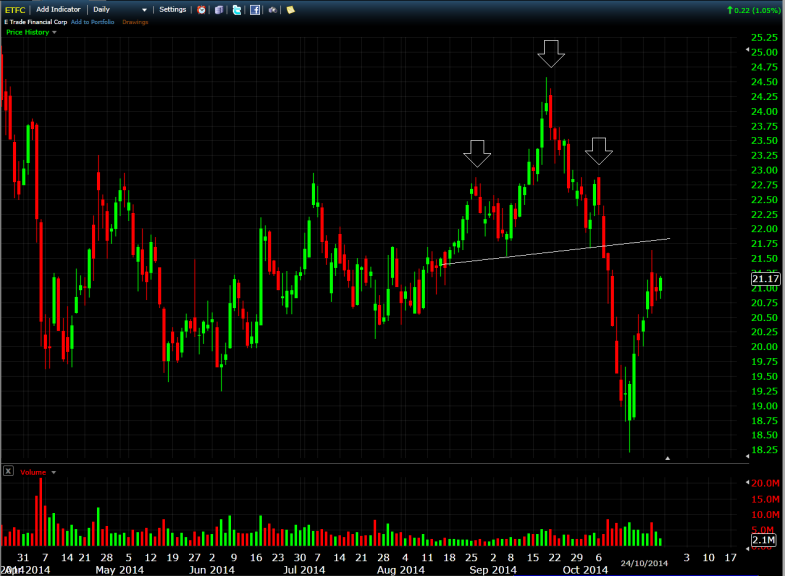
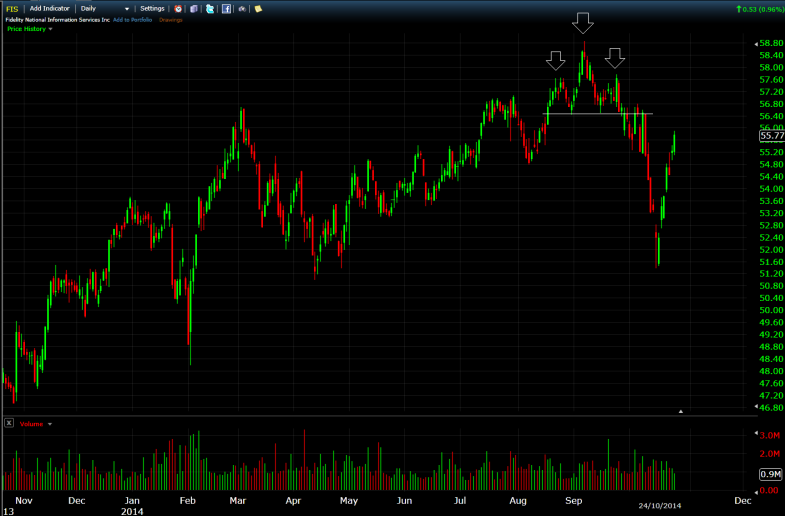
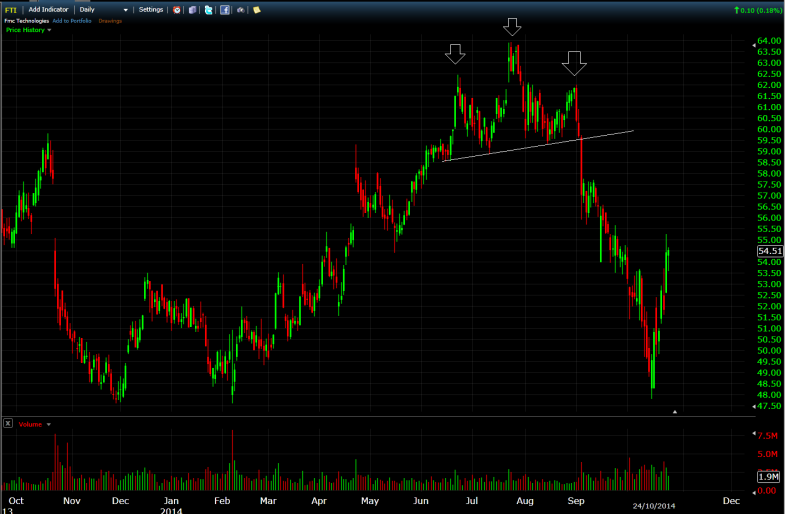
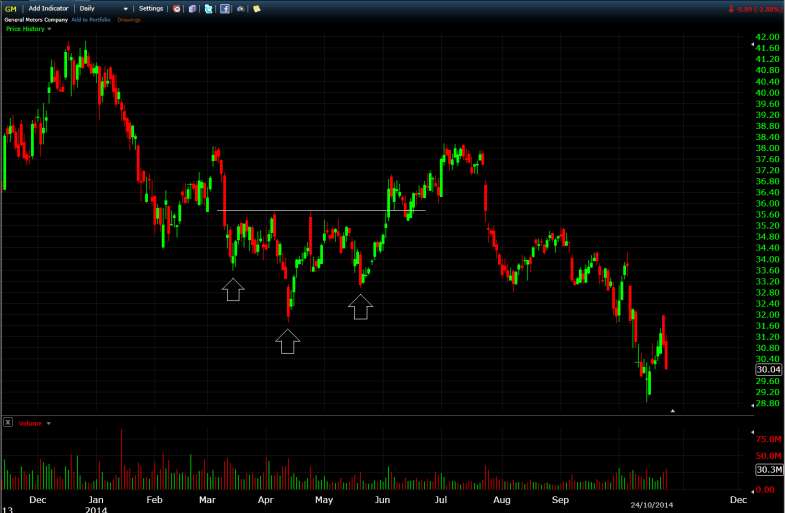
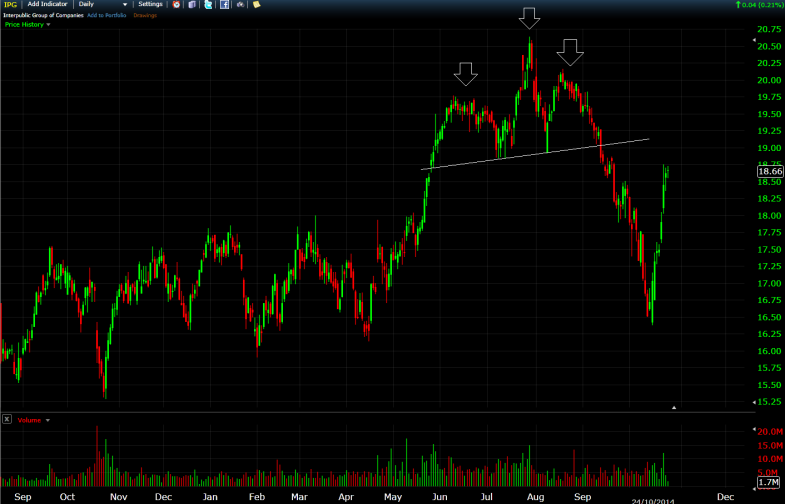
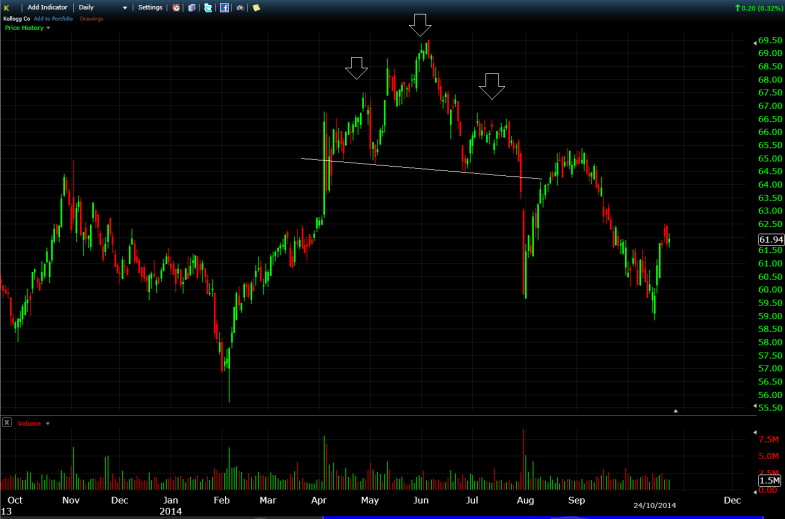
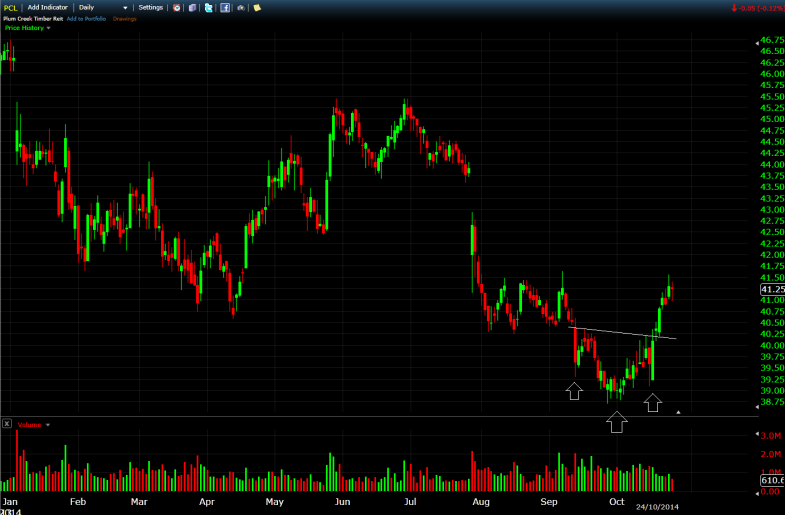
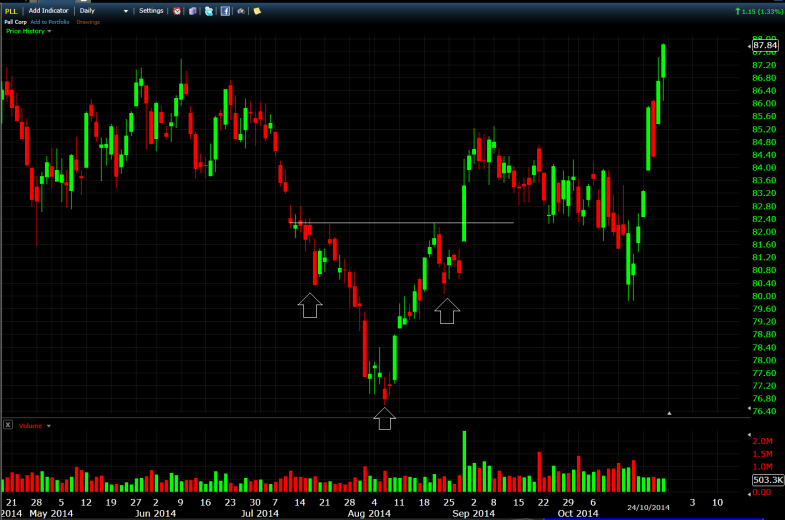
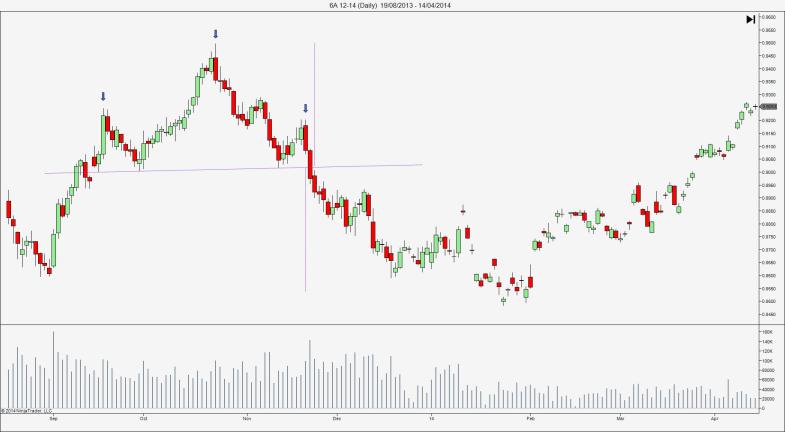
The head-and-shoulders top is a tenet of classical charting theory, one invented when trading off price action was accomplished using pencils and rulers.
It suggests that buying in a bull move is composed of three waves - smart money, dumb money and dumber money. Underneath each of these waves is drawn a 'neck-line', which represents the approximate points at which prices fade off the peak of each wave.
Wave 1 consists of smart money and forms the left shoulder. It represents the activity of a syndicate of buyers operating 'in secret', quietly accumulating shares. These buyers have a 'real reason' to pick up shares, one derived from research. These buyers are not momentum investors (as at this point there has not been enough momentum to attract their attention). As such the volume will be higher than normal but not so high that it scares buyers away. In fact, it can't be too high since buyers are only beginning to be attracted to the potential.
Wave 2 consists of dumb money and forms the head. These buyers missed the first big move up, the strength of which attracted their attention in the first place. They take advantage of the fade in prices off the peak of the left shoulder and use it to aggressively accumulate shares. This volume is typically the highest.
It is during the fade off the top of wave 2 that the syndicates responsible for the first leg up start to unload shares. Since they have been vested in the stock from the beginning, they recognize when things are getting 'frothy' and are scared by the frantic buying of the momentum crowd (who are more concerned with missing 'the next big thing'). It's sort of like the end of a party where all the suits have gone home and you are left with a bunch of milling drunks. Prices fade back to the neckline.
Wave 3 consists of dumber money and forms the right shoulder. This last group of buyers missed both waves 1 and 2 and looked at the fade in prices as yet another buying opportunity. These investors consist of both new money and those who entered positions late in the second wave and are thus sitting on paper losses. The volume in wave 3 is typically weaker than that forming the head and the left shoulder. So the rise in prices here is short lived due to the fact that it is even less grounded that the rise that formed the head.
Once prices fade off the right shoulder, the formation is confirmed when prices break below the neckline. This is where the short hammer is dropped.
Sounds like a lot of work, right? Wrong. This formation is so predictable that when a really good one is found (as you can see, there are a lot of conditions that must prevail for it exist fully) you are looking at a chance to trade with a high degree of success and a low amount of risk.