Hayek and the Keynesian's 3 Big Mistakes

I would have thought that after the culmination of Keynes economics, the stagflation of the 70's, nobody would even try to go down that road again.

Here we are still arguing against failed ideas, people never change.

The thing is that monetary policy has limits that nobody seems to care about anymore. It cannot cure the structural problems of the economy such as demographics, yet Obama, Geithner, et al. seem oblivious to the obvious.
 
Quote from Mav88:

I would have thought that after the culmination of Keynes economics, the stagflation of the 70's, nobody would even try to go down that road again.

Here we are still arguing against failed ideas, people never change.

The thing is that monetary policy has limits that nobody seems to care about anymore. It cannot cure the structural problems of the economy such as demographics, yet Obama, Geithner, et al. seem oblivious to the obvious.

If the long term health of the country were a priority for these politico's and bureaucrat's, then I'd agree...but it's always about getting thru the next month, quarter, year and tossing the problem to someone else. I think that explains alot of the popularity of a "spending gone wild" economic philosophy and a "no austerity" clause. Keep all your political donors fat and happy, feed some scraps to the lower classes (so they don't revolt) and make sure everyone, everywhere has a student loan (who cares if they can't repay them)...
 
Quote from Tsing Tao:

The money printed goes towards buying the debt. The Fed buys short/long dated treasuries (depending on what they're trying to do at the moment) and gives that cash to primary dealers. The result is a much lower interest rate that the US enjoys on it's debt than if it had to go to the open market to find a buyer.

Your bank analogy ignores that pesky aspect of rates. It also ignores the devaluation of printing more money and what that does to the currency, and therefore inflation. This has been the problem with your arguments since you and I began discussing this however long ago.

Without the Fed in the bond market, rates would be much higher as investors would demand more interest to compensate for higher risk. This is the fundamental aspect to credit and debt, but you ignore it.

So if the Fed stops, rates shoot up and interest becomes unbearable. If the Fed continues, it devalues the currency further, promoting inflation and loss of purchasing power. And before you try to tell me there's no inflation, I'll go get my charts of the last 5 years of commodities and staples ready.

I don't know. Perhaps Convertibility needs more fiber in his diet.
By far the largest part of commodity prices is a result of fundamentals, not speculation.

Besides, wages are rising, too.
 
Quote from Ricter:

By far the largest part of commodity prices is a result of fundamentals, not speculation.

Besides, wages are rising, too.
I love it when non-traders spout off like this.
 
Quote from Ricter:

By far the largest part of commodity prices is a result of fundamentals, not speculation.

Besides, wages are rising, too.

Complete and utter bullshit.

That's why crude oil futures plunged from $147 to $38 in 6 months back in the fall of 2008...yeah, sure, whatever you say.

Wages aren't rising.
 
Quote from Ricter:

By far the largest part of commodity prices is a result of fundamentals, not speculation.

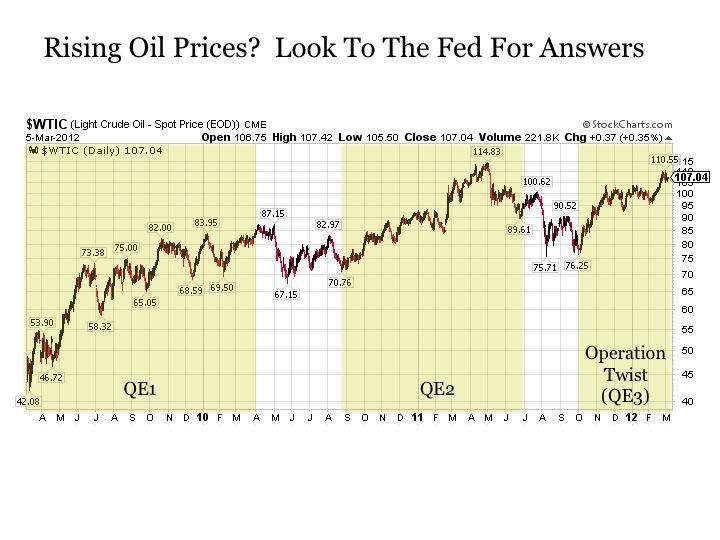
Really? Then perhaps you might explain this chart that shows oil, for example, rising exactly when QE was announced or promised.

Here's what the CME had to say...interesting...QE.

http://www.cmegroup.com/education/market-commentary/energy/2012/08/pre-open-crude-oil_2264.html


403065-1331058715510546-Eric-Parnell_origin.jpg


http://seekingalpha.com/article/415381-who-s-really-to-blame-for-higher-oil-prices

There are about a thousand articles out there linking commodities to a rise in the money supply vis-a-vis QE.

Fundamentals indeed. Where do you think all that money goes that is printed? Into assets, of course! Commodities priced in dollars, dollar gets cheaper in relation to foreign currencies. Those in foreign currencies buy commodities as a hedge. It's, at most, 8th grade economics.


Quote from Ricter:


Besides, wages are rising, too.

Wages are rising at the slowest in 5 years, and not keeping up with inflation. Please pay close attention to "average hourly income" in the below chart.

US%20Consumer%20LT.jpg
 
Quote from denner:

Complete and utter bullshit.

That's why crude oil futures plunged from $147 to $38 in 6 months back in the fall of 2008...yeah, sure, whatever you say.

Wages aren't rising.

Wages are rising, but it's barely 1.5% over prior year in nominal terms. In real terms they are falling, you are correct. Real terms is only what matters.
 
Quote from Tsing Tao:

Really? Then perhaps you might explain this chart that shows oil, for example, rising exactly when QE was announced or promised.

Here's what the CME had to say...interesting...QE.

http://www.cmegroup.com/education/market-commentary/energy/2012/08/pre-open-crude-oil_2264.html


403065-1331058715510546-Eric-Parnell_origin.jpg


http://seekingalpha.com/article/415381-who-s-really-to-blame-for-higher-oil-prices

There are about a thousand articles out there linking commodities to a rise in the money supply vis-a-vis QE.

Fundamentals indeed. Where do you think all that money goes that is printed? Into assets, of course! Commodities priced in dollars, dollar gets cheaper in relation to foreign currencies. Those in foreign currencies buy commodities as a hedge. It's, at most, 8th grade economics.


Wages are rising at the slowest in 5 years, and not keeping up with inflation. Please pay close attention to "average hourly income" in the below chart.

US%20Consumer%20LT.jpg
Your first chart simply tracks the recovery. Where that was slowing, QE was implemented. The tail is wagging the dog.

In response to the second chart:

<img src="http://upload.wikimedia.org/wikipedia/commons/thumb/0/01/United_States_Income_Distribution_1947-2007.svg/800px-United_States_Income_Distribution_1947-2007.svg.png">
 
Quote from Ricter:

Your first chart simply tracks the recovery. Where that was slowing, QE was implemented. The tail is wagging the dog.


Sorry, that's a nice try and it would be the case had all commodities not shown spikes and upward trajectories beginning when QE was inferred, twice of which occurred at the Jackson Hole speech for Bernanke in August of the year in question. QE wasn't implemented until October of that year.

Nice try, however.


Quote from Ricter:


In response to the second chart:

<img src="http://upload.wikimedia.org/wikipedia/commons/thumb/0/01/United_States_Income_Distribution_1947-2007.svg/800px-United_States_Income_Distribution_1947-2007.svg.png">

Posting income levels in $$ is all fine and dandy, but if the Y/Y increase isn't keeping up with inflation, then wages aren't really gaining. They're falling behind. Surely you grasp the difference between real and nominal.

Feel free to argue either of these points. But you're incorrect on both accounts.

If you'd like, I can go back and find Bernanke's own words that QE has the desired effect of causing the stock market to rise. He didn't say commodities, but all asset prices behave the same under monetary expansion.
 
Back
Top