Little old lady waving a white flag is a terrorist, too, don't ya know.plus there's this:
https://www.elitetrader.com/et/thre...-of-casualty-information.378065/#post-5918864
Israel's basically looking at the health ministry's numbers above, looking at age and sex of casualties and saying "well, adult male is a fighter (by extension hamas) because which adult male wouldn't fight if we're bombing your household?"
citation needed

You are using an out of date browser. It may not display this or other websites correctly.
You should upgrade or use an alternative browser.
You should upgrade or use an alternative browser.
Hamas must be eliminated
- Thread starter gwb-trading
- Start date
Little old lady waving a white flag is a terrorist, too, don't ya know.
A shame that a Hamas sniper shot her while the IDF was trying to direct the group down another street instead of walking straight ahead -- because the IDF was trying to deal with the Hamas sniper. Keep in mind that back in November Hamas was killing Palestinians regularly while trying to prevent they from fleeing to the south -- because Hamas wanted they to stay in Gaza City as human shields.

Whether Israel ignores the ICJ judgement w/America's blessing, and despite where Jews may sit on the zionist scale, as Haaretz said, they have to admit that in the eyes of the world, Israel went from a irrelevant entity for many at best, to an occupier for some, to a victim post oct 7, and now to be credibly accused of genocide by the bulk of the international community. This flies in the face of Israel making a world a safe place for Jews, unless their purpose is to make them pariahs everywhere else and fleeing to "safe zion" w/their actions.Patrick Lawrence: The Palestinians Won in The Hague: So Did the Rest of Us
January 29, 2024
Leave a Comment on Patrick Lawrence: The Palestinians Won in The Hague: So Did the Rest of Us
The non–West has spoken, it has raised its voice.
Half a dozen years ago I sat in the lobby lounge at the Algonquin Hotel in Manhattan talking at length with Richard Falk, the scholar, lawyer, U.N. rapporteur, and advocate of Palestinian rights. Inevitably, the conversation turned for a time to international law, a topic on which Falk has long been a recognized authority. Here is a little of what he said as we took our afternoon tea:
When international law is on the side of the geopolitical actors, then they are very serious about its relevance. When the American embassy was seized in Tehran after the Iranian Revolution, they talked about the flouting of international law as if that was the most sacred body of law that ever existed. International law is used very instrumentally. If you’re protecting private investment in Venezuela or Chile, then it’s barbaric not to uphold it. But if it’s blocking the pursuit of some kind of interventionist project, then it’s flaky or irrelevant to talk about it …
I thought about that exchange over the weekend, as I considered the International Court of Justice’s ruling last Friday that the apartheid state of Israel may be guilty of genocide against Gaza’s Palestinian population, as South Africa charges, and that the case Pretoria brought last month must proceed. Later Friday, the estimable Phyllis Bennis quoted Falk in a piece she wrote for In These Times. Falk called the decision the court’s “greatest moment,” and went on to explain, “It strengthens the claims of international law to be respected by all sovereign states—not just some.”
Consistency of thought: It does not get more admirable than this.
There are many, many ways to look upon the ICJ’s ruling, many things worth saying. The very first of these is that the significance of the ICJ’s interim finding lies beyond dispute. Will the barbarities of a nation self-evidently suffering a collective psychosis now stop? No. What Dick Falk said six years ago still holds: Israel has already made clear it will ignore The Hague’s judgment.
But what “the Jewish state” does this week or next is not for the moment our question. What are the enduring consequences of this ruling for the global order? How shall we situate the court’s judgment? Where does its importance lie? These are our questions. And Falk was right last Friday, too: The ICJ has begun the work—the long work—of restoring international law as a foundational feature of a world order worthy of the term.
Having made this point, I must immediately note the abject deflections we find in the reports of our corporate media—which, nearly to a one, urge their readers, listeners, and viewers to dismiss the ICJ’s interim finding as, borrowing from Falk, more or less flaky and irrelevant. In the second paragraph of its main story Friday, The New York Times, fairly bursting to get the point across, wrote, “The court did not rule on whether Israel was committing genocide, and it did not call on Israel to stop its campaign to crush Hamas…”
Three untruths here, straight off the top. One, the South Africans did not ask The Hague to issue a ruling on genocide one way or the other. In the cause of expedience, to stop the savagery as quickly as possible, it asked for what it got—a swift interim judgment so the court could order Israel to stop the violence and that the larger case on genocide could proceed.
Two, a mountain has been made of the fact that the ICJ did not, in so many words, call upon Israel to cease fire in Gaza. This is preposterously misleading. Peruse the six stipulations that comprise the ruling, the first of which reads, “Israel shall take all measures within its power to prevent all acts within the scope of Genocide Convention, Article 2.” Here I defer to Raz Segal, an Israeli historian who professes at Stockton University in New Jersey. This is from a segment of Democracy Now!, distributed last Friday:
We’re already seeing headlines in The New York Times today which frame this as, “The court did not issue an order for a ceasefire”—which, in effect, it actually did, because if it ordered that Israel should cease from genocidal acts, and it ordered Israel should facilitate the entry of humanitarian aid, it actually said, “You have to cease fire because there is no [other] way of doing that.”
And three, what Israel is doing in Gaza—as any review of the daily death toll will make clear, any five minutes of video footage—can be characterized as “a military campaign to crush Hamas” only by those so abjectly committed to defending Israeli atrocities that all thought of honest reporting and writing is cast aside.
Almost all major media have followed The Times’s lead, per usual. Among the exceptions—and I confess my surprise here—is National Public Radio. It got the no-ceasefire bit wrong, but it otherwise published a quite good, balanced report from London that included worthy material from its South Africa correspondent (unless NPR took this off the wires):
Since former President Nelson Mandela’s administration, South Africa has long supported the Palestinian cause, saying it sees echoes of apartheid in the situation between the Israelis and Palestinians.
“We, as South Africans, will not be passive bystanders and watch the crimes that were visited upon us being perpetrated elsewhere,” [South African President Cyril] Ramaphosa said Friday. He noted the ICJ affirmed South Africa’s right to take Israel to court, “even though it is not a party to the conflict in Gaza.”
But exceptions prove rules, let us not forget. For the sheer nonsense of its reporting, I have to single out—the envelope, please—the reliably egregious MSNBC. You may want to take a moment to read this twice. In its Friday evening newscast, it had it that the ICJ ruling is nicely aligned with the Biden regime’s calls to minimize civilian casualties. Further, we need to know what The Hague’s finding is not and what it does not do: It is not any kind of indictment of the Biden regime’s policy, no, and it does not make Biden and the U.S. complicit in genocide.
It is and it does, in my view.
The running theme in American media is that The Hague’s judgment has changed nothing. Who can be surprised? Nothing ever changes when these media are telling us about the world. America is never wrong. America never makes a mistake. America is never on the wrong side. America is always good. America never loses.
Let us now consider what enormous changes occurred when Joan Donoghue, an American judge who currently presides at The Hague, read out the ruling.
Rest of article...
Last edited:
citation needed.A shame that a Hamas sniper shot her while the IDF was trying to direct the group down another street instead of walking straight ahead -- because the IDF was trying to deal with the Hamas sniper. Keep in mind that back in November Hamas was killing Palestinians regularly while trying to prevent they from fleeing to the south -- because Hamas wanted they to stay in Gaza City as human shields.
I don't believe it, but will point out that colonial aggression causes all kinds of distortions.A shame that a Hamas sniper shot her while the IDF was trying to direct the group down another street instead of walking straight ahead -- because the IDF was trying to deal with the Hamas sniper. Keep in mind that back in November Hamas was killing Palestinians regularly while trying to prevent they from fleeing to the south -- because Hamas wanted they to stay in Gaza City as human shields.
Have you seen Sanders' Saturday piece in The Guardian?Whether Israel ignores the ICJ judgement w/America's blessing, and despite where Jews may sit on the zionist scale, as Haaretz said, they have to admit that in the eyes of the world, Israel went from a irrelevant entity for many at best, to an occupier for some, to a victim post oct 7, and now to be credibly accused of genocide by the bulk of the international community. This flies in the face of Israel making a world a safe place for Jews, unless their purpose is to make them pariahs everywhere else and fleeing to "safe zion" w/their actions.
I have notHave you seen Sanders' Saturday piece in The Guardian?
edit: just skimmed. Bernie's been late to the party on this (caught some flak over it) so i'm glad he's "seen the light"....the stats he quotes are a known to me already but at least he's using his voice to bring it to a bigger audience. I had been fairly on the sidelines of "giving a damn" on this conflict in the past but Israel's made it impossible to ignore now.
Last edited:
'The flood will wash them away:' IDF's message to Hamas in viral image
The quote is from the Quran, relating to the biblical flood: “…and the flood washed away their sins." This is a clear allusion to the name Hamas gave to the October 7 attacks.
https://www.jpost.com/israel-hamas-war/article-784363
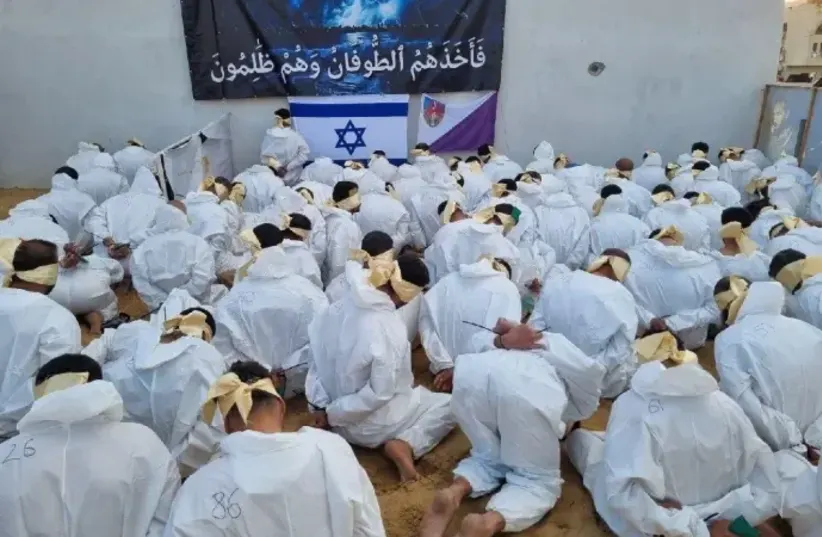
The suspects arrested in Khan Yunis and behind them the sign. January 30, 2024.
A photo published on social media on Wednesday went viral after it showed suspects arrested by the IDF in Khan Yunis handcuffed and blindfolded. Behind them are the flags of Israel and the Givati Brigade, as well as a massive sign with a quote-turned-pun from the Quran.
The quote in question is taken from a sura in the Quran relating to the biblical flood: “…and the flood washed away their sins." This is a clear allusion to the name Hamas gave to the October 7 attack – “Al-Aqsa flood.”
The message is clear: The action backfired on its perpetrators, who are now paying for their sins.
Evoking Sodom and Gomorrah
Adi Cohen, an orientalist, and researcher of the Arab world, explained the meaning of the photo in a conversation with Maariv on Monday.
"For them, the image will evoke Sodom and Gomorrah, a deviation from the right path and the path of Islam," he said.
"The mention of the sins is also important, it relates to people who did not follow the path of Israel, believe in idols and statues, and Allah subsequently punishes them.
"An additional theme is the biblical flood. The people did not want to align themselves; they went against Islam and worshiped pagan idols; therefore, Allah sent the flood upon them except for Noah, who was a righteous man; the idea is a play on the name they themselves called their attack. 'The flood of al-Aqsa'. You are the terrorists, and the flood is yours."
The quote is from the Quran, relating to the biblical flood: “…and the flood washed away their sins." This is a clear allusion to the name Hamas gave to the October 7 attacks.
https://www.jpost.com/israel-hamas-war/article-784363
The suspects arrested in Khan Yunis and behind them the sign. January 30, 2024.
A photo published on social media on Wednesday went viral after it showed suspects arrested by the IDF in Khan Yunis handcuffed and blindfolded. Behind them are the flags of Israel and the Givati Brigade, as well as a massive sign with a quote-turned-pun from the Quran.
The quote in question is taken from a sura in the Quran relating to the biblical flood: “…and the flood washed away their sins." This is a clear allusion to the name Hamas gave to the October 7 attack – “Al-Aqsa flood.”
The message is clear: The action backfired on its perpetrators, who are now paying for their sins.
Evoking Sodom and Gomorrah
Adi Cohen, an orientalist, and researcher of the Arab world, explained the meaning of the photo in a conversation with Maariv on Monday.
"For them, the image will evoke Sodom and Gomorrah, a deviation from the right path and the path of Islam," he said.
"The mention of the sins is also important, it relates to people who did not follow the path of Israel, believe in idols and statues, and Allah subsequently punishes them.
"An additional theme is the biblical flood. The people did not want to align themselves; they went against Islam and worshiped pagan idols; therefore, Allah sent the flood upon them except for Noah, who was a righteous man; the idea is a play on the name they themselves called their attack. 'The flood of al-Aqsa'. You are the terrorists, and the flood is yours."
Hamas is so concerned for its own comfort that it puts elevators in its tunnels. You know, this elevator should have been used in a hospital in Gaza but Hamas diverted it just like everything else.
IDF finds secret tunnel leading to underground elevator in north Gaza
https://www.msn.com/en-sg/news/othe...nderground-elevator-in-north-gaza/ar-BB1hIFiF
IDF finds secret tunnel leading to underground elevator in north Gaza
https://www.msn.com/en-sg/news/othe...nderground-elevator-in-north-gaza/ar-BB1hIFiF