One has only to look at South Africa after Nelson Mandela took over. From a very prosperous country, now South Africa is now but, a shell of what it was before. Whites being murdered and their land taken from them, most whites now impoverished and poor and the other blacks are not much better off. Of course, those at the top are filthy rich. Black officials have done very well for themselves and their families only.

You are using an out of date browser. It may not display this or other websites correctly.
You should upgrade or use an alternative browser.
You should upgrade or use an alternative browser.
Great contributions to the world by great people
- Thread starter derektrader
- Start date

One has only to look at South Africa after Nelson Mandela took over. From a very prosperous country, now South Africa is now but, a shell of what it was before. Whites being murdered and their land taken from them, most whites now impoverished and poor and the other blacks are not much better off. Of course, those at the top are filthy rich. Black officials have done very well for themselves and their families only.
It is terrible to say the least how things went south in S. Africa.

Now I don't know if you're being silly; or just tarded; or maybe both.Maybe you are the hateful person? Why would you want to glorify MLK when all he did was cause riots?
(...and you were doing so well.)
Now I don't know if you're being silly; or just tarded; or maybe both.
(...and you were doing so well.)
Well you did accuse me of being a hateful person. I guess because I am white and voted for Trump that this makes me a hateful person by default?
False. In that post: I asked you a question. Also: I said nothing about your color, nor who you voted for.Well you did accuse me of being a hateful person. I guess because I am white and voted for Trump that this makes me a hateful person by default?
Advice: If you believe someone falsely accused you, call them out on it, rather than respond in a way that makes you appear to be tarded.
When you look at majority black cities or even take it a step further, majority black countries, why are they so much more dangerous than white cities or white majority countries?
India is a very poor country but not violent so lets not use poverty as an excuse.
Where is the innovation in these black countries?
India is a very poor country but not violent so lets not use poverty as an excuse.
Where is the innovation in these black countries?
Frederick Douglass
https://en.wikipedia.org/wiki/Frederick_Douglass
Frederick Douglass (born Frederick Augustus Washington Bailey; c. February 1818 – February 20, 1895)[1][4] was an American social reformer, abolitionist, orator, writer, and statesman. After escaping from slavery in Maryland, he became a national leader of the abolitionist movement in Massachusetts and New York, becoming famous for his oratory[5] and incisive antislavery writings. Accordingly, he was described by abolitionists in his time as a living counter-example to slaveholders' arguments that slaves lacked the intellectual capacity to function as independent American citizens.[6][7] Likewise, Northerners at the time found it hard to believe that such a great orator had once been a slave.[8]
Douglass wrote several autobiographies, notably describing his experiences as a slave in his Narrative of the Life of Frederick Douglass, an American Slave (1845), which became a bestseller, and was influential in promoting the cause of abolition, as was his second book, My Bondage and My Freedom (1855). Following the Civil War, Douglass remained an active campaigner against slavery and wrote his last autobiography, Life and Times of Frederick Douglass. First published in 1881 and revised in 1892, three years before his death, the book covers events both during and after the Civil War. Douglass also actively supported women's suffrage, and held several public offices. Without his approval, Douglass became the first African-American nominated for Vice President of the United States as the running mate and Vice Presidential nominee of Victoria Woodhull, on the Equal Rights Party ticket.[9]
Douglass was a firm believer in the equality of all peoples, be they white, black, female, Native American, or Chinese immigrants.[10] He was also a believer in dialogue and in making alliances across racial and ideological divides, as well as in the liberal values of the U.S. Constitution.[11] When radical abolitionists, under the motto "No Union with Slaveholders," criticized Douglass' willingness to engage in dialogue with slave owners, he replied: "I would unite with anybody to do right and with nobody to do wrong."
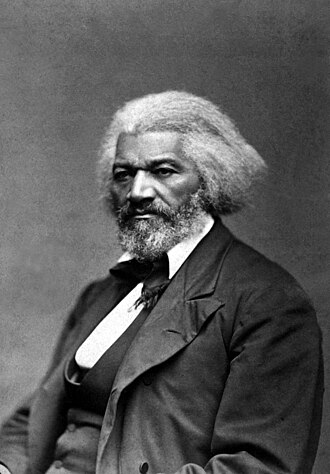
https://en.wikipedia.org/wiki/Frederick_Douglass
Frederick Douglass (born Frederick Augustus Washington Bailey; c. February 1818 – February 20, 1895)[1][4] was an American social reformer, abolitionist, orator, writer, and statesman. After escaping from slavery in Maryland, he became a national leader of the abolitionist movement in Massachusetts and New York, becoming famous for his oratory[5] and incisive antislavery writings. Accordingly, he was described by abolitionists in his time as a living counter-example to slaveholders' arguments that slaves lacked the intellectual capacity to function as independent American citizens.[6][7] Likewise, Northerners at the time found it hard to believe that such a great orator had once been a slave.[8]
Douglass wrote several autobiographies, notably describing his experiences as a slave in his Narrative of the Life of Frederick Douglass, an American Slave (1845), which became a bestseller, and was influential in promoting the cause of abolition, as was his second book, My Bondage and My Freedom (1855). Following the Civil War, Douglass remained an active campaigner against slavery and wrote his last autobiography, Life and Times of Frederick Douglass. First published in 1881 and revised in 1892, three years before his death, the book covers events both during and after the Civil War. Douglass also actively supported women's suffrage, and held several public offices. Without his approval, Douglass became the first African-American nominated for Vice President of the United States as the running mate and Vice Presidential nominee of Victoria Woodhull, on the Equal Rights Party ticket.[9]
Douglass was a firm believer in the equality of all peoples, be they white, black, female, Native American, or Chinese immigrants.[10] He was also a believer in dialogue and in making alliances across racial and ideological divides, as well as in the liberal values of the U.S. Constitution.[11] When radical abolitionists, under the motto "No Union with Slaveholders," criticized Douglass' willingness to engage in dialogue with slave owners, he replied: "I would unite with anybody to do right and with nobody to do wrong."
Ok, he wrote a book about slavery. We all know slavery was wrong and we also know it was over 160 years ago.
Lets talk about some modern marvels and who built them.
Lets talk about some modern marvels and who built them.
A famous architect from our RTP area of N.C. - I know his son who was just appointed to the Durham City Council.
Phil Freelon
https://en.wikipedia.org/wiki/Phil_Freelon
Philip Goodwin Freelon (March 26, 1953 – July 9, 2019) was an American architect. He was best known for leading the design team (with J. Max Bond, Jr. of Davis Brody Bond, and David Adjaye) of the Smithsonian Institution's National Museum of African American History and Culture.
Some of his other projects include the Center for Civil & Human Rights, the Reginald F. Lewis Museum of Maryland African American History & Culture and the Museum of the African Diaspora. Freelon was a Fellow of the American Institute of Architects (and the recipient of their Thomas Jefferson Award for Public Architecture), and a LEED (Leadership in Energy and Environmental Design) Accredited Professional. In 2012, President Barack Obama appointed Freelon to the U.S. Commission of Fine Arts.[1] Freelon was married to six-time Grammy nominated jazz vocalist Nnenna Freelon.[2]
Phil Freelon
https://en.wikipedia.org/wiki/Phil_Freelon
Philip Goodwin Freelon (March 26, 1953 – July 9, 2019) was an American architect. He was best known for leading the design team (with J. Max Bond, Jr. of Davis Brody Bond, and David Adjaye) of the Smithsonian Institution's National Museum of African American History and Culture.
Some of his other projects include the Center for Civil & Human Rights, the Reginald F. Lewis Museum of Maryland African American History & Culture and the Museum of the African Diaspora. Freelon was a Fellow of the American Institute of Architects (and the recipient of their Thomas Jefferson Award for Public Architecture), and a LEED (Leadership in Energy and Environmental Design) Accredited Professional. In 2012, President Barack Obama appointed Freelon to the U.S. Commission of Fine Arts.[1] Freelon was married to six-time Grammy nominated jazz vocalist Nnenna Freelon.[2]
Another great American - contributed to over 400 modern marvels...
Julian Abele
https://en.wikipedia.org/wiki/Julian_Abele
Julian Francis Abele (April 30, 1881 – April 23, 1950) was a prominent African-American architect, and chief designer in the offices of Horace Trumbauer. He contributed to the design of more than 400 buildings, including the Widener Memorial Library at Harvard University (1912–15), Philadelphia's Central Library (1917–27), and the Philadelphia Museum of Art (1914–28).[4] He was the primary designer of the west campus of Duke University (1924–54).[5]
Abele's contributions to the Trumbauer firm were great, but the only building for which he claimed authorship during Trumbauer's lifetime was Duke University Chapel. Following Trumbauer's 1938 death, he co-headed the architectural firm and designed additional buildings at Duke, including Allen Administrative Building and Cameron Indoor Stadium.[6]

Julian Abele
https://en.wikipedia.org/wiki/Julian_Abele
Julian Francis Abele (April 30, 1881 – April 23, 1950) was a prominent African-American architect, and chief designer in the offices of Horace Trumbauer. He contributed to the design of more than 400 buildings, including the Widener Memorial Library at Harvard University (1912–15), Philadelphia's Central Library (1917–27), and the Philadelphia Museum of Art (1914–28).[4] He was the primary designer of the west campus of Duke University (1924–54).[5]
Abele's contributions to the Trumbauer firm were great, but the only building for which he claimed authorship during Trumbauer's lifetime was Duke University Chapel. Following Trumbauer's 1938 death, he co-headed the architectural firm and designed additional buildings at Duke, including Allen Administrative Building and Cameron Indoor Stadium.[6]